
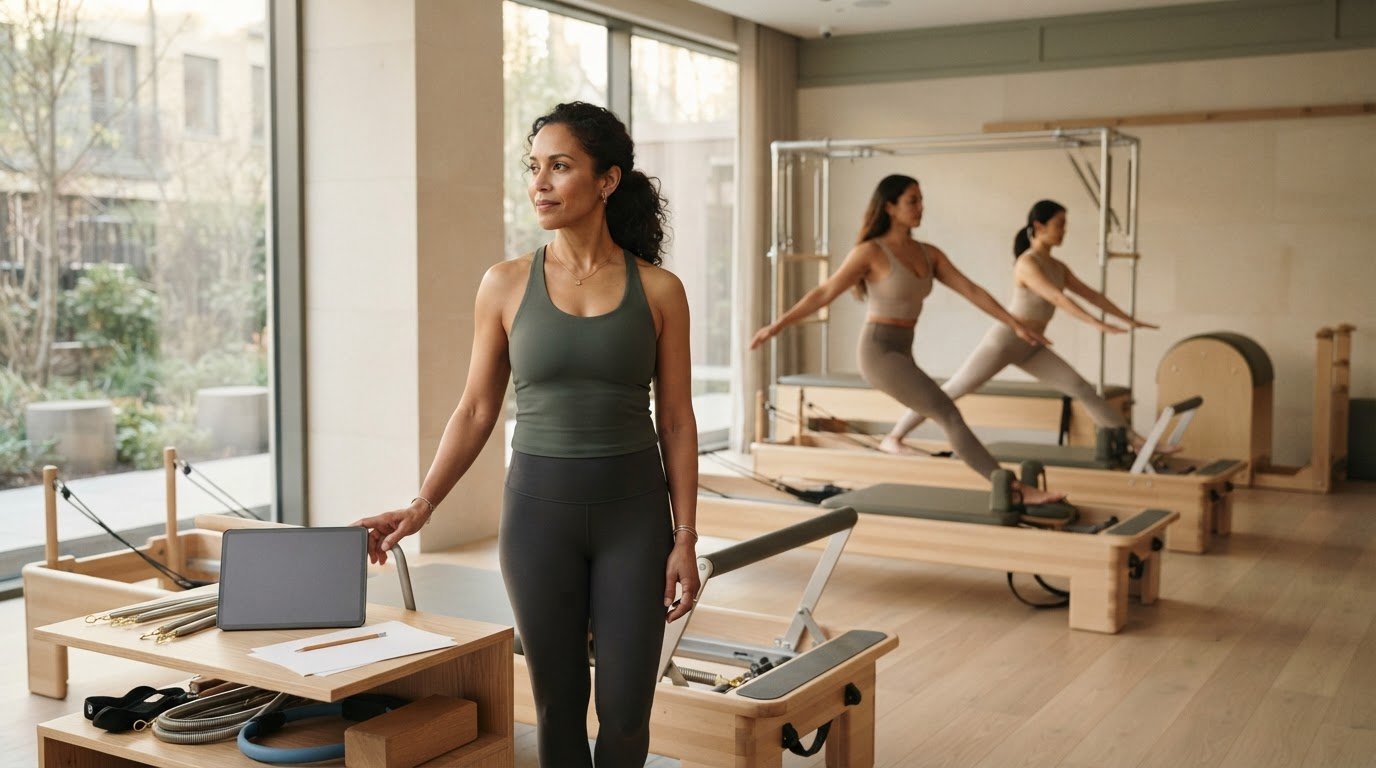
Creative block on the studio floor doesn't mean you've run out of ideas. It means you've run out of bandwidth. When it comes to overcoming pilates instructor creative block, the solution lies in eliminating decision fatigue, not forcing your imagination. You know the friction intimately. You stare at a blank notes app between clients, default to the same supine abdominal sequence for the third week running, and struggle to balance client cravings for novelty against sound biomechanical principles. After consecutive hours on the floor, cognitive exhaustion inevitably takes over.
You shouldn't have to spend your precious downtime agonizing over lesson plans. This guide shows you how to eliminate planning fatigue, reignite your programming inspiration, and sequence fresh Reformer classes effortlessly. We will break down a repeatable framework to design balanced, fluid classes in under ten minutes, giving you practical ways to vary choreography while protecting your focus and professional confidence.
Key Takeaways
- Recognize that sequencing paralysis stems from acute decision fatigue and high-volume teaching loads, not a lack of imagination.
- Apply intentional movement constraints to minimize apparatus adjustments and free up mental bandwidth for real-time cueing.
- Satisfy client psychology by anchoring classes in familiar movement foundations and introducing subtle, targeted variations.
- Use a reverse-engineered four-step framework to map out balanced, peak-exercise flows in under ten minutes.
- Discover how overcoming pilates instructor creative block becomes effortless when you replace scattered notebooks with streamlined digital planning tools.
Table of Contents
- What Causes Pilates Instructor Creative Block?
- The Biomechanical Framework: Limiting Options to Fuel Creativity
- Balancing Routine and Novelty: What Clients Actually Value
- How to Break Sequencing Paralysis: A 4-Step Action Plan
- Building a Sustainable Planning System with Modern Digital Tools
What Causes Pilates Instructor Creative Block?
Instructor creative block is rarely an absence of imagination. Instead, it is acute decision fatigue caused by managing hundreds of variable inputs simultaneously. Teaching 15 or more dynamic movement hours each week requires non-stop choreography, risk mitigation, and vocal projection. While clinical psychologists often study a prolonged creative slowdown as an emotional or artistic stall, movement educators face a structural dilemma. You don't have the luxury of walking away to wait for inspiration when a room full of clients arrives at 7:00 AM. There is a sharp distinction between general burnout and sequencing paralysis. Your passion for movement remains intact, but your cognitive sequencing pipeline is jammed. Overcoming pilates instructor creative block begins by identifying that mental bottleneck.
The Reality of Decision Fatigue on the Reformer
Every Reformer sequence demands split-second choices. You calibrate spring tensions, adjust footbar heights, monitor headrest positions, and scan eight bodies for asymmetrical pelvic tilt. That cognitive load drains your mental energy fast. Falling back on identical footwork setups and familiar supine abdominal progressions isn't laziness; it's a protective reflex. Your nervous system automates choreography so you can maintain spatial awareness and client safety. Still, the underlying fear of boring regular clients who show up three times a week creates quiet, persistent panic.
Deconstructing the Myth of Constant Novelty
The fitness industry often conflates fresh programming with complex acrobatics. In practice, inventing disconnected exercises under pressure compromises movement mechanics and halts motor learning. Clients build strength and somatic awareness through deliberate repetition, not constant confusion.
- Biomechanical progression: Layering subtle tempo variations, range shifts, or resistance changes into core movements.
- Superficial novelty: Stacking unstable choreography simply to make an exercise look unfamiliar.
When mental fatigue sets in, classical movement roots serve as reliable anchors. True confidence in overcoming pilates instructor creative block comes from trusting proven movement patterns rather than feeling pressured to reinvent the carriage every fifty minutes.
The Biomechanical Framework: Limiting Options to Fuel Creativity
Blank slates cause paralysis. When you sit down with limitless exercise possibilities, the brain freezes under the sheer volume of choices. The most effective strategy for overcoming pilates instructor creative block is not brainstorming freely; it is imposing rigid mechanical constraints. Restricting your apparatus variables immediately sharpens your focus. By locking down setup logistics early, you free up the mental bandwidth required for nuanced vocal cueing and biomechanical corrections. If you want a structured foundation for building seamless transitions without guesswork, review the core principles of how to sequence a reformer pilates class.
The Single-Setup Class Structure
Constant spring shifts fragment class momentum. They turn dynamic movement into stop-and-start mechanical adjustments. Build an entire class block around one spring tension, such as a single blue or red spring, and keep your footbar in a single locked position. Instead of altering hardware, shift the client's relationship to gravity:
- Transition from kneeling to seated, then to quadruped, all on the same spring profile.
- Change carriage direction or lever length rather than adding equipment resistance.
- Introduce a single prop, like a magic circle or mini ball, to challenge stability without touching a gearbar.
These boundaries eliminate mid-sequence lag. Clients remain locked in an uninterrupted somatic rhythm while you teach with total composure.
Programming Across Anatomical Movement Planes
When class design stalls, academic research highlights how anxiety and choice overload act as common causes of creative block across practical disciplines. You can resolve this overload by treating the human body as your creative blueprint. Rather than searching for entirely new exercises, map your class across the three anatomical movement planes:
- Sagittal: Settle the nervous system with familiar linear flexion and extension patterns.
- Frontal: Shift laterally with side-lying leg presses, skater lunges, or mermaid stretches.
- Transverse: Introduce intentional thoracic rotation to challenge oblique stabilization and spinal mobility.
Balancing heavy sagittal flexion with dedicated prone thoracic extension instantly refreshes tired sequences. If you need a reliable pocket companion to streamline these structural combinations during weekly prep, you can explore ReformerFlow on mobile to quickly verify functional exercise progressions. Imposing smart physical constraints eliminates decision fatigue, turning overcoming pilates instructor creative block into an efficient, predictable habit.
Balancing Routine and Novelty: What Clients Actually Value
Instructors often worry that familiar routines breed disinterest. In reality, client psychology relies heavily on the comfort of predictable patterns. When participants step onto the carriage, they want to feel competent, capable, and grounded. Dropping clients into a sequence of unfamiliar shapes forces their nervous systems into defensive tension rather than controlled muscular effort. According to professional methodologies in reformer pilates class design, lasting client retention stems from reliable physical foundations punctuated by small, intentional challenges. Academic research into unlocking creative potential shows that structured discipline outperforms raw improvisation every time. For instructors, overcoming pilates instructor creative block means understanding that your clients do not require continuous circus tricks to see meaningful physical transformation.
The 80/20 Rule of Class Programming
Balance your programming by dividing each class into a deliberate ratio:
- 80% Foundation: Mastered repertoire such as fundamental footwork, supine leg straps, and elephant variations. These build stability, reinforce neural pathways, and establish somatic rhythm.
- 20% Exploration: A focused branch of novelty, such as an asymmetrical load, a single-arm balance challenge, or a tempo change.
This division protects your mental energy. You no longer have to conceive fifty minutes of original material from scratch. Advanced practitioners find profound burn in small variations, while newer students maintain postural confidence without feeling overwhelmed.
Focusing on Cuing Variations Over Choreography
Novelty does not require new shapes. It requires fresh internal awareness. You can transform the most basic movement ladder simply by shifting where the client directs their attention:
- Tempo manipulation: Slow the return carriage count from two beats to four, exposing eccentric instability.
- Tactile checkpoints: Instruct students to focus on maintaining equal weight through the second metatarsal rather than just pressing the footbar.
- End-range pulses: Hold the deepest point of a lunge for three seconds before adding micro-movements.
When you stop obsessing over choreographic acrobatics and start refining the sensory depth of familiar exercises, sequencing becomes effortless. This shift in perspective makes overcoming pilates instructor creative block a liberating, manageable part of your studio craft.
How to Break Sequencing Paralysis: A 4-Step Action Plan
Staring down an upcoming shift without a plan creates instant friction. When you need immediate traction, generic creative exercises won't solve the problem. You need a systematic, repeatable roadmap designed specifically for the mechanics of the Reformer. Overcoming pilates instructor creative block becomes straightforward when you replace random brainstorming with a disciplined four-step protocol:
- Step 1: Pick one anatomical focus. Select a targeted biomechanical theme (such as hip dissociation or thoracic mobilization) before touching your notes.
- Step 2: Anchor the peak exercise. Choose one culminating movement pattern and reverse-engineer its mobility and stability demands.
- Step 3: Group by carriage position. Cluster your exercises into blocks based on client setup to maintain physical flow.
- Step 4: Consult professional references. Use dedicated reformer pilates instructor tools to instantly pull variations without second-guessing spring tensions.
The Peak Pose Reverse-Engineering Method
Build your sequence backward from a definitive pinnacle movement. Suppose you select Short Spine Massage as your class peak. Instead of wondering what to teach for the first half-hour, list the exact physical requirements:
- Hamstring flexibility to handle the carriage return.
- Deep pelvic stability to control spinal flexion.
- Segmental spinal articulation during the rollback phase.
Your warm-up and bridge work naturally emerge from these requirements. Every prior sequence serves a physiological purpose, removing guesswork and giving your class cohesive narrative structure.
Positional Grouping for Seamless Transitions
Excessive setup shifts ruin class flow. Moving clients from supine to standing, back to kneeling, and then supine again exhausts both their physical endurance and your mental presence. Group your programming into four distinct positional blocks:
- Supine block: Footwork, bridging, and abdominal series with headrest lifted.
- Seated or kneeling block: Straps for arm work, rotation, and kneeling abdominal presses.
- Standing block: Lunges, carriage kicks, or lateral side splits.
- Prone or finishing block: Extension series and restorative spinal recovery.
Positional grouping cuts down apparatus adjustments, eliminates dead time, and protects your cueing capacity. It provides the clear structural pathway needed for overcoming pilates instructor creative block in high-volume studio environments.
Start your 14-day free trial on iOS and Android## Building a Sustainable Planning System with Modern Digital Tools
Relying on scattered systems guarantees mental fatigue. Handwritten journals get misplaced, voice memos lack structure, and native phone notes quickly dissolve into chaotic lists. None of these analog habits account for equipment calibration or dynamic pacing. Exploring a purpose-built reformer pilates class planning app replaces scattered notes with structured clarity. Treating digital tools as cognitive co-pilots protects your mental reserves during demanding studio schedules. Developing an organized, tech-enabled workflow is the final key to overcoming pilates instructor creative block for good.
Instant Repertoire Inspiration on Demand
When you stare at an empty schedule, scrolling through walls of text rarely sparks creative energy. Movement pros think visually. ReformerFlow, designed and maintained by professional instructor Ginty, acts as an intuitive digital co-pilot with a curated library of over 400 Reformer exercises with video demonstrations:
- Targeted filtering: Filter repertoire instantly by anatomical focus, client skill tier, or studio prop integration.
- Visual recall: Watch concise video demonstrations to spark spontaneous exercise variations and verify smooth mechanics.
- Sequence curation: Build and save your most successful sequences into a personal archive, creating an accessible library of reliable class plans.
Having instant visual references removes planning friction, allowing you to assemble balanced, high-retention classes in minutes.
In-Studio Presence Through Glanceable Teaching
Creative exhaustion doesn't end when the class starts; it often spikes during live instruction when you struggle to recall your next movement block. ReformerFlow eliminates mid-class hesitation with a dedicated, high-contrast glanceable teaching mode:
- Review the next exercise block with a single downward glance, keeping your eyes on client alignments.
- View spring settings tailored and calibrated to specific commercial Reformer models to guarantee safety and smooth carriage flow.
- Maintain natural studio presence without flipping pages, checking messy margins, or losing connection with your room.
Offloading mechanical memorization to a dedicated mobile co-pilot frees up your cognitive capacity. By streamlining routine preparation, overcoming pilates instructor creative block becomes an effortless reality, letting you teach every class with absolute authority and composure.
Reclaim Your Focus and Reignite Your Studio Flow
Class planning should elevate your teaching, not drain your nervous system between shifts. Remember that overcoming pilates instructor creative block comes down to structural systems, not forced invention. By setting mechanical constraints, leaning into the 80/20 movement split, and reverse-engineering from peak exercises, you protect your cognitive energy before stepping into the studio. With ReformerFlow as your digital co-pilot, you gain access to an intuitive class builder designed to create seamless flows in minutes, over 400 curated Reformer exercises with clear video demonstrations, and machine-specific spring calibrations tailored to your studio's equipment.
Start your 14-day free trial of ReformerFlowStep onto the floor with quiet confidence, composed presence, and a clear mind. Your best classes happen when you have the mental space to actually connect with the bodies in front of you.
Frequently Asked Questions
How often should I change my Reformer Pilates class sequences?
Change core sequence structures every two to four weeks rather than every single session. Rotating movement themes on a bi-weekly or monthly cycle gives regular clients adequate time to build neurological adaptations and measurable muscular endurance. You can keep 80% of the structure stable while swapping out the remaining 20% with subtle tempo shifts or unilateral variations. This rhythm supports overcoming pilates instructor creative block while respecting genuine client progression.
Is it acceptable to repeat the exact same class plan for different groups?
Yes, repeating identical sequences across multiple classes is standard professional practice. Seasoned instructors frequently run the same framework for three to five distinct client groups each week. Because individual bodies, energy levels, and movement capabilities vary dramatically, no two deliveries ever feel identical. Reusing a well-crafted sequence lowers cognitive fatigue, sharpens your verbal cues, and lets you focus entirely on hands-on corrections rather than choreography recall.
How do I keep advanced clients engaged without completely altering the routine?
Layer subtle resistance, range, or stability challenges onto foundational exercises instead of inventing new movements. For instance, turn standard footwork into a single-leg challenge, introduce an isometric pause at carriage return, or remove a strap during arm work to test rotational stabilization. Small, precise progression layers deliver deep physical work and challenge neuromuscular control without complicating the apparatus setup or confusing newer participants in the room.
What should I do if my mind goes completely blank while teaching?
Pause, breathe, and cue an intentional isometric hold or slow pulse. Instructing clients to hold an active plank or carriage extension buys you ten seconds of quiet focus without breaking class momentum. From there, return to a reliable classical base like bridging or kneeling arm pulls. Having a glanceable mobile tool resting on your tower also ensures you can recover your sequence trajectory with a quick downward look.
Can using a digital class planning app make my teaching feel robotic?
No, digital tools enhance presence rather than restrict it. When you rely on a mobile co-pilot to handle choreography archives and spring calibrations, you eliminate mid-class memorization panic. Overcoming pilates instructor creative block with a dedicated app frees your cognitive bandwidth to scan the room, offer precise verbal adjustments, and connect authentically with your clients. Technology handles the mechanical framework so your live teaching remains dynamic, spontaneous, and personal.
How can I quickly adapt my class when unexpected injuries or client limitations arise?
Regress the movement base by increasing support surfaces or adjusting spring resistance. If a client reports acute shoulder impingement during kneeling strap work, transition them into a seated position or reduce strap load immediately. Keep standard modifications ready for common pathologies: lower headrests for neck tension, offer wedges for wrist discomfort, and swap deep spinal flexion for neutral tabletop holds. Consistent biomechanical rules make adaptations immediate and stress-free.