
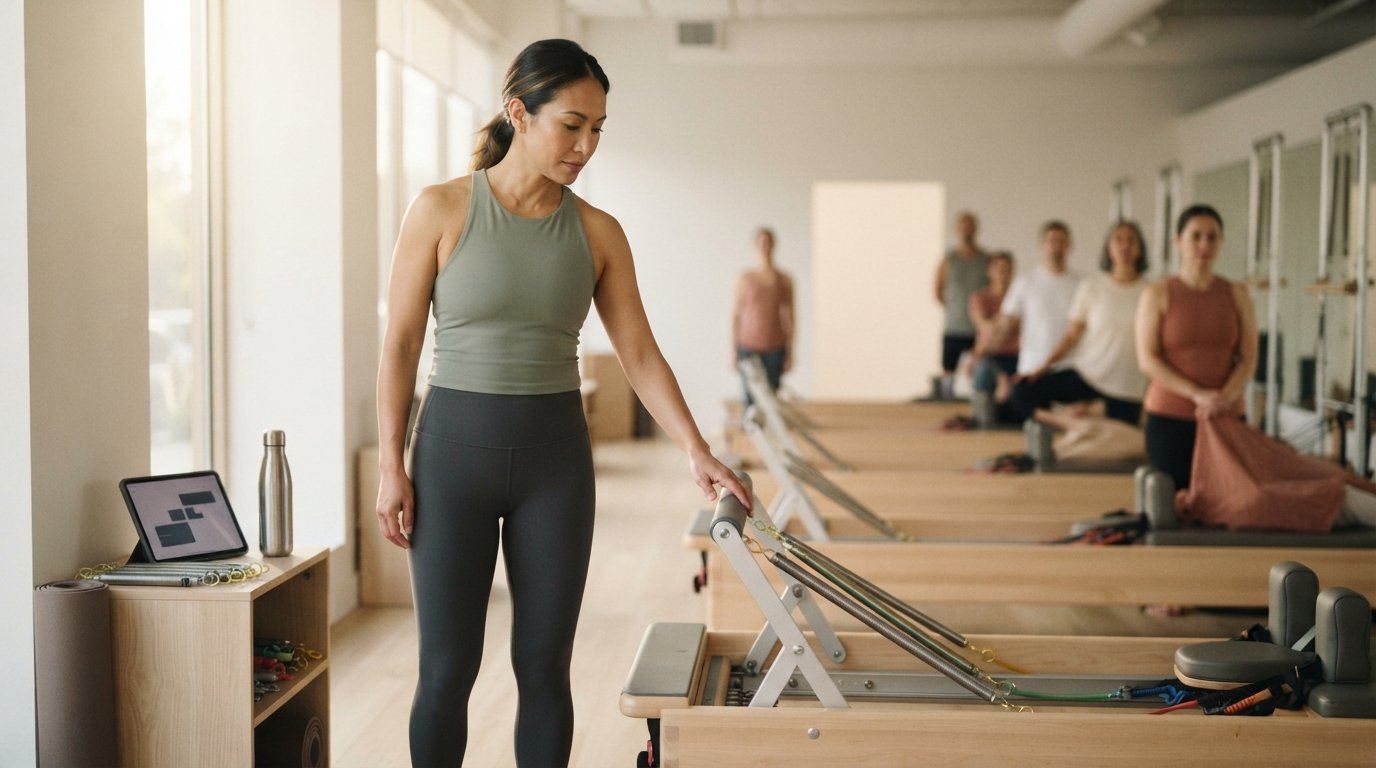
You're standing by the footbar, the playlist is fading, and eight sets of eyes are waiting for the next cue, but your mind has suddenly gone blank. It's a moment every professional instructor fears, yet it happens to even the most seasoned experts. Learning how to reduce anxiety before teaching reformer isn't about achieving a perfect memory. Instead, it's about building a reliable system that protects your focus and reduces the heavy cognitive load of a live session.
You already know that "spring anxiety" is a genuine hurdle. Managing complex resistance changes across different machine brands while maintaining a composed presence is a high-pressure task. This guide provides the actionable psychological and logistical strategies you need to reclaim your mental clarity. We'll explore rapid nervous system regulation, modular sequencing, and how to use a digital co-pilot to handle the technical details. You'll discover how to transition from pre-class nerves to a state of quiet, professional authority in the studio.
Key Takeaways
- Identify the root cause of the "Instructor Anxiety Loop" to stop performance nerves before they start.
- Learn how to reduce anxiety before teaching reformer by implementing a tactile "Machine Walkthrough" for immediate grounding.
- Replace bulky notebooks with glanceable digital sequences to maintain eye contact and professional presence.
- Establish a 15-minute preparation ritual that prioritizes mental clarity and equipment safety checks.
- Use a digital co-pilot to manage complex spring transitions and class timing with quiet confidence.
Table of Contents
- Why Reformer Instructors Experience Performance Anxiety
- 5 Steps to Reduce Anxiety Before Teaching Reformer
- Building a Mental Safety Net: Digital vs. Paper Planning
- The Pre-Class Ritual: Calming the Nervous System
- Transitioning to Presence with ReformerFlow
Why Reformer Instructors Experience Performance Anxiety
Performance anxiety in the Pilates studio is often a result of the "Instructor Anxiety Loop." This cycle begins when the fear of forgetting a sequence creates physical tension in your body. This tension clouds your mental clarity; making it harder to recall the next exercise. It's not just about memory. It's about cognitive load. As an instructor, you're managing spring transitions, anatomical cues, client safety, and timing all at once. This simultaneous demand leads to mental exhaustion. Even seasoned teachers fear "The Blank." This sudden loss of flow isn't a lack of knowledge. It's a symptom of a brain that's simply over-taxed.
When you carry this stress into the room, your clients notice. Tension is contagious. A stressed instructor creates a rigid environment, which directly impacts the client's ability to find their own flow. Understanding the mechanics of this anxiety is the first step toward professional composure.
The Science of Pre-Class Nerves
When you step into the studio, your sympathetic nervous system often treats the session like a performance. Your heart rate rises, and your focus narrows. In the context of the Reformer, this is compounded by "Spring Setup Stress." Unlike mat Pilates, the mechanical variables of the carriage and resistance settings add a layer of liability. You aren't just teaching movement; you're managing a machine.
Many instructors try to solve this by over-preparing on paper. However, static notes can actually increase anxiety. If the class needs a modification or a transition takes longer than expected, a rigid paper plan becomes a source of friction rather than a support. Learning how to reduce anxiety before teaching reformer requires moving away from these static scripts toward more dynamic support systems that handle the technical details for you.
Recognizing the Signs of Burnout vs. Simple Nerves
It's vital to distinguish between first-class jitters and chronic preparation fatigue. Jitters usually dissipate after the first set of footwork. Burnout, however, feels like a heavy weight before you even leave your house. If you find yourself dreading the planning process, it's time to look at pilates instructor burnout solutions. Efficiency in your workflow is the best defense against long-term career fatigue.
You can reframe those initial nerves as "performance energy." This shift in perspective turns anxiety into a tool for heightened awareness and presence. Instead of trying to eliminate the energy, focus on directing it toward your clients. This professional mastery allows you to hold the space with quiet confidence, regardless of how many advanced clients are in the room.
5 Steps to Reduce Anxiety Before Teaching Reformer
Managing a room full of clients requires significant mental bandwidth. To maintain your composure, you need a protocol that moves you from preparation to presence. Here is how to reduce anxiety before teaching reformer using a structured five-step approach.
- Step 1: Offload your sequence. Finalize your plan at least one hour before class. Don't keep the choreography in your head; move it to a digital tool.
- Step 2: Perform a machine walkthrough. Physically touch the springs for your first three exercises. This tactile check confirms the equipment is ready and grounds your focus in the physical space.
- Step 3: Regulate your nervous system. Use controlled breathwork to regulate the nervous system. The 4-7-8 technique is particularly effective for shifting from a "fight or flight" state to a calm, authoritative baseline.
- Step 4: Visualize the first transition. Mentally rehearse moving from footwork to the next series. Stumbles usually happen during transitions, not the exercises themselves.
- Step 5: Review your glanceable plan. Ensure the flow is logical for the group's level. A quick scan of your digital co-pilot ensures you're ready to lead without hesitation.
The Power of the 5-Minute Prep
Spending hours on a single lesson plan often leads to second-guessing and cognitive fatigue. When you over-analyze, you lose the ability to read the room. Instead, learn to plan a reformer pilates class in minutes. This efficiency keeps the sequence fresh and intuitive. Use the "Rule of Three": memorize only the first three movements to build initial momentum. Let your digital tool handle the rest of the sequence, allowing you to focus entirely on your clients' form.
Visualizing Success and Transitions
Professional athletes use mental rehearsal to perform under pressure; you should do the same. Focus specifically on how to transition between reformer exercises. Smooth transitions signal authority and keep the class heart rate consistent. Prepare "safety-net" cues for common injuries, such as lumbar issues or neck tension. Having these regressions ready prevents panic if a client struggles with a specific move. To build this confidence into your daily routine, consider starting a 14-day free trial to see how streamlined planning reduces stress.
Building a Mental Safety Net: Digital vs. Paper Planning
For many instructors, the "Paper Trap" is a primary source of stress. When you rely on a handwritten notebook, you're forced to break eye contact with your clients to decipher your own notes. This disconnect doesn't just disrupt the flow of the class; it creates a mental barrier between you and the room. Learning how to reduce anxiety before teaching reformer requires a shift toward tools that support eye contact rather than hindering it. Digital planning provides a cleaner, more professional aesthetic that builds client trust. By using a tablet or phone, you replace cluttered binders with a streamlined interface that feels like a natural extension of your teaching presence.
Why Manual Planning Increases Cognitive Load
Manual planning often leads to a high cognitive load that paper simply can't resolve. Handwriting can become illegible in dim studio lighting, and notebooks are easily lost or forgotten. More importantly, paper plans lack the flexibility needed for real-time adjustments. If a client arrives with a new injury, adjusting a pre-written paper sequence in seconds is nearly impossible. When evaluating pilates class planning software, the primary benefit is the ability to pivot without losing your composure. This digital flexibility is a core component of maintaining your authority when the unexpected happens.
The Digital Advantage for Visual Learners
A digital library offers instant video support, which is invaluable for verifying form before you demonstrate to the group. This removes the fear of "getting it wrong" during complex movements. A dedicated reformer pilates app for teachers acts as a secondary brain, holding the technical details so you don't have to. Beyond choreography, machine-specific presets eliminate the mental math of spring configurations. Instead of calculating resistance for different brands, you simply glance at your screen and cue with confidence.
This offloading allows you to practice techniques to evoke the relaxation response, such as mindful breathing, because your mind isn't occupied with mechanical logistics. You can focus on the energy of the room rather than the details of the resistance. To experience this level of support, you can start a 14-day free trial and see how a digital co-pilot transforms your pre-class experience.
The Pre-Class Ritual: Calming the Nervous System
Arriving 15 minutes early isn't just about punctuality. It's about "Space Ownership." Walk the room. Touch the reformers. This tactile grounding, such as checking carriage tension and headrest positions manually, provides the sensory feedback you need to feel in control. It's a foundational step in how to reduce anxiety before teaching reformer. When you physically interact with the studio environment, you signal to your nervous system that the space is safe and familiar.
Use the "First Name" strategy by reviewing your roster before the first client walks through the door. Memorizing names allows you to build personal connections immediately, which shifts the dynamic from a performance to a conversation. Finally, practice personal energy management by setting a "Studio Boundary." This is a conscious mental ritual where you leave personal stress at the door. By visualizing a clear line between your external life and your professional role, you protect your focus and your clients' experience.
Grounding Techniques for the Studio Floor
Proprioceptive exercises help you feel centered before the music starts. Stand with your feet hip-width apart and notice the weight distribution. This simple check-in grounds your physical presence. Follow this with a brief voice warm-up. Ensuring your cues carry authority without strain prevents the vocal fatigue that often accompanies performance anxiety. If an early client interrupts your preparation, have a polite, pre-planned response. Direct them to their machine to begin a gentle warm-up while you finish your ritual. Protecting these final minutes is essential for maintaining your mental clarity.
Setting the Physical Environment
Control the variables that affect your mood. Adjust the lighting, temperature, and music to create a stabilizing atmosphere for both yourself and your clients. Ensure your reformer pilates beginner class plan is loaded and ready on your device. This prevents the technical friction that can trigger a spike in nerves. Finally, select an "Emergency Exercise." This is a reliable, go-to move you can cue if you ever need 30 seconds to breathe or consult your plan. Having this safety net in place allows you to lead with quiet confidence.
Start your 14-day free trial to streamline your pre-class workflow## Transitioning to Presence with ReformerFlow
Effective instruction requires a delicate balance between following a plan and reacting to the room. When you're constantly worried about the next exercise, your presence suffers. ReformerFlow by Ginty's "Glanceable Teaching Mode" is designed to solve this specific friction point. It provides a high-contrast, minimalist interface that allows you to verify your next move without breaking eye contact with your clients. This is a practical answer to how to reduce anxiety before teaching reformer. By offloading the sequence to a screen that requires only a split-second look, you keep your focus where it belongs: on the bodies in front of you.
The app's internal timer further stabilizes the studio environment. Checking a wall clock is a subtle tell that an instructor is stressed about timing; it breaks the "flow" for everyone. Using an integrated timer allows you to stay on track invisibly. You'll feel the confidence that comes from having 400+ exercises and their corresponding modifications available at a moment's notice. Whether you're teaching a beginner or an advanced athlete, you never have to fear "blanking" on a progression again.
Staying Present While Following a Sequence
The true mark of a master instructor is the ability to move from "What comes next?" to "How is my client moving?" When the sequence is handled by a reliable tool, your mental bandwidth opens up for deeper observation. Professional reformer pilates class design tools facilitate better hands-on corrections because you're no longer tethered to a notebook or a memorized script. Trusting the technology allows you to trust your intuition. You can spot a misaligned pelvis or a tensed shoulder faster because your brain isn't busy calculating the next spring change.
Your Digital Co-Pilot in the Studio
Personalized machine settings are a core feature of the ReformerFlow by Ginty experience. Whether the studio uses Balanced Body, Peak Pilates, or Align-Pilates, the app translates your sequence into the correct spring configurations for that specific equipment. This removes the "mental math" that often triggers pre-class nerves. Understanding how to reduce anxiety before teaching reformer often comes down to reducing the number of decisions you have to make mid-class. The "Teaching Mode" acts as your digital co-pilot, ensuring the flow of the class remains steady and professional. Testing a new, anxiety-free workflow is a low-risk investment in your career longevity.
Start your 14-day free trial and teach with total confidence.## Reclaiming Your Focus in the Studio
Confidence isn't about memorizing every spring change; it's about building systems that support your expertise. By offloading logistical details to a digital co-pilot, you free your mind to focus on the clients in front of you. You've learned how to reduce anxiety before teaching reformer by adopting grounding rituals and utilizing glanceable sequences that maintain the flow of your class. These simple shifts transform your teaching experience from one of performance pressure to one of professional flow.
With the ability to build a full class in five minutes and access over 400 high-quality exercise videos, your preparation becomes a source of strength rather than stress. Personalized machine spring setups ensure you lead with precision, regardless of the equipment brand. This streamlined workflow allows you to hold the space with professional mastery and aesthetic minimalism.
Download ReformerFlow and reclaim your teaching confidence with a 14-day free trialYou have the knowledge and the tools to lead with quiet authority. It's time to step into the studio with mental clarity and a reliable plan.
Frequently Asked Questions
Is it normal to feel anxious before teaching a Reformer Pilates class?
Yes, performance anxiety is a common experience for Reformer Pilates instructors due to the high cognitive load required to manage mechanical equipment, client safety, and flow simultaneously. Acknowledging this is the first step in learning how to reduce anxiety before teaching reformer. Most seasoned teachers use specific rituals to move from a state of high arousal to one of quiet, professional authority before the first client arrives.
How can I remember my Reformer sequences without looking at notes?
Memorizing every detail of a 50-minute session often leads to mental fatigue. Instead, focus on the "Rule of Three" by committing the first three movements to memory to build initial momentum. For the rest of the class, rely on a glanceable digital co-pilot that provides instant cues. This allows you to maintain eye contact with your clients rather than breaking your presence to decipher handwritten notes in a binder.
What should I do if I 'blank' during a Reformer class?
If you lose your place, cue a reliable "Emergency Exercise" like a basic bridging series or a simple supine stretch. This gives your clients a safe, productive movement while you take 30 seconds to breathe and check your sequence. Having a digital library of 400+ exercises at your fingertips ensures you can find a logical progression quickly, restoring your composure without the clients ever noticing a lapse in flow.
Does using a planning app make me look like a less experienced instructor?
Using professional tools signals intentionality and mastery rather than a lack of experience. Clients value an instructor who is prepared and present; a clean tablet interface is far more professional than a cluttered notebook or a phone used for scrolling. By offloading technical details like spring tensions to an app, you demonstrate that your primary focus is on providing high-quality anatomical cues and hands-on corrections.
How do I manage my time better during a 50-minute Reformer session?
Effective time management relies on building your class in modular blocks rather than a rigid script. Assign specific durations to your footwork, carriage work, and strap series. Using an app with an integrated timer helps you stay on track without the distraction of checking a wall clock. This ensures you leave adequate time for a proper cool-down, preventing the stress of rushing through the final exercises of the session.
What are the best breathing exercises for instructors with pre-class nerves?
The physiological sigh, which involves two quick nasal inhales followed by one long exhale, is one of the fastest ways to lower autonomic arousal. You can also use the 4-7-8 technique to shift your nervous system from a sympathetic to a parasympathetic state. Performing these exercises for just three minutes before class helps you enter the studio with mental clarity and a steady, authoritative voice that carries without strain.
How can I quickly modify a Reformer exercise for a client with an injury?
Successful modifications require having a "safety-net" of regressions ready for every movement. Instead of trying to invent a variation on the spot, use a curated exercise library that offers pre-planned modifications for common issues like lumbar tension or neck strain. This preparation allows you to offer a safer alternative instantly, maintaining the group's momentum while ensuring the individual client feels supported and protected throughout the session.
Why is spring setup the most stressful part of teaching Reformer?
Spring setup is inherently stressful because it carries mechanical liability and varies significantly between equipment brands. Cueing the wrong resistance can lead to joint strain or a loss of carriage control, which triggers instructor anxiety. Using personalized machine configurations removes the "mental math" of resistance settings. When you know exactly which springs to cue for your specific Reformer, you can focus entirely on the quality of the client's movement.