
A full calendar doesn’t have to mean a scattered teaching week. To learn how to get organized as a Pilates instructor, set a regular time to plan upcoming sessions, keep lesson types distinct, and store studio notes where you can find them quickly. Build each lesson around a clear sequence, then leave space to adjust for the people in front of you.
Planning takes focus, especially when clients have different histories, goals, and equipment setups. A consistent system can make preparation easier without turning every class into a script. This guide explains how to get organized as a Pilates instructor by planning sessions across the week, sorting class plans and client notes, and using a framework for balanced classes while leaving room to adapt.
Key Takeaways
- Use a simple class framework to balance movement patterns and body positions, while leaving room to adapt in the moment.
- Plan upcoming sessions in focused blocks and build from what clients worked on previously.
- Keep private lessons, apparatus classes, and studio notes in distinct sections so client details are easier to retrieve.
- Use dividers and consistent labels to make lesson plans quicker to scan and update.
- Keep bookings, schedule changes, and class preparation organized in clear, separate workflows.
Table of Contents
- Balancing structure and creativity
- Planning sessions during the week
- Separating private lessons, apparatus classes, and studio notes
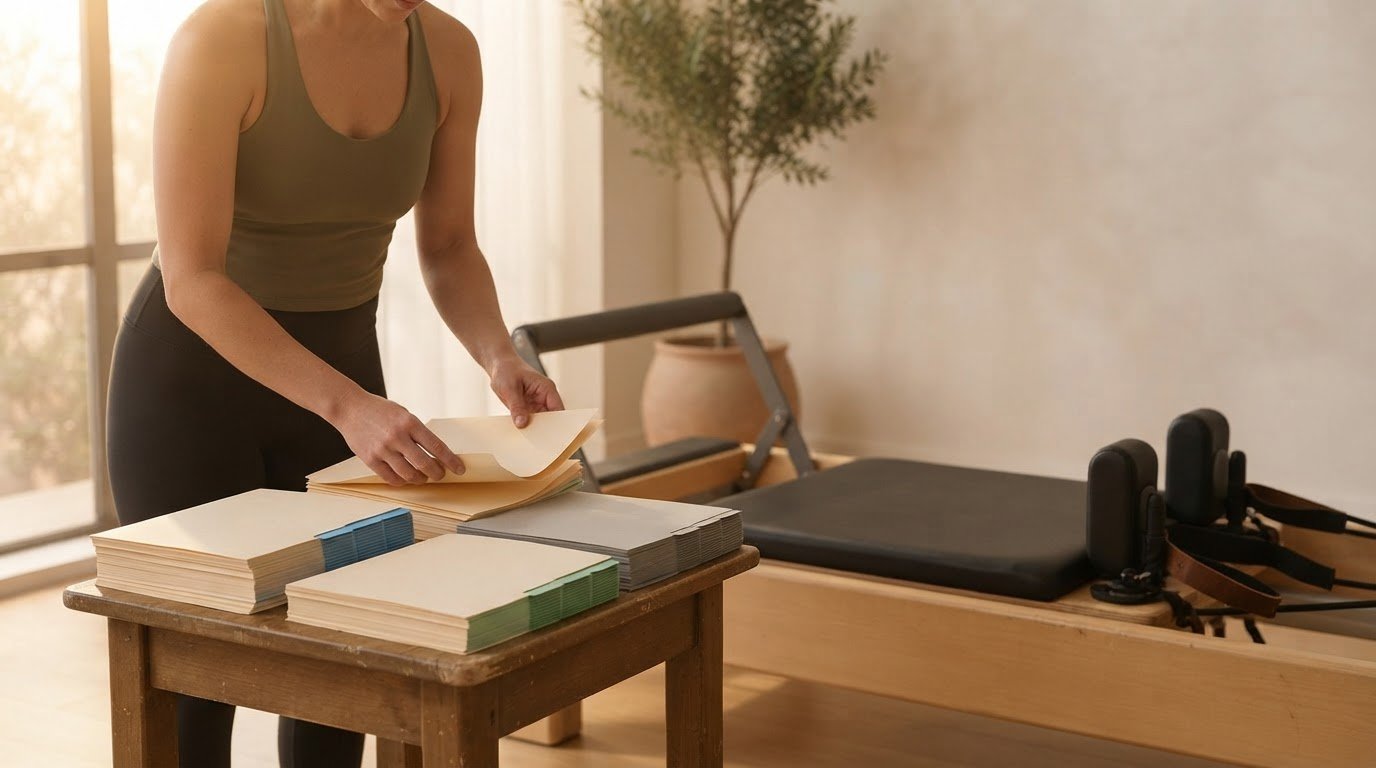
- Organizing lesson plans with dividers
- What systems help Pilates instructors organize class schedules and bookings?
- ReformerFlow by Ginty
Balancing structure and creativity
Build a repeatable class framework, then adapt its exercises to the people attending. Use a few planning steps to protect both sequence and choice.
- Choose a movement framework. Map the class around movement patterns and changes in body position. For example, plan a progression from supine work to seated or standing exercises instead of selecting movements at random. A sequence gives your teaching direction, while the individual exercises can change with the group. Note the intended focus for each section, such as mobility, control, or balance.
- Set a clear starting point and progression. Record the opening position, class focus, and transition into the next phase. Starting supine can offer a lower-load beginning before clients move into other positions. Choose movements that prepare students for what comes next. A written progression helps you check for variety while keeping transitions connected.
- Leave decisions open. Mark one or two points where you can adjust the exercise, range, or pace to suit the group. If a planned sequence feels too demanding, for example, choose a familiar variation while keeping the class’s overall direction. Your training may have covered exercise technique and cueing; a personal planning framework helps turn that knowledge into a usable class. Keep the framework consistent, not every class identical.
- Keep business records apart from lesson planning. If you teach independently, organize income records, expense receipts, invoices, and related tax documents in a dedicated system. Keep these records separate from movement sequences so a class edit does not get mixed up with bookkeeping.
Manage Client Records and Health Information
Store each client’s contact details, signed waivers, and relevant health information together in a restricted record. Before teaching, review details that affect exercise choices, such as a recorded movement limitation, and avoid collecting unrelated personal information. Keep lesson notes factual and useful: learned exercises or equipment setup can inform the next plan. Store these records separately from general studio notes.
Use Scheduling and Client Management Software
Choose a software system that brings scheduling, payment tracking, and client records into a clear workflow. Make sure calendar entries, attendance, and payment status are easy to distinguish, so a booking change is not mistaken for a completed payment. Keep relevant teaching notes in the client profile and class plans in their own format. A tool should reduce duplicate entry, not create another place to search.
A balanced Pilates class gives students opportunities to move in a range of body positions. Use this as a check when reviewing your sequence: note which positions are represented and where a change of position could fit naturally. Keep the class’s central focus in view, so variety supports the progression rather than becoming movement for its own sake.
Keep room for creativity by choosing movements you know how to teach, then adapting them to the group. If an exercise or transition does not fit, make a deliberate substitution while preserving the intended direction. The plan can remain a dependable guide without making every session identical.
Planning sessions during the week
Give each planning block a clear purpose: review the calendar, prepare sessions, and set aside time for work around teaching. A repeatable weekly rhythm helps you respond to clients without starting every class plan from scratch.
- ### Organize Class Schedules and Bookings
Review upcoming bookings in one planning block, then group sessions by format and equipment. For each booking, note the class type, expected attendance, and any setup that affects the room’s flow. A Tower class, for example, may need a different sequence from a Reformer session. Check for schedule changes before planning, so you do not prepare for an outdated booking.
Use the schedule to identify practical constraints before choosing exercises. If several clients share an apparatus class, plan a sequence that minimizes unnecessary equipment changes. For a Tower class with eight people, prepare an alternative for a participant who cannot curl while the group does the stomach series. The class can share a structure while still offering each person an appropriate option.
- ### Plan Teaching, Training, and Administrative Time
Block separate time for teaching, teacher training, and administration, then protect each block from unrelated tasks. In a focused preparation session, review what clients did previously and decide how the next session can build on it. Teacher training programs may devote hundreds of hours to exercise, anatomy, and cueing, while giving little attention to class planning. Make planning a deliberate part of your week.
Some instructors plan on Sundays and Wednesday evenings, looking ahead a few days at a time. This rhythm can keep preparation close to upcoming sessions while leaving room for changes. Set aside a separate block for administrative work, such as updating bookings or organizing records. Avoid letting these tasks spill into the minutes before teaching, when your focus belongs on clients.
- Review and adjust each plan. Before a session, compare the planned sequence with the client’s previous work and current needs. Keep the main class intention, but adjust exercise choice, pace, or alternatives as needed. Your plan is a working guide, not a script to follow regardless of who arrives.
After teaching, record one useful observation for the next session, such as an exercise learned or a transition that needs refinement. This brief review connects one class to the next without requiring a full rewrite. A digital Reformer Pilates class-planning tool can help when you want to build and organize reformer sessions alongside your weekly schedule.
Use the record of the clients’ previous session as a starting point, noting what they did and how the next session can build on that work. Treat the plan as responsive to the people who arrive: adapt the session to clients’ needs that day instead of putting your own goals first. For a Tower class, arrange the sequence to minimize equipment changes and help the lesson flow. If the Tower class has 8 people, include an alternative activity for the participant who cannot curl while the rest of the group does the stomach series.
Separating private lessons, apparatus classes, and studio notes
Separate records by teaching format and give studio information its own place. Organize equipment by setup and use, and record maintenance observations for follow-up.
- Create distinct sections for each teaching format. Use five labeled sections: Private Lessons, Tower Classes, Reformer Classes, Mat Classes, and Studio Notes. This keeps client-specific details separate from plans shared across classes. File a private lesson under the client’s name, and store a sequence intended for a Reformer class with that format.
Choose labels that match the way you teach. If a client attends both private lessons and group classes, keep their individual progress in Private Lessons. Add only class-wide information to the relevant apparatus section. This separation makes it easier to find an exercise plan without sorting through unrelated client notes.
- Record each client’s equipment setup and learned exercises. Before a private lesson, note the apparatus the client uses and the exercises they have learned. A concise entry might name the Reformer setup, familiar movements, and a progression to consider next. Update the record after teaching so the next plan reflects the client’s experience.
Keep these details factual and easy to scan. Write “practiced footwork and bridging” rather than a general note such as “good session.” If a client moves between apparatus classes, record relevant progress in their individual section and keep the shared class plan in its own section.
- Give studio notes a separate, practical format. Use Studio Notes for information about the teaching space, rather than one person’s lesson. For example, record where commonly used props belong, how the room is arranged for Mat Classes, or which Reformer setup a class requires. Keep client progress out of this section.
Use consistent labels for equipment and locations. If straps, boxes, or other props have designated storage areas, name those locations clearly. A substitute instructor or colleague can then understand the setup without searching through private records or lesson plans.
- Build a simple equipment check into studio routines. Return props to their assigned storage places after class, and record equipment concerns as soon as you notice them. For example, note a component that feels loose or visible damage, identify the apparatus, and follow the manufacturer’s maintenance guidance. Do not guess at a repair or use equipment that appears damaged.
Keep maintenance observations together, with the date and apparatus identified. Review the notes before classes that use the equipment. This creates a clear record of what needs attention while keeping maintenance details separate from teaching sequences and client information.
Organizing lesson plans with dividers
Use dividers to make lesson plans easy to find, compare, and revise. Keep the system simple enough to maintain after teaching.
Organize the supplies you use, such as mats, straps, rings, blocks, and small props, by type and storage location. Keep Reformer and Tower setup notes with the related plans, rather than mixing them among general supply notes.
- Choose dividers that match your teaching formats. Label sections for private lessons, Reformer classes, Tower classes, Mat classes, and studio references. Use the same names in your binder and digital files. This consistency makes it easier to move between a printed sequence and a class note without searching through unrelated material.
Start with broad categories and add a divider only when a section becomes difficult to scan. A small binder can hold core plans, while less-used reference pages stay in a separate archive.
- Give each lesson plan a repeatable layout. Put the class focus, exercise sequence, and transition notes in the same order on every page. For example, list the opening movement first, followed by the main sequence and closing work. A consistent layout makes plans easier to compare and helps you spot where students may need another option.
Keep each entry brief enough to scan while teaching. Note the exercise, intended focus, and a useful cue. Leave space to record a variation after class, so what you learn in one session can inform the next plan.
- Sort plans by use, not by when you created them. File a private lesson under its client record and a group sequence under its class type. If a plan works for more than one format, keep the original in its main section and add a clear cross-reference. This reduces duplicate pages and keeps revisions together.
Use a simple index at the front of the binder. List each plan title beside its divider and format, and update the index when you add, rename, or retire a sequence.
- Separate active plans from reference material. Keep current class plans near the front of each section, then move completed or older sequences behind them. Add a brief status label such as “current” or “revise.” This helps prevent you from reaching for an outdated plan when preparing for class.
Review older plans when you need variety, but adapt them to the class in front of you. A familiar sequence can be a useful starting point without limiting your choices.
- Make supplies as easy to retrieve as plans. Assign a storage place to each prop category and return items there after use. Keep written equipment setup notes beside the relevant apparatus plans. A labeled shelf for rings, straps, or blocks clarifies studio setup, while a separate maintenance record keeps equipment concerns off lesson pages.
At the end of a teaching day, put supplies back and return plans to their dividers. This short reset keeps your next class preparation focused on students and learning.
What systems help Pilates instructors organize class schedules and bookings?
Use one reliable calendar as the source of truth for teaching times, class formats, and booking changes. Pair it with a simple review routine so the schedule informs your preparation instead of competing with it.
- Choose one calendar for every teaching commitment. Record private lessons, group classes, and studio appointments in the same calendar. Label each entry by format, such as “private Reformer” or “Mat class.” Add the location and setup details that affect arrival or preparation. A single view helps you spot conflicts before they disrupt your teaching day.
Keep personal commitments visible if they affect your availability. Avoid separate calendars that do not show each other’s bookings. If you use a digital calendar, update it as soon as a class changes. For paper planning, use one designated place to record every change.
- Set a clear booking routine. Decide how new requests, confirmations, cancellations, and rescheduling enter your system. For example, mark a requested session as pending until you agree on a time, then change its status once confirmed. This prevents a tentative conversation from appearing as a firm booking.
Use consistent labels for each status, and keep the client’s name, session format, and scheduled time together. Before sending a reminder or preparing the room, review the latest entry. Do not rely on an old message thread if the calendar has since changed.
- Keep payments and attendance easy to reconcile. Record attendance separately from payment status, even if one tool stores both. A simple entry might list “attended” and “payment received” as distinct details. This makes it easier to identify sessions needing follow-up without confusing a booking with a completed payment.
Choose a method you can update consistently after each class. If you use software, make sure client, date, attendance, and payment entries are easy to find. If you use a spreadsheet, keep the same fields in each row. Avoid scattering essential information across multiple notes.
- Review the calendar before planning classes. At the start of each planning block, scan upcoming bookings for format changes, attendance notes, and equipment needs. A Reformer class and a private lesson may need different preparation, even when scheduled close together. Update the calendar first, then align your lesson plans with the revised schedule.
After teaching, record changes that matter for the next session. A brief note such as “client learned footwork sequence” can guide future preparation. Keep booking details in the calendar and teaching progress in the appropriate client record.
Build and organize Reformer class plansUse a digital calendar for schedules and booking changes, then choose a system that makes client, date, attendance, and payment entries easy to find. A spreadsheet with consistent fields is another option.
ReformerFlow by Ginty
ReformerFlow by Ginty supports the weekly planning system with a focused tool for Reformer class sequencing. Use it when building each class from scratch takes time or you want exercise options organized in one mobile app. Its curated library includes over 400 exercises, with video, level, and spring-setup details. The app personalizes exercise information to your Reformer machine and includes a glanceable teaching mode.
You can build a class in about five minutes, then adapt the sequence to your students and teaching style. The ReformerFlow App Subscription includes access to the exercise library and class sequencing tools, and a 7-Day Free Trial is available. For instructors seeking a more organized approach to Reformer lesson planning, contact ReformerFlow by Ginty to learn more.
Make your next teaching week more intentional
A useful planning system should support your teaching, not become another task to manage. Notice where your current routine creates the most friction. Is it finding the right lesson plan, preparing a Reformer sequence, or carrying client details from one session to the next? Choose one pressure point and improve that part first.
There is no single fixed answer to how to get organized as a Pilates instructor. The best approach depends on your teaching mix, studio workflow, and preferred way to prepare. Keep the parts that help you stay present with students, and adjust anything that pulls your attention away from teaching.
For Reformer class planning, ReformerFlow by Ginty offers a focused next step. Contact ReformerFlow by Ginty
Build a system that gives your week direction while leaving you free to focus on the people in front of you.
Frequently Asked Questions
How can Pilates instructors plan and organize class sequences and lesson plans?
Start each plan with the session’s main purpose, then choose exercises that support it. For example, a class focused on spinal mobility can use that aim to guide exercise choices and transitions. After teaching, note which movements you completed and what you changed. This creates a useful record for your next planning session and helps you develop fresh sequences while maintaining continuity for returning students.