
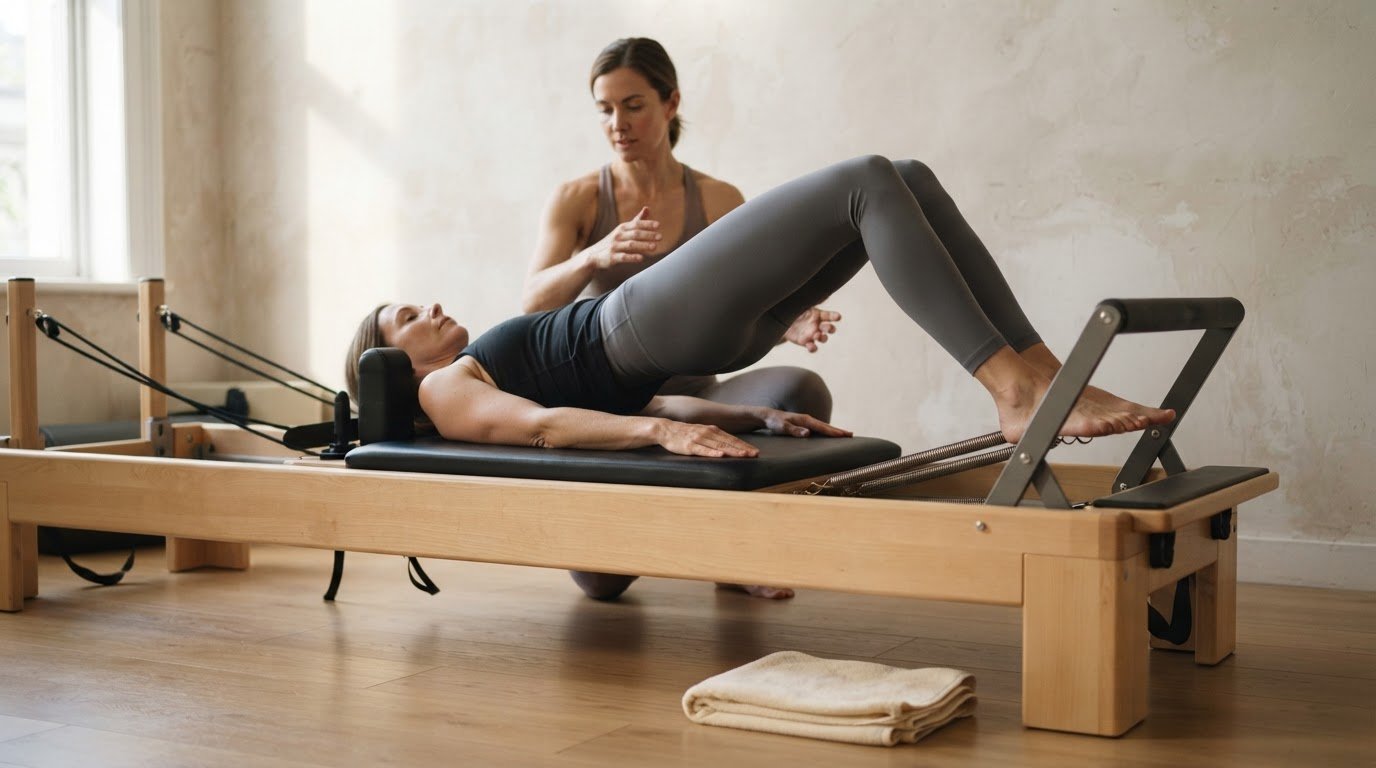
To understand how to improve Reformer Pilates sequencing, build each class around movement quality, clear transitions, and the demands of the equipment. Teach unfamiliar exercise components before combining them, then link movements to avoid unnecessary repositioning. The sequence should feel purposeful, not simply packed with exercises.
It’s easy to focus on what comes next and lose the thread between movements. A more reliable approach considers how each exercise prepares the body for the next, and how spring tension and carriage movement affect the flow. The equipment isn’t just a backdrop; it shapes how transitions work in practice.
This guide shows you how to teach exercise components before combining them, connect movements with fewer interruptions, and organize a class into a warm-up, main body, and cool-down. You’ll also learn to plan progressions and regressions, vary movement directions, and account for the Reformer’s setup as you sequence. The result is a practical framework for planning cohesive classes while leaving room to adapt to the people in front of you.
Key Takeaways
- Teach the parts of a movement first, then combine them when clients can maintain control and alignment.
- Build progressions around readiness, using foundational movements before adding more demanding positions or variations.
- Connect exercises through shared positions and purposeful transitions to reduce pauses and unnecessary repositioning.
- Give the warm-up, main body, and cool-down distinct roles, while balancing stability, mobility, and varied movement directions.
- Plan around spring tension, carriage movement, and equipment setup so the sequence stays controlled and practical to teach.
Table of Contents
- Teaching exercise components before combining them
- What is the Best Way to Sequence a Pilates Class?
- Linking movements to reduce interruptions
- Structuring a class with a warm-up, main body, and cool-down
- How Pilates equipment relates to the sequence
- ReformerFlow by Ginty
Teaching exercise components before combining them
Build a sequence around clear movement skills, not a list of demanding exercises. Teach the parts, check control, then connect them in a purposeful order.
- ### Choose Exercises for a Beginner Routine
Start with foundational Reformer exercises that establish the positions and movement themes clients will use later. Choose a manageable set, then check that each exercise suits the group’s experience and allows controlled practice. People new to Pilates, or returning after a break, don’t need to perform every exercise in the classical sequence. Leave out movements they aren’t ready for, or choose a preparatory exercise to build toward them.
- ### Order Exercises to Prepare the Body
Place each exercise where it prepares the body for what follows. In the classical Reformer sequence, movements are intended to warm the body for the next exercise, so consider the physical and positional demands of each transition. Before loading one side, prepare the body bilaterally. Check that the previous exercise gives clients a useful foundation rather than asking for an abrupt jump in control or coordination.
- Break a complex exercise into teachable components. For example, introduce the arm and leg actions separately, then combine them once clients can perform each part with control. Cue the essential alignment for each component before adding the coordination challenge. This makes it easier to spot which part needs adjustment and keeps the progression connected to the movement’s purpose.
- Group exercises by starting position when it creates a smoother class. For example, place several supine exercises together before moving clients to a seated position. This reduces time spent changing positions and gives the class a clearer physical rhythm. Keep the group’s readiness in view: if an exercise requires a different setup or a more demanding skill, make the transition intentional rather than preserving a grouping at the expense of control.
- Rehearse the exercise order for the Mat, Reformer, or other apparatus before teaching it. Practice helps you recognize where one movement prepares the next and where a component needs separate instruction. Repeat the sequence to internalize its structure, then adapt it for the people in class. A beginner routine should offer themes clients can build on, not require them to master the full classical order at once.
What is the Best Way to Sequence a Pilates Class?
Sequence a workout by matching each movement’s challenge to the client’s ability. Start with a clear progression, then plan options for clients who need more or less support.
For beginners, start with foundational exercises and add complexity only while movement remains controlled. For pregnancy or injuries, adapt the sequence to individual ability, omit movements that aren’t appropriate, and use preparatory alternatives. Common mistakes include advancing too quickly and improvising regressions; plan both options before class.
- ### Set the Starting Progression
Begin with foundational Reformer exercises that introduce positions and movement themes clients can build on. Check that the opening exercises suit the group’s experience and let clients establish control before adding a harder variation. A beginner sequence doesn’t need every classical exercise. Choose a focused starting flow, then observe how clients manage its demands before progressing.
- ### Progress the Challenge by Level
Increase challenge in stages, using the same movement theme to connect levels. At beginner level, establish the basic position and action. Intermediate practice can add standing and kneeling positions to movements introduced at beginner level. For advanced clients, choose variations that test control and coordination without changing the class’s purpose. Base each progression on demonstrated ability, not the label attached to a workout.
- ### Plan Progressions and Regressions
Write a progression and a regression beside each exercise in your plan. For a movement that demands balance, for example, choose a simpler preparatory exercise for clients who can’t yet maintain control. Progress when clients perform the current version with consistent technique; regress when added demands disrupt that technique. This gives you a clear response to different abilities without stopping to invent an alternative.
- ### Adapt Sequences to Individual Needs
Adapt the exercise order to the people taking the class, including beginners and clients with pregnancy or injuries. Identify movements that aren’t appropriate for an individual, omit them, and choose alternatives that prepare the person for movements they may build toward. For a mixed-ability group, plan both a foundational option and a more demanding progression. Don’t assume everyone should perform the same exercise just because it appears in a set sequence.
If sequencing feels difficult, start with a flow of three to four exercises. Prioritize stabilization before mobilization, then choose one or two backbend exercises where they suit the class. Mermaid and Headstands are often omitted in adapted sequences. These choices help keep the workout coherent while leaving room to adjust the challenge and exercise order for the group.
Linking movements to reduce interruptions
If you’re working out how to improve reformer pilates sequencing, examine the connections between exercises, not just their order. A purposeful link can reduce unnecessary pauses while keeping movement controlled and precise.
- ### Apply Pilates Principles to Movement
Prioritize control and precision as clients move between exercises. Joseph Pilates’ method calls for attention to how movement is performed, so observe alignment throughout the transition, not only at its endpoints. Anthea Maclean describes movement flow as three to four layers within an exercise choice. Teach those layers in a clear order, and avoid adding a new demand before clients can manage the current one.
- Identify a shared position or action that can carry clients into the next exercise. For example, One Leg Stretch Level 1 can transition into Double Leg Stretch Level 2 while the arms remain overhead. Keep the link only if clients can preserve control through the change. If they need to reset their position, cue the reset clearly rather than treating uninterrupted movement as the goal.
- ### Sequence Spinal Movement
Plan for flexion, extension, lateral flexion, and circumduction across the class. These four spinal movements give the sequence distinct directions to explore. To improve reformer pilates sequencing, map where each direction appears and whether clients can move with control. Avoid placing demanding spinal actions back to back when a different movement could create a more considered progression.
- Refine each movement before adding a variation or increasing repetitions. Watch whether clients maintain control from the first repetition through the transition. If alignment changes or momentum takes over, simplify the link and cue the movement again. A high repetition count isn’t the measure of a well-sequenced class; movement should remain intentional and controlled.
- Review where the sequence asks clients to stop, reposition, or change equipment. Note each interruption, then decide whether a shared position or setup could create a more direct link. Don’t remove a necessary reset just to keep the class moving. Instead, make the transition clear and purposeful, allowing clients to prepare for the next exercise without losing awareness of their movement.
- Use a quick rehearsal to test the class from the instructor’s perspective. Walk through the cue, the movement, and the entry into the next exercise. This reveals links that look smooth on paper but require extra explanation in practice. Adjust the order or cue where needed, and keep the final sequence responsive to the class rather than forcing every movement into one continuous flow.
Structuring a class with a warm-up, main body, and cool-down
Give each class phase a clear purpose: prepare movement, develop strength and mobility, then bring the work to a close. Plan one connected session, not three unrelated blocks.
There’s no single duration for each phase. Allocate time according to the class length, its movement goals, and the attention needed for transitions and instruction.
- ### Balance the Body Across the Sequence
Choose exercises that vary muscle groups and movement directions across the class. If the main body emphasizes hip extension, include work that challenges a different pattern rather than repeating the same demand. Review the full sequence for balance between mobility and stability, and between left and right sides. This helps avoid concentrating the session on one area while leaving other movement needs unaddressed.
- ### Integrate the Full Body
Build intermediate and advanced work by combining whole-body demands. For example, a standing exercise can challenge leg control while the trunk maintains stability and the spine moves with intention. Progress from isolated actions to coordinated patterns only when clients can keep the movement organized. Avoid adding complexity for its own sake; each layer should support the class’s movement focus.
- ### Include Upper-Body Strength and Balance
Include upper-body work alongside lower-body exercises so the sequence develops more than leg strength. Pair an arm-strengthening exercise with a movement that asks clients to maintain trunk control, then consider how its position fits the next transition. Check that upper-body demands don’t dominate the class or disrupt its overall balance. In a mixed sequence, distribute these challenges rather than placing them all together.
- ### Allocate Time to Each Class Section
Set the warm-up, main body, and cool-down durations by working backward from the total class time. Leave enough room for clients to prepare, explore the session’s primary movement goals, and finish deliberately. If a transition or teaching point needs more attention, adjust the exercise count instead of rushing the cues. Keep each phase purposeful, not equal by default.
- Use a standing lower-body flow to connect leg strength with hip and spinal movement. One example uses one full right spring and targets the hip’s external rotators and spinal mobility. Place it where clients can focus on the standing demands, then follow with a movement that changes the emphasis. The spring setup and position should serve the sequence, not interrupt it.
- Review the class from opening to close. Check that the warm-up prepares clients for the main body, that the main body includes varied muscle groups and directions, and that the cool-down provides a clear ending. For intermediate or advanced clients, progress toward full-body integration while keeping each phase connected to the class’s central movement aims.
How Pilates equipment relates to the sequence
Plan around the Reformer’s moving carriage, spring resistance, and setup changes. Select spring resistance to suit the exercise and the client’s control, then progress it when they can manage the movement steadily.
- Map each exercise to its equipment setup. A Reformer uses a sliding carriage, pulley system, and springs that provide varying tension and resistance. Note the spring configuration, footbar position, and accessories before arranging exercises. This helps you spot setup changes early and place them where they won’t interrupt a connected sequence.
- Choose spring resistance according to the exercise’s purpose and the client’s ability to control the carriage. Observe whether they can move smoothly through the intended range without losing alignment. Increase resistance only when the movement remains controlled; if added load disrupts the action, return to a setup that supports clearer execution.
- Use carriage control as a sequencing cue. Moving too quickly can cause the carriage to ricochet, so avoid placing a rushed transition after a demanding exercise. Allow time to steady the carriage before changing position or spring setup. Awareness of carriage speed helps you distinguish a purposeful transition from momentum that carries clients out of control.
- Place exercises with similar setups together when their movement goals still make sense. For example, group movements that use the same footbar position before introducing a change that requires adjustment. Don’t keep a setup just to save time if it compromises the exercise. Preserve both the intended movement and a practical order for equipment changes.
- Introduce Reformer Snake and Twist with the footbar in the low position before exploring the high position. Treat the footbar change as a progression, not an incidental setup detail. Before moving to the higher position, assess whether clients can manage the current variation with control. This gives you a clear, equipment-based decision point in the sequence.
- Rehearse equipment transitions as part of the class plan. Track where spring adjustments, footbar changes, or repositioning occur, then place them between exercises with a natural pause. In a group class, give clear setup instructions before clients move. Account for equipment handling as well as movement, so the Reformer supports the flow rather than causing abrupt stops.
Plan Reformer sequences with the app## ReformerFlow by Ginty
ReformerFlow by Ginty helps instructors turn sequencing principles into a planned Reformer class. Use the app to arrange exercises, review video demonstrations, and consider each movement’s level and spring setup. Its curated library includes over 400 exercises, with spring configurations personalized to the instructor’s Reformer machine.
It’s useful when planning transitions, comparing exercise options, or organizing a full class takes more time than you want to spend. The app is designed to help build a class in about five minutes, with a glanceable teaching mode for use while instructing. The ReformerFlow App Subscription includes access to the app, and a 7-Day Free Trial is available.
Contact ReformerFlow by Ginty to explore whether it fits your class-planning workflow.
Keep Refining Your Teaching Practice
A useful next step in learning how to improve Reformer Pilates sequencing is to notice what clients need from the plan in real time. After class, record where cues needed repeating, where transitions felt unclear, and which variations supported steady movement. Use those observations to make one deliberate adjustment before teaching the sequence again.
This small review turns planning into an ongoing teaching practice. Instead of rebuilding every class, refine the details that affect how the sequence works for your clients. A clearer cue, a different exercise link, or a more suitable variation can give you a focused direction for your next session.
If you’d like support organizing your Reformer class plans, contact ReformerFlow by Ginty.
Keep your choices intentional, stay responsive to the people in class, and let each session inform the next.
Frequently Asked Questions
Why is it important to target a variety of muscle groups?
Varying muscle groups helps prevent a class from repeatedly loading the same areas while neglecting others. For example, if a sequence emphasizes hip extension, consider adding upper-body and trunk work rather than stacking more similar hip exercises. Review the whole class, not each exercise in isolation. That wider view helps balance the session’s demands and keep its movement goals coherent.
What are the principles of effective reformer Pilates sequencing?
Effective sequencing uses purposeful order, controlled movement, and clear adaptations. Start by naming the class’s central movement goal, such as trunk stability or hip mobility. Choose exercises that serve that goal, and make sure each setup supports the next movement. Plan simpler and more challenging options so you can respond to what clients demonstrate during class, rather than relying on a fixed routine for every group.
How should reformer Pilates exercises progress from warm-up to cool-down?
Move from preparation into the class’s main movement focus, then finish with exercises that help clients reduce effort and regain composure. For instance, use early movements to establish coordination, develop the session’s strength or mobility focus in the main body, and close with controlled breathing and an unhurried final position. Choose exercises to suit the class objective rather than adding intensity simply because the session is nearing its end.
How do you sequence reformer exercises for different fitness levels?
Keep the class objective consistent, then adjust exercise complexity to match each client’s control and experience. A beginner may use a foundational version, while an intermediate client explores a standing or kneeling variation. For advanced participants, add coordination demands only when the movement stays organized. In a mixed-level class, explain the options before the exercise begins so clients can choose an appropriate variation without losing the group’s rhythm.
How can reformer Pilates sequencing balance muscle groups and movement patterns?
Map the class by body area and movement direction. For example, note where the sequence includes pushing, pulling, rotation, or side bending, then identify areas receiving repeated emphasis. If one pattern dominates, choose a later exercise that adds a different demand. Also consider whether clients work evenly on both sides. This planning check helps balance the session without forcing every class to use an identical exercise menu.
How can instructors create smooth transitions between reformer exercises?
Plan each transition as part of the exercise, including the next body position and any equipment adjustment. Before class, rehearse the link between movements and identify where clients need a clear cue. For example, announce a spring change before asking the group to reposition. When exercises share a setup, use that continuity; when they don’t, allow a deliberate pause instead of rushing the change.
What are examples of effective reformer Pilates class sequences?
An illustrative sequence could move from Footwork into bridging, then into Pulling Straps, with setup and position changes planned between exercises. Another option is to organize a class around standing lower-body work, then add a contrasting movement that shifts the body’s focus. These are starting points, not fixed prescriptions. Choose variations according to the class goal, clients’ ability, and the control they demonstrate during practice.