
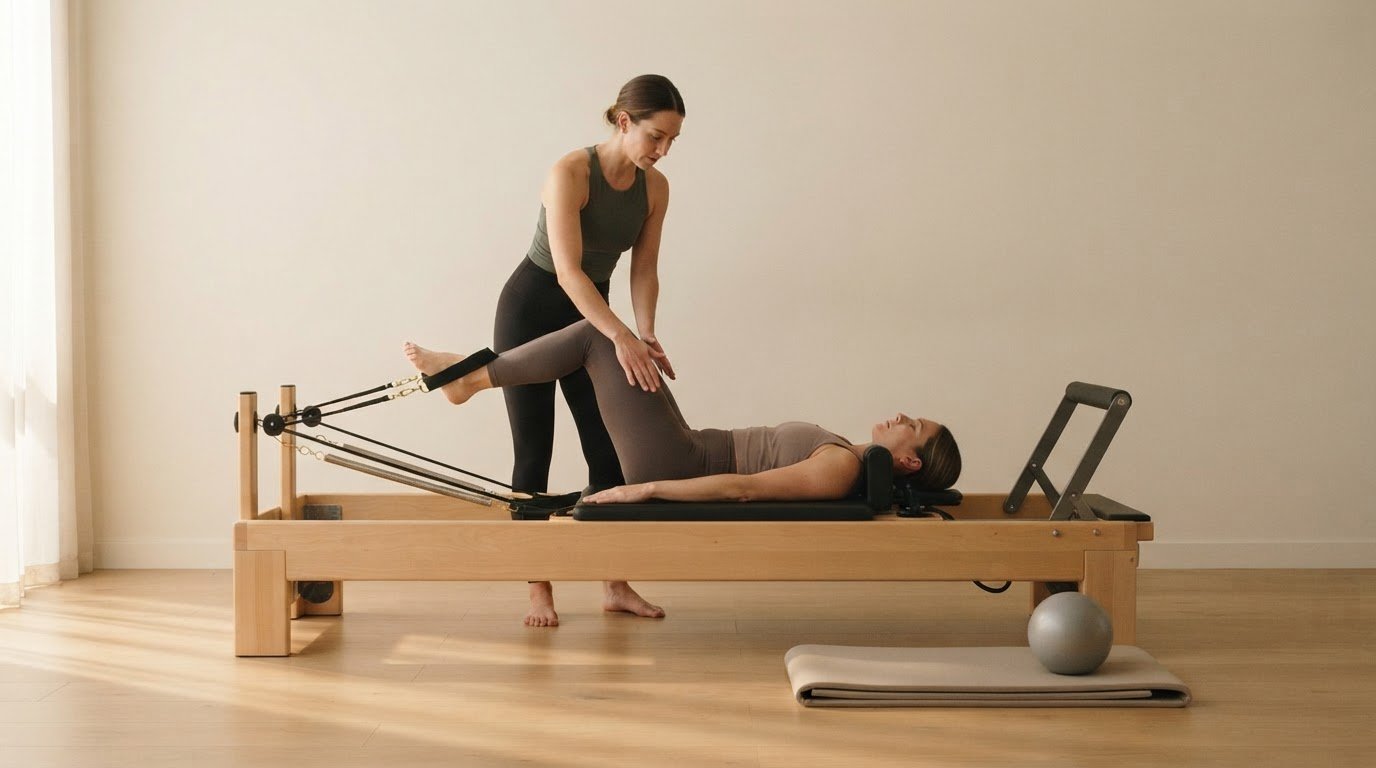
A useful Pilates library is curated, not collected at random. Start with a Pilates mat resource covering 34 exercises, then organize movements by purpose and difficulty. Building a personal library of Pilates exercises means choosing movements you can teach with confidence and arranging them into sessions with a clear warm-up, main sequence, and cool-down.
It’s easy to save more exercises than you can use. A simple structure makes each one easier to find and helps you plan with purpose. The goal isn’t to create the longest list, but to build a dependable selection you can adapt to your focus and experience.
This guide explains how to collect and organize mat exercise resources, balance movement categories, and shape them into practical sessions. You’ll also learn how to plan a gentle warm-up and a considered finish, so your library supports the whole practice, not just the exercises in between.
Key Takeaways
- Sort exercise resources by movement type, focus, and difficulty so you can find the right option when planning.
- Build sessions with a clear sequence, moving from foundational work toward more complex movements as control develops.
- Use gentle movement and breathing to prepare, then finish with stretching and relaxation.
- Adapt exercise variations to the practitioner’s experience, keeping technique and control central to each progression.
- For Reformer class planning, ReformerFlow offers a curated library of over 400 exercises with video, level, and spring-setup details.
Table of Contents
- 1. Pilates mat exercise resources
- 2. Structuring Pilates sessions
- 3. Warm-ups and cool-downs
- 4. What are the main categories of Pilates exercises for a balanced routine?
- 5. Which Pilates exercises are suitable for beginners, intermediate, and advanced levels?
- ReformerFlow by Ginty: ReformerFlow App Subscription
1. Pilates mat exercise resources
A Pilates mat resource can give your exercise library a clear starting structure. One mat exercise resource covers 34 exercises, offering a defined selection to review and categorize. Record each movement under its main purpose, such as mobility, strength, balance, or coordination. Then note the source and any teaching cues that make the exercise easier to recall.
The original Pilates routine is recommended as a starting point for home practice. A Traditional Flow workout with Courtney Miller runs 30 minutes, giving you a complete session to study. Rather than saving every movement, select exercises that fit your current practice goals. Building a personal library of Pilates exercises works best when each entry has a reason to stay.
Mat and Reformer exercises use different setups. Mat exercises rely on body weight and the floor, while Reformer exercises use a machine’s moving carriage, springs, and straps. Keep the two formats in separate categories so equipment needs and setup instructions stay clear.
You can begin a home mat practice without equipment, though a mat may be useful. Add optional props when an exercise calls for them. Costs depend on your choices, including the mat, props, materials, and brand. A mat-only setup avoids buying additional equipment.
For each exercise, record its name, purpose, starting position, movement sequence, and key cues. Add the intended repetitions or duration, plus easier and harder variations. For example, a roll back entry might note spinal articulation as its focus, a cue to move with control, and an option to use a smaller range. Keep notes concise enough to scan while planning.
Keep safety notes beside the movement rather than in a separate file. Record the space and equipment needed, balance demands, and modifications that reduce the range or complexity. Demonstrating proper exercise technique can help minimize injuries, according to the U.S. Bureau of Labor Statistics. Note the technique points that matter most, such as maintaining control during a transition or starting from a stable position.
To build your collection, choose a trusted resource, review its demonstrations, and save only useful exercises. Tag each entry by movement focus and equipment, then check whether your notes make it easy to teach or practice. A clear index turns saved material into a working library rather than a folder of disconnected videos.
2. Structuring Pilates sessions
A useful session has an intention, a sequence, and a clear finish. Start by choosing one focus, such as core strength, flexibility, posture, or back comfort. Select movements that match it, then balance them with exercises for other areas. For back comfort, prioritize controlled range and comfortable positioning instead of assuming one movement suits everyone.
Organize your exercise library with searchable tags for goal, difficulty, equipment, and body area. One exercise can have several tags: a Plank might be filed under core work, mat, and foundational or progressing variations. These labels let you build a sequence without rereading every note and make it easier to swap an exercise when a planned movement doesn’t fit.
A suggested home routine includes roll back or 100’s, Swan, side leg work, Saw, and Plank. Treat these as a sequence to adapt, not a fixed prescription. The five movements span different types of work, so record what each contributes and where it belongs. A focused home practice can last 20-30 minutes, with the session length shaped by transitions, pacing, and rest.
For a simple structure, plan a preparation phase, a main sequence, and a closing phase. The warm-up and cool-down sections below explain those bookends in more detail. For the main sequence, place familiar movements first, then add complexity or resistance as strength and coordination improve. Avoid making every exercise harder at once. Change one element and observe whether control stays consistent.
Each suggested exercise can be practiced for 30 seconds to a minute. Choose a duration that allows deliberate movement, rather than rushing to complete a target. If a sequence feels disjointed, review the transition between exercises. For example, arrange movements so the change in position feels purposeful, and avoid repeated setup changes that interrupt concentration.
Practice the five suggested moves for a week to get familiar with their order and transitions. After each session, note which movements felt clear, which needed adjustment, and whether the sequence matched your focus. This review turns a saved list into a working plan. Keep changes specific, such as moving Saw earlier or choosing a simpler Plank variation.
Progression should reflect the movement, not just the calendar. Begin with foundational versions, then consider more complexity or resistance as control develops. If an exercise loses its intended form, return to a manageable variation. End each session with stretching and relaxation to create a deliberate transition out of the main work.
For instructors sequencing Reformer classes, a digital class-planning workflow can help organize exercise choices and transitions.
Return to a foundational variation whenever control becomes inconsistent. Progress from foundational movements to greater complexity and resistance as strength and coordination improve. Practice the five Pilates moves for a week to build strength and control. Notice whether transitions remain smooth and each movement still serves the session’s focus. Make the next adjustment only when the current sequence feels controlled.
3. Warm-ups and cool-downs
Give every Pilates session an opening and a closing sequence. Start with cat-cow stretches, gentle twists, and breathing exercises to prepare the body and ease into the main practice. In your library, save these under a warm-up tag, separate from the main exercises. That makes preparation easy to find when you assemble a session.
Arrange opening movements from simple awareness to more active mobility. Begin with breathing, then add cat-cow and gentle twists. For cat-cow, record the starting position and direction of each movement. For twists, note how the torso rotates and where the movement should stay controlled. Clear notes help you reproduce the sequence without searching through unrelated entries.
Keep the warm-up connected to the session’s focus. If the main sequence includes Swan, use the opening to prepare for spinal movement with gentle, controlled actions. If side leg work follows, consider a warm-up that brings attention to the torso and hips. These are planning examples, not fixed pairings. Choose movements that create a coherent transition into the session.
Plan the cool-down as deliberately as the opening. End a Pilates session with stretching and relaxation to help prevent injury and provide a satisfying conclusion. Save closing movements in a separate category, with notes about their position and purpose. For example, record whether a stretch follows supine work or a standing sequence. That context makes the exercise easier to place appropriately.
Breathing can mark the shift from active work to a quieter finish. Add a simple breathing cue to each relaxation exercise. Keep it brief and connected to the movement, such as breathing steadily while releasing a stretch. Avoid turning the cool-down into another demanding sequence. The aim is a clear ending, not an added challenge after the main practice.
Review the full session order before practice. Check that the warm-up leads into the selected movements and that the cool-down follows naturally. Moving from cat-cow to a floor-based exercise may require little repositioning. A standing finish after supine work may call for a calm change of position. Note transitions that affect the flow.
After practice, update the library with your observations. Note whether cat-cow prepared you for the next movements or whether a twist felt out of place. Record which stretch made a suitable final exercise and which breathing cue felt clear. These practical notes help you refine the opening and closing over time, so each entry supports a complete session rather than an isolated movement.
4. What are the main categories of Pilates exercises for a balanced routine?
Sort Pilates movements by action, not just by exercise name. Useful categories include flexion, extension, side work, rotation, and core work. These tags show which movement patterns your session includes and reveal gaps before you finalize a sequence. A library organized this way supports deliberate selection instead of relying on familiar favorites.
Flexion includes movements that curl or articulate the spine. Roll back is a useful example. Extension includes movements that lengthen the front body and extend the spine, such as Swan. Record each movement’s primary category, even when it also trains other areas.
Side work adds a distinct direction to your exercise selection. Tag side leg work with this category and its body-area focus. Give rotation its own label, using Saw as a practical example. These tags distinguish movements that may look similar in a long list and make it easier to choose varied work deliberately.
Core work is another useful category, but it shouldn’t be your only organizing principle. Plank is one example to tag for core work. Add secondary labels for its movement pattern, body area, and difficulty. An exercise can belong to several categories, helping you search by session need without creating duplicate entries.
Use the categories together to assess the session as a whole. For example, a sequence with roll back, Swan, side leg work, Saw, and Plank draws from all five suggested categories. Exercise names alone don’t guarantee balance. Review the tags and consider whether the session gives enough attention to each selected movement pattern.
Track the major muscle groups each exercise works, too. The Centers for Disease Control and Prevention says a balanced muscle-strengthening routine should work all major muscle groups, including the back and abdomen. Check these areas alongside your movement tags. If your library has several core entries but few back-focused choices, prioritize finding appropriate variety.
Keep classification useful, not elaborate. Give each entry one primary movement category, then add body-area and equipment tags. For example, label Swan as extension, then add its relevant body area and mat setup. Use the same terms throughout your notes. Consistent labels make filtering reliable and help you assemble routines with clearer coverage.
Before saving a new sequence, scan for missing categories and repeated patterns. If flexion appears several times, consider whether other categories need attention. Keep the session’s purpose in view and select movements that contribute to it. This quick review makes category labels a practical planning tool, not just a filing system used after practice.
5. Which Pilates exercises are suitable for beginners, intermediate, and advanced levels?
Choose Pilates exercises by the control they require, not by their names alone. A familiar movement can suit different levels when its range, pace, or support changes. Label each variation separately in your library. This makes progression visible and helps you choose a version suited to the practitioner’s current coordination.
For beginners, prioritize clear starting positions and manageable movement ranges. The suggested Plank option is three rounds of 10 seconds each. Record that version as an entry point, with a cue to maintain control throughout. A shorter hold can help a practitioner focus on alignment rather than extending the effort beyond their capacity.
Intermediate entries can add coordination or a more demanding sequence. For example, a practitioner might move from a supported position to a less supported version of the same exercise. Keep the central cue consistent as the challenge changes. Note what has changed, such as the support, range, or number of actions to coordinate.
Advanced options can involve greater complexity or resistance, but the movement should remain controlled. A progression might combine a larger range with a more involved transition. Avoid changing several demands at once. If the practitioner loses the intended control, return to the previous variation and build from there.
Use a consistent record for every level. Name the exercise, describe its setup, and write the key cue. Then document an easier variation and the next progression. For a Plank entry, distinguish the brief hold from a more challenging option by noting its specific setup and control demands. Clear descriptions prevent a level label from becoming the only guide.
Difficulty also depends on the person practicing. Strength, coordination, familiarity, and the ability to maintain the intended movement all matter. A practitioner may handle a familiar movement confidently but need a simpler variation for a new one. Keep level categories flexible: they should guide selection, not define a person’s overall ability.
Review each exercise during practice, then update its level notes. Record whether the setup was clear, the cue supported control, and which modification worked. If an intermediate variation proves inconsistent, keep the beginner option easy to find. If the movement stays controlled, note the next progression without rushing to add complexity.
A well-organized library presents each exercise as a progression, not a single fixed task. Separate entry-level, developing, and more demanding variations, then compare their setup and control requirements. This structure helps you choose deliberately and adjust the session when a movement needs a simpler approach.
Explore ReformerFlow class planningBeginners can start a home Pilates practice with five minutes of exercise a day. Keep the brief session focused on a manageable selection of movements and cues that help preserve control. As confidence develops, review which variations remain comfortable and which need adjustment, rather than treating duration as a test of progress. A home routine can draw on the beginner options in your library, with clear setup notes ready to consult. Consistent, attentive practice gives you a practical basis for deciding whether to keep or change a variation.
ReformerFlow by Ginty: ReformerFlow App Subscription
ReformerFlow by Ginty offers the ReformerFlow App Subscription for instructors planning Reformer Pilates classes. Its curated library includes over 400 exercises, with video, level, and spring-setup details. Exercise information is personalized to the instructor’s specific Reformer machine, including spring configurations and a glanceable teaching mode. Use it when your planning shifts from collecting mat resources to sequencing Reformer classes. The app is designed to help instructors build a class in about five minutes, keeping exercise selection and setup details together. A 14-Day Free Trial is available to explore the subscription. If you’re ready to organize Reformer class planning in one app, visit reformerflow.app.
Make your next practice intentional
Let your next session test how well your exercise library works in practice. Choose a focus, select movements that support it, and notice where your notes make planning easier. If an exercise takes too long to interpret, refine its cues or tags before using it again. Small edits can make your collection more useful over time.
As your practice develops, let your library develop with it. Keep variations that serve a clear purpose, and update entries when your preferred approach changes. This keeps planning flexible without turning every session into a new search. The value of building a personal library of Pilates exercises is having a resource you can shape around your practice.
If Reformer class planning is your next focus, explore the app as a dedicated planning option.
Explore ReformerFlowStart with one thoughtful session, then keep refining. Your next clear sequence begins with the choices you make today.
Frequently Asked Questions
How do I start building a personal library of Pilates exercises?
Start with a small collection tied to one practice goal. Choose a few exercises you already understand, then create a separate entry for each variation. Add a short cue in your own words and note what makes the movement easier to follow. After practice, mark entries that were clear and useful. This first review helps you decide what to keep, revise, or add next.
Where can I find reliable Pilates exercise instructions and videos?
Choose resources that identify the exercise and show the full movement, including its setup and finish. Look for demonstrations with visible alignment and cues that explain how to move, not just what a position looks like. Compare the written instructions with the video to make sure both describe the same action. Save the source with your notes so you can revisit the demonstration when details become unclear.
How can I build Pilates routines from individual exercises, and how long should sessions be?
A focused home Pilates practice can last 20-30 minutes. To build a routine, choose a clear focus, arrange compatible exercises into a sequence, and account for transitions between positions. Review the complete flow before practicing, rather than judging each exercise in isolation. If the sequence feels rushed or disconnected, adjust the selection or pacing so each movement has room to be performed with control.