
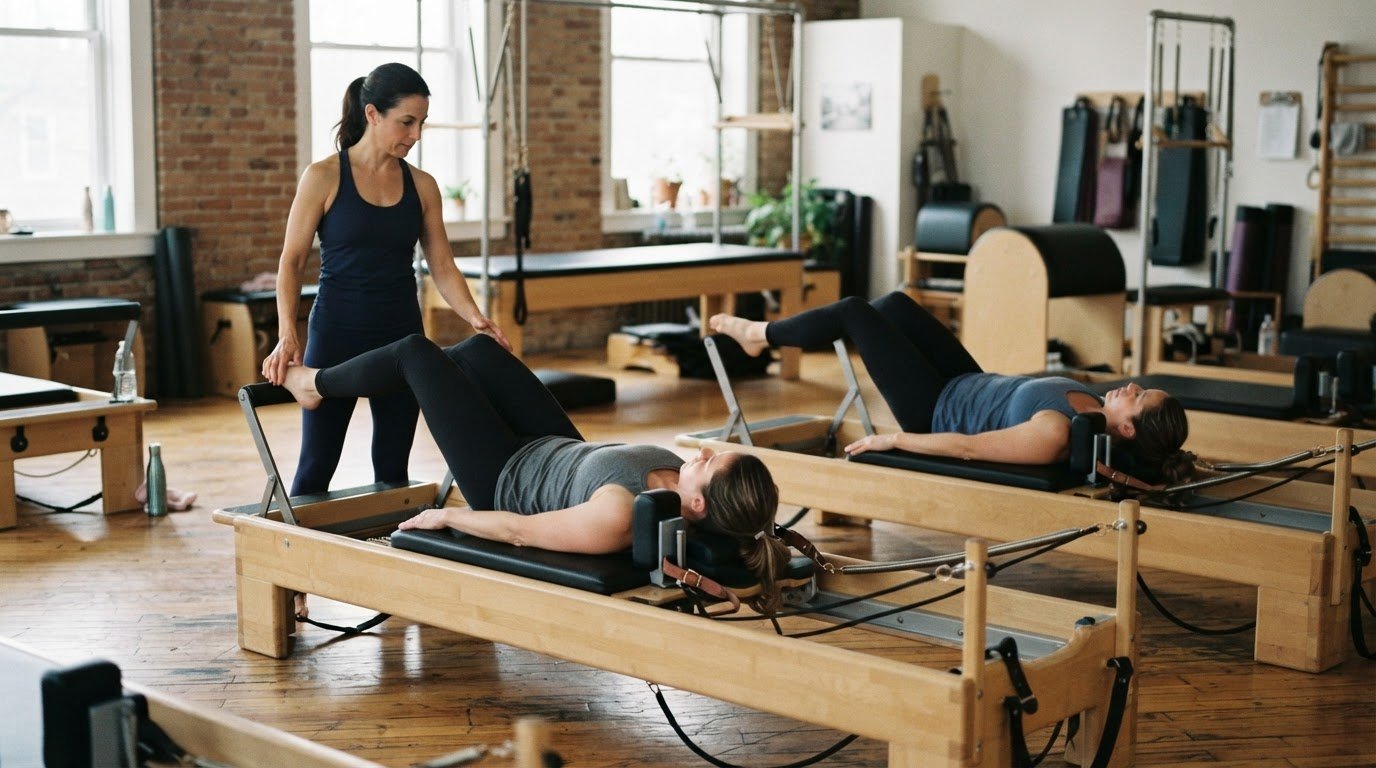
Teaching efficiently isn’t about rushing through a class. The practical answer to how to be a more efficient Pilates instructor is to strengthen five connected skills: client relationships, consistent personal practice, clear cueing, continued education, and a solid grasp of Pilates fundamentals. Together, these help you plan with purpose and respond confidently to the people in front of you.
Good teaching takes more than knowing the exercises. You also need to build trust, communicate in ways clients understand, and keep your own practice fresh. When those elements are in place, class planning and in-the-moment decisions feel more focused without sacrificing the care that keeps clients engaged.
This guide covers practical ways to improve each area, from understanding clients’ needs to refining your cues and adapting movement. It also explains why anatomy, exercise mechanics, and the method’s foundational principles matter to efficient teaching. Apply the ideas that fit your current practice, then build on them over time.
Key Takeaways
- Build client trust with attentive communication, individualized sessions, and feedback that helps you refine your teaching.
- Keep a personal Pilates practice to test sequences, sharpen technique, and stay connected to the method.
- Use clear verbal cues and purposeful body language, adapting your approach to how each client learns.
- Choose continued education that strengthens your teaching and supports the clients you want to serve.
- Apply Pilates principles, anatomy, and exercise mechanics to adapt movements while preserving their intent.
Table of Contents
- 1. Developing business, marketing, and client-retention skills
- 2. Maintaining a personal Pilates practice
- 3. How does communication and cueing affect client success?
- 4. Continuing education and specialized training
- 5. Pilates foundational principles and exercise mechanics
- ReformerFlow by Ginty: ReformerFlow App Subscription
1. Developing business, marketing, and client-retention skills
Efficient teaching starts before clients arrive. Learn their names, ask about their goals, and note their preferences so each session feels considered. Before class, ask about physical conditions or limitations that could affect participation. Use what you learn to shape the program, choose suitable variations, and make decisions without stopping class to gather basic information.
Build experience across settings and client groups. A studio class, a private session, and a community demonstration each call for different pacing and communication. Small group Pilates classes may have 3 or 4 students, while larger Reformer groups may have 6 to 12 or more. Teaching across those formats develops skills in managing attention, adjusting plans, and keeping every participant included.
For clients new to group Reformer classes, the article recommends starting with one or two private sessions. These give instructors time to understand a participant’s experience and needs before the faster pace of a group class. As clients progress, keep checking their goals and adapting exercises to their injuries, fitness levels, and preferences. A useful program responds to the person, not just the plan.
Read the room as you teach. Notice whether clients follow a cue, hesitate, lose alignment, or look uncertain. When someone needs correction, choose the most important adjustment and give a brief, specific cue. In a group class, aim for no more than three corrections to one client. Focused feedback helps preserve the class’s flow.
Make feedback part of your routine. After class, ask clients what worked and what they would change; look for recurring comments rather than reacting to one opinion. With their consent, filming a session can help you review their responses to your cues and programming. Ask a peer or mentor to observe, then choose one practical improvement for your next class. Small, visible changes can build trust and strengthen your reputation.
Business skills matter when you teach independently or open a studio. Invest time in learning marketing, client retention, and pricing strategies, and use demonstrations inside and outside your club to introduce Pilates to prospective members. A full-time teaching business may take about a year to build. Some instructors teach 30 sessions per week, though finding a sustainable workload may take a couple of years.
Efficiency also means protecting your capacity. One estimate places a realistic upper workload for most instructors at 20 to 25 sessions a week before burnout. Compare your schedule with client feedback and your own teaching quality. If the program feels rushed or your attention slips, review the workload and refine how you prepare, communicate, and retain clients.
2. Maintaining a personal Pilates practice
Keep your own practice on the calendar, even during a full teaching week. A practical target is 20 minutes daily: enough time to explore a sequence, notice where transitions feel awkward, and reflect on how an exercise changes with different effort levels. Practising helps you stay connected to Pilates as a physical method, not just a program you deliver in the studio.
Rehearse planned sequences in your own body before teaching them. Try each transition, check whether the exercises build logically, and note where clients might need a pause or alternative. If a sequence moves quickly from kneeling to standing, for example, practise the transition and consider how different mobility levels could affect the flow. This preparation supports clearer decisions in class.
Personal practice also sharpens your ability to tailor exercise programming. Before a session, identify each client’s goal, fitness level, and relevant injury or limitation. Choose an appropriate starting point, then decide how to progress or simplify the movement. A client returning to exercise after an injury may need a smaller range of motion, while a more experienced participant may benefit from a different challenge.
Plan classes around a simple structure: choose the session’s focus, order exercises coherently, and prepare modifications for likely needs. During class, make transitions purposeful and give each exercise a clear place in the sequence. To keep preparation and follow-up manageable, prioritize what will affect the next session: review the plan beforehand, then record useful observations and agreed adjustments afterward.
Keep administration manageable by using consistent session notes and grouping similar tasks together. A brief template can capture a client’s goals, exercise variations, and follow-up point without requiring a long report after every class. Set up each Reformer and place planned props before participants arrive. Match the spring setup and equipment arrangement to the exercises so transitions don’t become a scramble.
Protect personal commitments by building recovery and practice into the weekly calendar, rather than leaving them to leftover time. A 30-hour workweek is one suggested way to maintain balance, but individual capacity differs. Some instructors find that 10 sessions per week are already too much. Track your energy and teaching focus; if either declines, adjust your schedule and simplify repeatable admin tasks.
A consistent personal practice can help keep teaching fresh. Use a weekly review to identify one sequence that worked, one transition to improve, and one client need to prepare for. This turns experience into specific programming decisions and keeps your own movement practice from becoming another task you indefinitely postpone.
3. How does communication and cueing affect client success?
Clear cues give clients a useful next step without overwhelming their attention. Follow a simple sequence: name the action, describe the movement, then offer one focus. For example, “Press the carriage out; keep your ribs steady.” This concise structure supports learning while leaving clients room to feel the exercise.
Pair verbal instructions with purposeful body language. Demonstrate the direction or rhythm of a movement, then let clients try it. A small gesture toward the shoulder can show where to release tension; a steady hand motion can indicate the pace of a controlled return. Keep demonstrations visible, specific, and connected to the exercise’s purpose.
Adapt your language to the person learning. Some clients prefer an anatomical explanation, such as engaging the muscles around the hips; others respond better to imagery, such as drawing the legs inward like magnets. Ask which approach makes sense, then notice whether the client changes the movement. A useful cue is one the client can apply, not one that merely sounds technical.
Give instructions in manageable pieces. Before a new exercise, explain the starting position and first action. Add details once clients begin moving, rather than giving several corrections at once. During footwork, for example, establish foot placement first, then cue the carriage movement and breathing as the sequence continues. This makes the physical task easier to follow.
Use precise words for direction, range, and effort. “Move slowly” can mean different things to different clients; “take three counts to return” gives a clearer rhythm without a lengthy explanation. If someone looks uncertain, pause the sequence, restate the key action, or demonstrate it again. Clear, accurate cueing reduces confusion and frustration, supports correct technique, and can help prevent injury.
Corrections should feel respectful and useful. Name the movement you want rather than criticizing the client’s body: “Keep your pelvis steady as the legs move” is more actionable than “You’re doing it wrong.” Use a calm tone, give the client time to respond, and watch the next repetition before adding another instruction.
Learn communication skills by observing instructors who correct clients kindly and effectively. Notice their timing, tone, demonstrations, and choice of words, then practise one technique in your own teaching. A colleague’s observation can also show whether clients hear and understand a cue and make the intended adjustment. These details give you a concrete focus for developing your teaching career.
After class, ask a client which cue helped and which felt unclear. Their feedback can show whether anatomical language, imagery, or a visual demonstration worked best. Carry that insight into the next session. An effective cue is concise, suited to the person, and connected to the movement’s purpose.
4. Continuing education and specialized training
Continuing education helps you respond as clients, movement practices, and professional interests evolve. Professional development means acquiring skills, knowledge, and certifications to improve teaching practice and career prospects. Start with a specific question from your work: do clients need more accessible Reformer options, or would your programming benefit from stronger anatomy knowledge? A clear goal helps you choose education relevant to your sessions.
Match your training to the movement you teach. If you work primarily with the Reformer, deepen your understanding of its exercise variations, transitions, and spring choices. If clients share a particular goal or belong to a specific population, targeted learning can help you adapt your program. Exploring yoga, barre, or functional training can broaden your movement vocabulary. Apply new ideas selectively, keeping the Pilates method and client needs central.
Course length alone doesn’t show how prepared you’ll feel to teach. Some instructor courses can be completed in a few weekends, but self-mastery, observation, and practice teaching also take time. Other courses require hundreds of hours of observation and practice teaching. Comprehensive teacher training can take 1–2 years of part-time study, while comprehensive certification across all equipment can require 500 hours before paid teaching begins.
Before enrolling, look closely at what a course asks you to practise. Seek opportunities to observe teaching, teach with feedback, and study how instructors adapt movement for different abilities. A short course may address one focused skill; longer training may allow more time for practice and integration. Choose a format that fits your experience, learning goals, and available time.
Keep learning between formal courses. Attend classes at other studios to observe how instructors structure sessions, explain exercises, and manage transitions. Ask a respected peer to observe one of your classes, then request feedback on a specific area, such as exercise progressions or cue timing. Test one observation in your next session instead of changing your whole method at once.
Turn education into a repeatable cycle: identify a teaching question, choose a learning activity, apply one idea, and review the result. For example, after learning a new way to regress a movement, try it when a client struggles and assess whether it preserves the exercise’s intent. This connects study to practical teaching instead of leaving new information in your course notes.
Record each course, class observation, and practice-teaching insight in a simple development log. Note the skill you worked on, how you applied it, and what you want to refine next. Over time, the entries can reveal patterns: recurring difficulty with Reformer progressions may point to a useful focus for your next study.
5. Pilates foundational principles and exercise mechanics
Pilates teaching is guided by concentration, control, center, flow, precision, and breath. Use these principles as practical checks when planning a class. Ask whether a transition supports control, whether breath complements the movement, and whether each exercise has a clear purpose. These questions help a Pilates teacher build a coherent sequence rather than collect movements without direction.
Understanding mechanics is central to how to be a more efficient Pilates instructor. Before adding an exercise to a sequence, identify its movement pattern, the muscles involved, and the coordination it requires. In a leg exercise, for instance, notice how the pelvis and trunk respond as the legs move. That analysis helps you choose a suitable starting position and explain the exercise’s purpose.
Anatomy and biomechanics support thoughtful sequencing and adaptations. Consider how an exercise’s demands relate to each client’s abilities and physical limitations. Knowledge of muscle activation can help you decide whether to advance or regress a movement pattern. The goal isn’t to make every exercise harder; choose a variation that suits the client’s capacity and the session’s aims.
When a client struggles, preserve the movement’s intent while changing its demands. First, identify the difficulty: balance, range, coordination, or load. Then adjust the position, range, or complexity while keeping the central action recognizable. If the full movement is too challenging, offer a smaller or supported variation. Observe the response before deciding whether to progress or simplify further.
Build a sequence with clear logic. Name the class focus, then choose exercises that prepare clients for the work and develop it progressively. Check how each movement transitions into the next, and remove anything that doesn’t serve the session’s purpose. This gives clients a clear journey through class. Understanding mechanics also shows how to be a more efficient Pilates instructor: each exercise has a reason to be there.
Apply the same reasoning across experience levels. A familiar exercise can remain useful when its range, resistance, or coordination is adjusted for the participant. Explain the purpose of the variation, then watch how the client moves. If control or alignment changes, adjust the demand instead of pushing through the planned version.
Courses and observation can deepen your understanding, but apply new ideas thoughtfully. Study an exercise’s mechanics, practise it, and note the muscles and movement qualities it emphasizes. Then consider where it fits within the Pilates method. Keep the takeaway simple: know the purpose, recognize the demands, and adapt without losing the purpose.
Bring more intention to your Reformer class planning with a focused exercise library.
Explore Reformer class planning## ReformerFlow by Ginty: ReformerFlow App Subscription
ReformerFlow by Ginty offers an app subscription for instructors who want to streamline Reformer class planning. Build a class in about five minutes from a curated library of over 400 exercises, with video, level, and spring-setup details. The app personalizes exercises to your specific Reformer machine, shows exact spring configurations, and includes a glanceable teaching mode.
Turn to it when planning each class takes time away from personal practice, client follow-up, or focused teaching preparation. The exercise library and sequencing tools can help organize your plans while leaving you to apply your knowledge of clients and Pilates fundamentals. A 14-Day Free Trial is available.
For a focused way to plan Reformer classes, explore the ReformerFlow App Subscription or visit reformerflow.app.
Choose one improvement and make it part of your practice
Progress doesn’t require changing your entire teaching routine at once. Choose one recurring friction point, such as planning a class or adapting an exercise, and decide what a better process would look like. Try it in your next session, then reflect on what changed for you and your clients.
If you’re working out how to be a more efficient Pilates instructor, treat efficiency as an ongoing practice, not a finish line. Keep what supports thoughtful teaching, refine what creates unnecessary effort, and let the needs you see in class guide your next step.
Explore the ReformerFlow App SubscriptionBuild at a pace that protects your focus and the quality of your teaching. Each intentional adjustment can make your next class more considered for both you and your clients.
Frequently Asked Questions
How can upskilling courses advance your Pilates career?
Targeted courses can help you develop expertise for a particular client group or teaching need. If you want to work with runners, for example, choose learning that helps you understand their movement goals and adapt Pilates exercises accordingly. Apply new knowledge in your programming, then review how clients respond. This gives you practical experience to build on and helps clarify the direction you want your teaching career to take.
How does communication and cueing affect client success?
Clear communication helps clients understand what to do and notice how a movement feels. After giving an instruction, watch the next repetition for a change that shows whether it made sense. If the client still looks unsure, demonstrate the action or try different wording. This quick check helps you respond in the moment instead of repeating an instruction that hasn’t connected.
What are the best tips to improve your Pilates teaching?
Choose one teaching habit to refine at a time. For example, if clients lose track during transitions, adjust how you introduce the next exercise in your following class. Briefly record what you changed and what you observed. This creates a practical learning loop: identify a teaching challenge, test an adjustment, and decide whether it helped clients participate with more confidence.
Why is understanding human anatomy critical?
Anatomy helps instructors understand how the body responds to movement and make better-informed exercise choices. If a client struggles to maintain a position, consider which muscles and movement patterns the exercise asks them to coordinate. That insight can guide a simpler variation or different range of motion while preserving the exercise’s intent. It also helps you explain an adjustment clearly.
How can Pilates instructors create reusable lesson plans for different levels?
Build each lesson around a shared movement goal, then prepare variations that change the exercise’s demands. For example, a plan might include a supported version, the intended base movement, and a more challenging option. Record the setup, key transition, and what each variation changes. This creates a reusable framework, not a rigid script, so you can choose the version that suits the people attending.
How can Pilates instructors track client progress and adapt exercises efficiently?
Track observations that inform your next programming choice. After a session, note the exercise, the variation used, and the client’s response, such as whether they performed the movement with more control. At the next session, compare your note with their current goals and performance. Keep records concise and specific so you can decide whether to repeat, adjust, or progress an exercise without relying on memory.
How much time should Pilates instructors spend on class preparation and client follow-up?
Review the class plan before the session, then record useful observations and agreed adjustments afterward. Focus on preparation and follow-up that will shape the next session.