
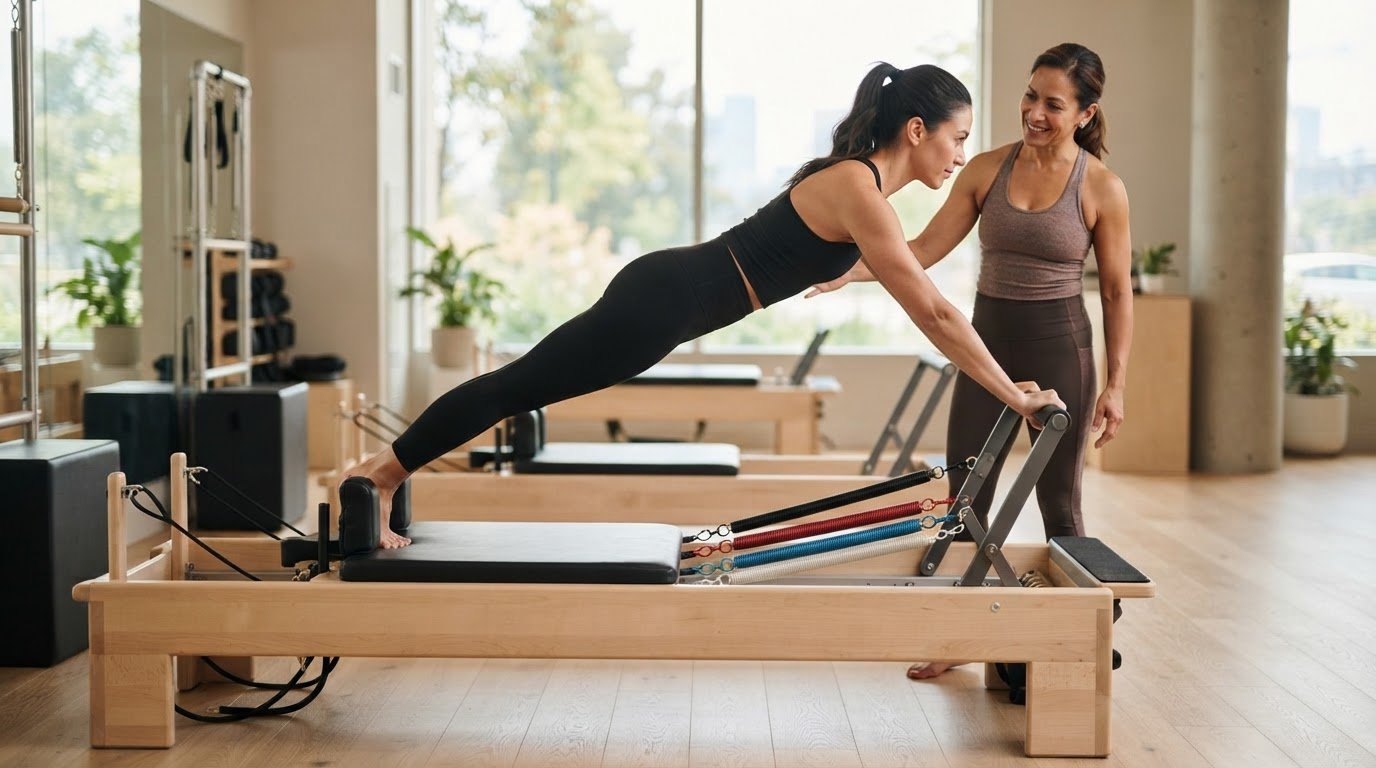
The color that signals light resistance on one Reformer can mean something different on another. In a STOTT Reformer spring configuration, black is extra-heavy, red is heavy, blue is medium, and white is light; a Merrithew white spring has 25% tension. The color key is a useful starting point, but the exercise and the person using the Reformer matter too.
It’s natural to look for one “right” spring setting, especially when planning a sequence across different movements. But heavier tension doesn’t automatically make an exercise harder: a lighter spring can demand more strength and control, while more support may suit a beginner or a movement that needs stability.
This guide explains how spring colors and resistance vary by brand, what to consider when choosing a suitable spring range, and how to think through settings for upper-body work, planks, and long-stretch exercises. You’ll also see how carriage and Gearbar positions affect the setup, helping you make deliberate adjustments rather than rely on color alone.
Key Takeaways
- On Merrithew Reformers, black, red, blue, and white indicate extra-heavy, heavy, medium, and light tension; color meanings don’t carry across brands.
- Classical Reformers typically use four springs of the same heavy tension, unlike contemporary setups with a range of spring strengths.
- Choose a starting setup with the exercise, the client’s comfort, and the desired support in mind, not spring color alone.
- For upper-body, plank, and long-stretch work, the right resistance depends on the control and support the movement calls for.
- Footwork often starts with three to four heavy springs, but the suitable setting still depends on the person and the Reformer.
Table of Contents
- What Color Reformer Springs Should I Use?
- Why reformer spring resistance differs between brands
- Spring settings for upper-body, plank, and long-stretch exercises
- Choosing a reformer with a suitable spring range
- What is the standard STOTT Reformer spring configuration for footwork?
- ReformerFlow by Ginty: ReformerFlow App Subscription
What Color Reformer Springs Should I Use?
On a Merrithew Reformer, spring colors indicate different tension levels, but color alone doesn’t determine the right setup. Classical and contemporary Reformers use different spring systems, so consider the machine, exercise, and desired support together.
Classical and Contemporary Spring Tensions
Classical Pilates Reformers use four springs, all with the same heavy tension, while contemporary Reformers can combine springs of different strengths. That difference matters when planning a workout: a spring count on one style doesn’t translate directly to another. On a contemporary Pilates Reformer, changing the combination alters total spring tension and the support available through the movement.
Merrithew, formerly STOTT, color-codes its Reformer springs by tension: black is extra-heavy, red is heavy, blue is medium, and white is light. A Merrithew white spring has 25% tension. Use those labels to understand that machine’s setup, not as a universal scale for other pilates equipment. For example, a white spring identifies light tension on Merrithew equipment, but another brand’s white spring may represent a different resistance.
Merrithew professional Reformers come with a High Precision Springs Package, while home models use a Traditional Springs Package. The spring package helps identify the system fitted to the machine. Before planning around a color or spring count, match the exercise to the Reformer’s own spring set and intended resistance range.
Footwork Spring Configuration
For footwork, a typical Pilates spring chart suggests three to four heavy springs as a starting point. This provides substantial support as the carriage moves, helping the practitioner focus on controlled leg action rather than managing an unstable carriage. Treat it as a starting reference, not a fixed setting for every person or machine.
Carriage position also affects the setup. On a STOTT Reformer, Carriage Stopper and Gearbar positions 2 and 2 are often called the standard position, but they don’t suit every situation. For most clients, set the initial stopper so the hip angle is 90 degrees when lying supine with heels on the bar. Torso length, leg length, and comfort also inform the position.
The Gearbar changes spring tension through the spring’s working length: placing it closer to the Carriage Stopper lowers tension, while moving it farther away increases tension. Keep enough initial spring tension to prevent play or looseness at the stopper. The carriage should feel controlled at rest, not slack against its stop.
To change springs, control the carriage and attach each spring securely to the machine’s designated connection points before loading it. Don’t use a spring that shows visible damage. Replace STOTT Reformer springs every two years. Oxidation, kinks, or gaps in a coil are signs that a spring needs replacement.
Why reformer spring resistance differs between brands
Spring colors aren’t a universal resistance scale. Reformer brands choose their own spring strengths and color systems, so matching colors across machines can lead to the wrong comparison. A green spring on one Reformer may feel different from a green spring on another. Compare the manufacturer’s resistance descriptions and the machine’s setup, not color alone.
Spring design is only part of what a practitioner feels. Gearbar position changes the tension, and the carriage’s position affects how resistance feels through its travel. Initial spring tension matters too: a setup that feels supported at the start may feel different as the carriage moves. These factors make a spring label an incomplete guide to exercise difficulty.
Color examples show why brand-specific references matter. On Balanced Body Reformers, green springs are heavy and blue springs are light. On FOLD Reformers, green springs are medium, with resistance between 2.6 and 19.3 kg. The same color, green, therefore signals different resistance levels across these brands. Don’t transfer a spring count or color choice from Balanced Body to FOLD as if the setups were interchangeable.
For Align-Pilates, compare the resistance descriptions for the specific spring set rather than assuming its colors match another manufacturer’s. Focus on the spring’s stated level and how it behaves on that machine. This prevents a color name from becoming a misleading shortcut when instructors plan a sequence across equipment brands.
Use a consistent comparison process when changing Reformers:
- Identify the manufacturer and the spring set fitted to that machine.
- Read its resistance labels, such as Balanced Body’s heavy green and light blue.
- Note the Gearbar position and whether the carriage begins with controlled tension.
- Assess how the resistance feels across the movement, not just at the start.
This approach helps instructors keep the intended challenge in view. A “green spring” isn’t a precise programming cue without its brand context. For example, when moving a class from Balanced Body to FOLD, translate the resistance level rather than copying the spring color. Likewise, interpret a STOTT Reformer setup through Merrithew’s spring system and that machine’s configuration.
Resistance also doesn’t map neatly to difficulty. A heavier spring can provide more support, while a lighter spring can require greater control in some exercises. Comparing brands by labels, setup, and movement feel gives instructors a clearer basis for choosing springs than relying on color alone.
Spring settings for upper-body, plank, and long-stretch exercises
For leg and foot exercises, choose tension that supports controlled carriage movement without restricting the intended range. Adjust the STOTT Reformer setup to the exercise, the client’s comfort, and the support required.
For upper-body work, planks, and long stretch, assess both spring tension and body position. The same setting won’t create the same challenge in every exercise or for every client.
Body Size and Experience in Spring Choice
Body size and experience affect how much support a client needs to control the carriage. A beginner will likely need more spring tension than an experienced practitioner for support during an exercise. That doesn’t mean heavier resistance is always easier: a lighter spring can demand greater strength and control. In a studio, match the setting to the movement and the client’s ability to maintain control.
Adjusting Setup for Body Height
Body height helps determine the Gearbar or Carriage Stopper position needed for a comfortable hip angle. Choose a gear or stopper setting that allows for a comfortable hip angle. Below 5’3”/161cm, move the carriage closer to the footbar and use the nearest gear or stopper. Above 6’4”/195cm, move it farther away.
For upper-body exercises such as the STOTT PILATES Mid-back Series or Back Rowing Preps, the carriage range can matter as much as spring tension. If the Carriage Stopper is at position 4, moving it to position 2 can create more room for arm movement. That adjustment changes the available range; it isn’t a spring-strength change. Keep the exercise’s intended movement clear when selecting both settings.
For planks and long-stretch exercises, choose resistance that supports a stable, controlled carriage rather than relying on spring color alone. If the setup feels compressive, a lighter spring may improve the exercise. If the carriage feels out of control, the spring may be too light. Use these movement cues to adjust, then reassess how well the client maintains alignment through the exercise.
Merrithew equipment uses its own spring system, so interpret settings within that Reformer’s setup. A person’s height may also affect carriage and stopper placement independently of spring choice. Change one variable at a time, such as spring tension or stopper position, so the effect on range and control remains clear.
A trapeze setup differs from Reformer carriage work, so don’t transfer its resistance choices directly to a Reformer plank. For a Reformer long stretch, focus on the carriage response and the client’s control. This makes the spring choice specific to the equipment and exercise, rather than a general studio rule.
Choosing a reformer with a suitable spring range
A suitable spring range supports the studio’s exercises, from core work to controlled movement. It should offer choices for different strength levels without making one spring color or count stand in for every use. A typical Pilates spring chart suggests 1-2 springs for core work and 0.5-1 spring for control work. Treat these as starting references, not universal settings.
Range matters because resistance changes the carriage’s behavior. A heavier spring doesn’t automatically make an exercise harder. Some movements require more strength and control on a lighter spring, while a heavier setting can provide more support. For example, a spring that helps stabilize one core exercise may limit the control intended in another movement.
Use the movement itself to assess the setup. If a Reformer feels compressive, try a lighter spring. If the spring feels out of control, it may be too light. These cues help distinguish excessive resistance from insufficient support. They also give instructors a practical way to assess whether a machine’s available range suits their planned exercises.
Compare spring levels using each manufacturer’s resistance descriptions, not color alone. Don’t assume a yellow spring on one machine matches a yellow spring on another. A useful range includes resistance options suited to the exercise and adjustable to the practitioner, while remaining specific to that Reformer’s spring system.
Before choosing a machine for a studio, map its spring options against the work it needs to support. Consider whether planned sessions include core sequences, control-focused work, and exercises requiring more support. Then compare those needs with the manufacturer’s spring range and the machine’s adjustment points. This is more useful than judging suitability by maximum resistance alone.
Keep apparatus types distinct. A Cadillac has a different structure and spring arrangement from a carriage-based Reformer, so its spring range isn’t a direct substitute for Reformer settings. If a studio uses both, assess each apparatus according to its intended exercises. The word “medium” also needs context: it describes a level within a manufacturer’s system, not a universal resistance shared by every brand.
A practical selection review can follow three questions:
- Does the spring range cover the studio’s core and control exercises?
- Can instructors choose support without losing the movement’s intended challenge?
- Can resistance be adjusted using the manufacturer’s own spring guidance?
For example, if a class plan relies on a control exercise charted at 0.5-1 spring, confirm the Reformer’s setup can represent that range. Then assess how the carriage moves during the exercise. A suitable range is one that gives instructors meaningful options, not simply the greatest number of springs.
What is the standard STOTT Reformer spring configuration for footwork?
A typical Pilates spring chart suggests three to four heavy springs as a starting point for footwork, but that isn’t a fixed STOTT setting for every person. The right configuration depends on the Reformer, the client’s position, and the control the movement requires.
Start with the carriage stopper and body position. For most clients, an initial stopper position that allows a 90-degree hip angle when lying supine with heels on the footbar is a useful reference. Torso length, leg length, and comfort also matter. On a STOTT Reformer, positions 2 and 2 for the Carriage Stopper and Gearbar are often called standard, but they don’t suit every situation.
Footwork settings should support smooth carriage movement without making the legs work against excessive resistance. Gearbar placement changes spring tension: closer to the Carriage Stopper lowers tension, while farther away increases it. Keep enough initial tension to prevent looseness at the stopper. Aim for a controlled start and a manageable range through the movement.
Use the client’s position on the footbar as another cue. If the balls of the feet create too much knee flexion, or the client has knee or hip issues, adjust the Reformer setup and positioning. Spring count alone won’t correct an uncomfortable joint angle. Reassess the carriage position and the client’s comfort before treating a change in resistance as the solution.
After footwork, adjust the Carriage Stopper for the next exercise, comfort, or desired spring tension. The footwork position doesn’t have to remain the setting for the entire session. For example, a later arm-range exercise may need a different stopper position to allow useful movement. Keep the exercise goal in view as you transition.
Feet-in-straps exercises also show why one setup won’t fit every sequence. For movements such as Bend and Stretch or Short Spine, adjust the Reformer settings if needed to keep the carriage from being drawn too close to the Pulley Bars. The carriage’s travel and the client’s comfort help determine the right adjustment.
Use this sequence to guide the setup: establish a comfortable hip angle, select a supported starting tension, then observe the carriage during footwork. If the carriage feels loose, address initial tension. If the position limits comfortable movement, adjust the stopper or body placement. This gives instructors a clearer basis than copying a spring count without considering the client or machine.
Plan Reformer classes with spring setup details## ReformerFlow by Ginty: ReformerFlow App Subscription
ReformerFlow by Ginty helps Reformer Pilates instructors turn spring choices into clear, machine-specific class plans. Its ReformerFlow App Subscription includes a curated library of over 400 exercises, with video, level, and spring-setup details. Each exercise can be personalized to the instructor’s Reformer, making it easier to plan sequences for different movements and resistance needs.
Use the app when you want to organize a full class without rebuilding every sequence from scratch. It supports class planning in about five minutes and provides a glanceable teaching mode for use during instruction. A 14-Day Free Trial is available to explore the app’s planning workflow.
Visit reformerflow.app to explore ReformerFlow by Ginty.
Build a More Intentional Class-Planning Rhythm
Make each spring choice part of a deliberate teaching process. Start with the movement’s purpose, then consider the client’s control, comfort, and response as the carriage moves. A thoughtful stott reformer spring configuration isn’t simply a setting to copy; it’s a decision you can refine as you plan and teach.
For your next class, choose one sequence and note why each resistance setting supports its exercises. Use those notes to clarify transitions and adapt the plan to the Reformer in front of you. This approach can help turn spring selection from a last-minute adjustment into a consistent part of your preparation.
If you’re ready to organize your class planning, explore the ReformerFlow app.
Explore ReformerFlow for class planningKeep your process practical, observant, and responsive. Each purposeful adjustment gives you a clearer starting point for the next class.
Frequently Asked Questions
What spring colors and resistance levels are used on a STOTT PILATES Reformer?
STOTT PILATES Reformers use black for extra-heavy, red for heavy, blue for medium, and white for light tension. A Merrithew white spring has 25% tension. The package also varies by model: professional Reformers come with a High Precision Springs Package, while home models use a Traditional Springs Package. Use the colors to identify relative levels within this system, rather than as a standard shared across Reformer brands.
What spring settings are used for arm exercises on a STOTT Reformer?
Arm exercises don’t have one spring setting that fits every sequence. For the STOTT PILATES Mid-back Series or Back Rowing Preps, moving the Carriage Stopper from position 4 to position 2 can create a better range of motion. Think about the space the arms need and the carriage response together. Adjusting the stopper changes the available movement range, while changing springs alters resistance.
How do STOTT Reformer spring configurations vary by exercise and body position?
Spring settings vary with the movement’s resistance needs and the practitioner’s position on the carriage. For a stott reformer spring configuration, consider how footbar work differs from feet-in-straps exercises such as Short Spine, which may need settings that prevent the carriage from traveling too close to the Pulley Bars. The client’s torso and leg length also affect initial positioning. Treat each transition as a fresh setup decision.
What spring setup is recommended for beginners on a STOTT Reformer?
Beginners will likely need more spring tension than experienced practitioners for support during an exercise. The right choice still depends on the movement and the person’s ability to control the carriage. Assess whether the carriage moves steadily and whether the client can maintain control. A beginner’s stott reformer spring configuration should support the movement without assuming the same spring combination suits every exercise.
How do spring settings differ between STOTT Reformer models?
STOTT professional models use a High Precision Springs Package, while home models use a Traditional Springs Package. Identify the model and its spring package before applying a setup reference. The package type provides useful context for interpreting the machine’s springs. For a class plan used across different STOTT Reformers, account for the actual spring package rather than relying only on color or spring count.