
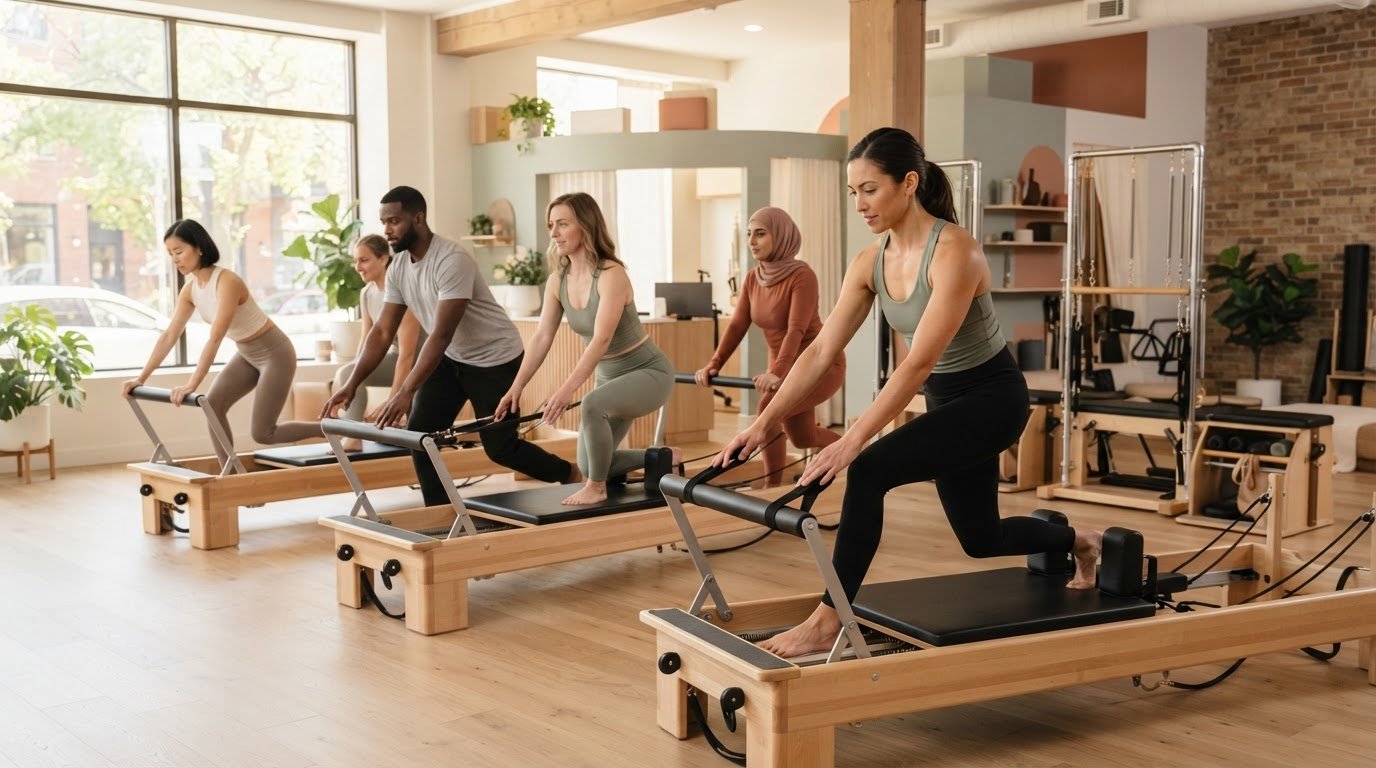
What if the transition is part of the movement, not a pause between exercises? Seamless transitions between reformer moves start with planning what happens next, not just choosing the next exercise. When springs need changing, straps need adjusting, or clients need to reposition, a clear sequence can keep the class moving without rushing the setup.
Even a well-designed plan can feel less fluid in a live studio. Clients may be waiting while equipment is adjusted, and transition cues can compete with demonstrations or hands-on support. That friction doesn't necessarily mean the sequence is wrong. It may mean the transition needs the same attention as the movement itself.
This guide shows you how to connect Reformer exercises with less equipment fumbling, clearer cueing, and a steadier class rhythm. You'll learn to anticipate spring and position changes, orient clients before they move, and spend less time searching for the next instruction. We'll cover practical sequencing choices, concise transition cues, and how planning tools such as ReformerFlow by Ginty can help you review exercise and spring details before class.
Key Takeaways
- Plan the bridge between exercises, including the movement, equipment handling, and cues clients will need.
- Decide whether to retain the setup, change it, or pause based on the next exercise and what clients need to do.
- Map upcoming setup changes and rehearse concise cues to make seamless transitions between reformer moves easier to teach.
- Use a repeatable pre-class check to anticipate client actions and equipment adjustments at each transition.
- Explore ReformerFlow’s library of over 400 exercises, with video, level, and spring details, to support sequence planning.
Table of Contents
- Why seamless transitions between Reformer moves matter in a live class
- The mechanics of seamless transitions between Reformer moves
- Compare transition options: keep the setup, change the setup, or pause
- A practical method for planning transitions before class
- Use ReformerFlow to prepare a clearer class flow
Why seamless transitions between Reformer moves matter in a live class
A Reformer transition is the planned bridge from one exercise to the next. It involves more than changing movements. Clients may need to reposition their bodies, adjust the carriage or footbar, handle straps, or change springs while following your cues. Planning that bridge helps clients stay oriented and gives you a clearer view of where your attention is needed.
A seamless transition is a clear, prepared, class-appropriate bridge that helps clients move from one exercise to the next without unnecessary confusion or equipment handling. It doesn’t mean eliminating every pause. A purposeful moment to recover, understand an instruction, or prepare equipment can support the class. The aim is to distinguish that useful pause from time spent searching for the next step.
That distinction matters in a practice built around controlled movement and attention. The Pilates method provides context for the principles and equipment behind the exercises. In a live class, however, the instructor’s sequencing and cue timing shape how clients experience the shift from one movement to another.
What can interrupt the flow between Reformer exercises?
Small setup changes can create friction when they arrive without a clear plan. A spring adjustment, strap change, or shift in body position may be straightforward on its own. But if clients are also waiting to learn what comes next, they may not know whether to stay still, move, or attend to the equipment. Several instructions delivered at once can make that uncertainty worse.
Consider moving from an exercise where clients are lying down to one that requires them to sit and use the straps. If you haven’t clearly cued the next position and equipment action, clients may move at different times or look to you for repeated clarification. By contrast, a deliberate pause to explain the change, check readiness, or allow recovery has a purpose. Don’t rush it just to make the sequence appear continuous.
What should a smooth transition feel like for clients?
Clients should have a reasonable sense of what comes next and where to direct their attention. They may need to listen, reposition, or wait while you handle equipment. Concise cues can make those actions easier to follow. Calm instruction matters more than speed. A smooth transition gives people enough time to understand and prepare.
That sense of continuity depends on choices made before class: whether the next exercise suits the group, what setup it requires, and when to give each cue. These are the practical foundations of seamless transitions between reformer moves. When you consider them in advance, you can spend less attention reconstructing the plan and more attention observing clients and responding to the room.
The mechanics of seamless transitions between reformer moves
A transition is easier to teach when you plan backward from the next exercise. Check the position clients need to reach, the carriage and footbar arrangement, whether straps are involved, and the spring setup. Then consider how the current exercise can finish in a position that makes the next step clear. This doesn’t mean forcing every movement into a continuous sequence. It means spotting useful connections before class.
Transition readiness depends on aligning movement, equipment, and instruction, not on speed alone. Clients may be ready to reposition while the equipment still needs attention, or the setup may be prepared while they need another cue. Considering these elements together helps you decide what to explain, what to handle, and when to pause.
Use the final phase of one exercise to prepare for the next
Use the closing moments of an exercise to orient clients when their focus allows it. For example, if the next movement involves changing position, preview that action before the current exercise ends. Give the specific instruction once clients are settled. Keep the current movement’s essential cues clear, and avoid layering several setup directions over a demanding final repetition.
The best connection depends on the exercises, the group, and your teaching judgment. A position that naturally leads into the next setup in one sequence may not suit another. Treat the final phase as an opportunity to prepare, not a rule that every exercise must flow directly into the next.
Plan equipment changes without losing client awareness
Before class, identify the changes between exercises: springs, straps, footbar, carriage position, or client orientation. Decide who can manage each action and whether you need to supervise or assist. The answer can vary with the exercise and the clients in front of you. If your attention needs to stay on client positioning, pause the sequence and make the equipment change deliberately.
Keep directions short and ordered. First orient clients, then cue the next action, then address the setup they need. If several changes are required, separate them into clear steps rather than giving the whole list at once. This helps clients know where to focus while you stay aware of the room. Don’t trade clear supervision for a faster-looking transition.
Reviewing each exercise’s setup before class can help you anticipate equipment changes. ReformerFlow includes a library of over 400 exercises with video, level, and spring details, personalized to the instructor’s Reformer machine. Use it to support your planning, while your judgment guides what fits the class. You can explore the ReformerFlow app to review exercise and setup details before teaching.
Compare transition options: keep the setup, change the setup, or pause
There isn’t one transition style that suits every sequence. Ask whether the current setup supports the next exercise and whether clients can follow the change while you keep your attention where it’s needed. Use this comparison to choose deliberately. Fewer equipment adjustments are not automatically better.
OptionEquipment handlingClient orientationTeaching attentionSuitable whenKeep the setupLittle or no adjustment is needed.Clients can move into the next position with a clear cue.You can stay focused on observing and directing the group.The existing settings and positions suit the next exercise and class objective.Change the setupSprings, straps, footbar, or body positions need adjustment.Clients need a specific order of actions or a brief explanation.Your focus may shift to coordinating or supervising the change.The next exercise calls for a different setup that’s appropriate for the group.Use a deliberate pauseEquipment handling can happen after clients settle or as directed.There’s time to clarify, reset, or confirm readiness.You can give the change your attention instead of cueing movement at the same time.Clients need recovery, time to understand, or closer supervision during the transition.
When can exercises connect with minimal equipment changes?
Retaining the setup can work when the current carriage, footbar, straps, and spring arrangement already suit the next movement. Check the whole connection, not just the equipment: does the next position make sense for these clients, and does it support the class objective? If so, prepare a short cue before the preceding exercise ends. Clients can move with continuity without being hurried or asked to guess what comes next.
When is a setup change or intentional pause the better choice?
Choose a setup change when the next exercise requires different equipment or body positioning. Choose a pause when clients need time to understand instructions, recover, or attend to the adjustment. For example, a strap change may be simpler to explain once clients are settled and looking toward you. Make the order of actions clear, and keep supervision in view. A continuous sequence isn’t worthwhile if it divides your attention when clients need guidance.
For seamless transitions between reformer moves, judge the option by clarity and suitability, not by how little time it appears to take. Sometimes the most fluid choice is to keep moving. Sometimes it’s to stop, explain, and reset before continuing.
A practical method for planning transitions before class
Give each transition a quick planning pass while you build the class. Identify the next exercise, map the setup it requires, then rehearse the cue that will guide clients into it. This helps you spot gaps before teaching, when you still have time to adjust the order or prepare a clearer option.
Map each transition while building the class sequence
Write the next exercise beside the current one. Note its starting position and any changes involving springs, straps, footbar, carriage, or client orientation. Add who is likely to handle each change and where you’ll need to be to observe the group. For broader guidance on organizing the class as a whole, see this Reformer sequencing guide.
Then mentally run the transition at a realistic pace. Include the time clients may need to understand, reposition, or complete a setup, along with the time you need to check in and observe. The purpose isn’t to script every second. It’s to notice where clients might be unsure or where you could be pulled between demonstrating, assisting, and monitoring.
Prepare concise cues and adaptable options
Draft one clear first cue that names the next action. For example, tell clients where to orient or what position to take before adding another detail. If someone needs more time or support, have an appropriate alternative ready, such as holding the current position while you clarify the next step. Adapt the plan to the clients in front of you. Don’t let the aim of continuity override your judgment about where closer attention is needed.
Check spring requirements as part of the setup map, and confirm that the details match your specific Reformer and teaching approach. For a focused reference, consult the Reformer spring setup reference. A pre-class run-through can’t account for every variation in the room, but it can help you recognize when to proceed, modify, or pause.
This preparation makes seamless transitions between reformer moves less dependent on memory in the moment. Keep the plan visible in whatever format works for you, and treat it as support for observation, not a substitute for responding to clients.
Explore the ReformerFlow app## Use ReformerFlow to prepare a clearer class flow
A prepared sequence helps you look beyond the exercise list. Before class, check what each movement asks clients to do and what the following exercise will require. That makes it easier to spot a spring or position change in advance, decide where a pause belongs, and enter the room with a plan you can adapt. ReformerFlow supports this preparation with a curated library of over 400 exercises, each with video, level, and spring details.
Keep exercise and spring details in view during preparation
Review the next exercise while planning its connection to the one before it. Use the exercise information to consider the starting position, equipment setup, and cue you’ll need to introduce the change. Spring configurations are personalized to your Reformer machine, helping you review setup details in the context of the equipment you teach on.
The sequence is still yours to shape. Exercise level and setup information can support planning, but they don’t determine whether a movement is right for a particular group or individual. Use your professional judgment to select, modify, or replace exercises, and allow for a different transition if clients need more time or support. The goal is preparation, not a fixed script.
Make the plan easier to reference while teaching
During class, ReformerFlow’s glanceable teaching mode is designed to support live instruction. A quick reference to the prepared sequence can help you recall what comes next without searching through separate notes. That can leave more attention available for observing clients, giving cues, and responding to the room.
Use the plan as a prompt, not an autopilot. The class may unfold differently than expected, and your decisions should reflect what you see in front of you. With the sequence and setup details prepared, you can make those adjustments from a clearer starting point. That’s the practical role of a planning app in supporting seamless transitions between reformer moves: it can help you anticipate the next step, while you remain responsible for how and when the class moves forward.
Explore ReformerFlow with a 14-day free trial## Bring more intention to your next class
Strong transitions aren’t about keeping clients moving at all costs. They come from choosing whether to retain the setup, change it, or pause, then making the next step clear. A brief pre-class review can help you anticipate equipment handling and prepare cues while leaving room to adapt to the group.
For seamless transitions between reformer moves, let preparation support your teaching, not replace your judgment. ReformerFlow offers a curated library of over 400 exercises with video, level, and spring details, including spring configurations personalized to your Reformer machine. Its glanceable teaching mode can help you reference your plan during live instruction.
Explore ReformerFlow with a 14-day free trialStart with one transition you’d like to make clearer. A little preparation can help you teach the next class with greater focus and a steadier rhythm.
Frequently Asked Questions
What makes a Reformer Pilates transition seamless?
A seamless transition gives clients a clear next action and enough time to make any necessary movement or equipment change. It doesn’t require removing every pause. Before class, consider how the current exercise ends, where clients need to go next, and what setup needs attention. In practice, seamless transitions between reformer moves depend on clear direction, suitable pacing, and active supervision, not on keeping the sequence moving at all costs.
How do you transition between Reformer exercises without losing momentum?
Plan the next position and equipment needs while you build the sequence. If it suits the exercise, preview a simple action before the current movement ends, then give any detailed setup cue once clients can focus on it. Account for spring, strap, or footbar changes, and allow time for clients to complete them. A short, intentional pause can preserve momentum better than rushed directions or uncertainty about what comes next.
Should Reformer instructors change springs during a transition?
Change springs when the next exercise and your teaching judgment call for a different setup. Some exercise pairings may use the same configuration; others won’t. Identify the requirement before class and consider whether clients can make the adjustment themselves or need your attention. Keep clients oriented while the setup changes. Don’t retain a spring setting just to avoid a pause or make the sequence look continuous.
How can I cue a transition clearly in a Reformer class?
Give one actionable instruction at a time. Tell clients what to do next, where to position themselves, and whether the equipment needs attention. For example, cue a change in body position first, then explain a strap adjustment once clients are settled. Avoid adding setup directions over a movement that already demands focus. If the next step is unfamiliar, use a suitable pause to explain it and check readiness.
Can Reformer exercises flow without changing the springs?
Yes, if the existing spring setup suits both the next exercise and the clients performing it. Check each exercise’s requirements rather than designing the sequence around avoiding adjustments. If a change is needed, plan when and how to communicate it. A clear cue and enough time can make the adjustment feel organized. Continuity is useful, but it shouldn’t take priority over an appropriate setup.
How can instructors plan transitions for clients with different needs?
Allow for differences in how quickly clients understand a cue, reposition, or manage equipment. Before class, consider where someone might need extra explanation, time, or an appropriate alternative. During the transition, observe the group and adjust your pacing rather than expecting everyone to move together. Planning helps you anticipate options, but it doesn’t replace your professional judgment or direct supervision of clients.
Can an app help plan transitions between Reformer moves?
A planning app can help you organize exercises and review setup details before class. ReformerFlow includes a curated library of over 400 exercises with video, level, and spring information, including spring configurations personalized to your Reformer machine. Its glanceable teaching mode is designed to support live instruction. These tools can help you prepare and reference a sequence, while you remain responsible for selecting exercises and guiding clients.