
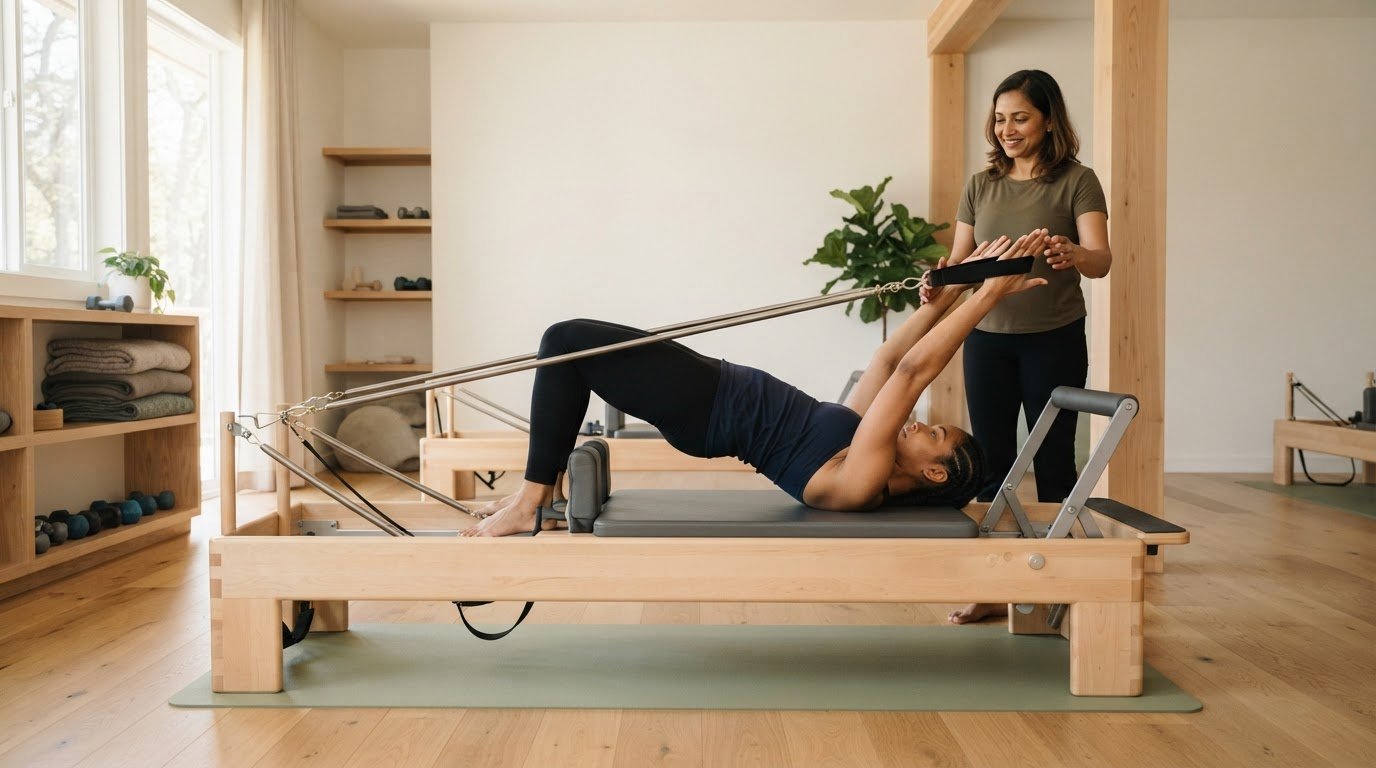
What if better posture came from having more ways to move, rather than holding one “perfect” position? Reformer exercises for better posture can help instructors plan opportunities to practise strength, mobility, and body awareness for everyday movement. The aim isn’t to pin the shoulders back or correct every curve. It’s to help participants move with control and ease.
Choosing the right movements takes more than scanning an exercise list. Instructors need to know what each exercise asks participants to do, how to cue it, and how to adapt it for different experience levels. Spring choices add another consideration, especially when Reformer setups vary. A purposeful plan makes these decisions easier to manage.
This guide explains how to select and teach posture-focused Reformer work without treating posture as a single fix. You’ll find movement goals, exercise options, and practical ways to adapt and sequence a class. The result is a more considered approach to helping participants explore comfortable, controlled movement on and off the carriage.
Key Takeaways
- Choose reformer exercises for better posture by the movement goal they serve, not by a promise to “correct” one body part.
- Combine trunk control, upper-back strength, hip mobility, and breath awareness for a balanced session.
- Use familiar movements such as footwork, bridging, arm work, and controlled quadruped variations with a clear teaching focus.
- Begin with supported, controlled work and progress toward greater coordination only when participants can manage the current task.
- Record each exercise’s purpose, level, order, and machine setup to make the class plan easier to teach and adapt.
Table of Contents
- How Can Reformer Exercises Support Better Posture?
- Which Reformer Movement Goals Matter Most for Posture?
- Which Reformer Exercises Can You Choose for a Posture-Focused Session?
- How Do You Adapt and Sequence Reformer Exercises Safely?
- How Can Instructors Turn Posture Goals Into a Reformer Class Plan?
How Can Reformer Exercises Support Better Posture?
A workday at a screen, a commute, or long stretches in one position can leave someone wanting to feel more supported when they stand and move. That doesn’t mean their body has failed to maintain a correct shape. Reformer exercises for better posture give participants a structured way to practise strength, mobility, and awareness, so they can explore more options for moving.
Posture changes throughout the day. Sitting, reaching, walking, lifting, and resting each involve different positions shaped by the task and individual comfort. Pilates draws on principles including controlled movement and core strength, as outlined in this overview of Pilates. On a Reformer, springs provide resistance as the carriage moves or the straps are guided. That resistance gives participants a task to coordinate and control, while instructors can observe how the movement is managed.
Posture practice builds the capacity to move and rest in comfortable, responsive positions; it doesn’t mean holding one rigid alignment. Exercise can support movement capacity and body awareness. It isn’t a way to diagnose or correct a medical condition, and visible posture alone doesn’t measure someone’s health or fitness.
What does better posture mean in a Pilates context?
Think of alignment as adaptable, not universal. A comfortable position for one person or task may not suit another. In a Pilates context, better posture can mean noticing how you’re positioned, changing position when needed, and moving with control rather than bracing to maintain one shape. The focus is how the body responds, not whether it matches a visual ideal.
That shift matters in everyday life. Instead of cueing someone to keep their shoulders back all day, an instructor might help them practise reaching and returning without rushing or losing control. This gives the participant options: they can adjust position, distribute effort differently, and find a level of support that feels manageable for the task.
Why use a Reformer for posture-focused practice?
The Reformer gives instructors ways to vary support and resistance. Springs affect how much resistance a movement meets, while the moving carriage gives participants a clear task to control. Straps add a different challenge for the arms or legs. These features don’t make an exercise automatically suitable for everyone. The machine setup, movement, and participant’s ability all affect how it feels.
For example, a controlled movement against spring resistance can give a participant a chance to coordinate their trunk and limbs while maintaining steady breathing. If the carriage moves too quickly or the participant strains to manage the task, pause, simplify the movement, or adjust the setup. The goal isn’t to choose the strongest spring or the largest range. It’s to find a workable challenge that supports clear, controlled movement.
These principles make posture-focused Reformer work more purposeful than searching for one corrective exercise. The next step is to define the movement goals, then choose exercises that give participants a chance to practise them.
Which Reformer Movement Goals Matter Most for Posture?
A posture-focused session is more useful when it develops several movement skills rather than targeting one “problem” area. The trunk, upper back, hips, and breathing all contribute to how someone organizes movement, but no single muscle group holds posture on its own. Choose goals based on what the participant can practise comfortably and with control.
- Trunk control: Practise coordinating the torso with arm and leg movement through a manageable range.
- Upper-back strength: Use pulling patterns to work the muscles that move and support the shoulder blades.
- Hip mobility: Explore comfortable hip movement so the pelvis and legs can contribute to everyday tasks.
- Breath awareness: Encourage steady breathing during effort rather than breath-holding or unnecessary tension.
These aims can overlap. A leg movement may challenge trunk control, while an arm pull may involve both upper-back strength and breathing. Identify the main intention for each exercise, then choose a cue that helps participants understand what to notice.
Build trunk control without bracing
Use a controlled carriage movement to practise coordinating the trunk with the limbs. Invite the participant to breathe steadily and move through a range they can manage. If they grip, hold their breath, or lose control of the carriage, reduce the range or choose a less demanding variation. The goal is responsive support, not a rigid torso.
Pair upper-body strength with mobility
Arm-strap pulls can invite upper-back effort and shoulder-blade control. Pair that strength focus with comfortable chest opening or gentle movement through the upper back, without promising to reverse a rounded shape. Choose a range and resistance that suit the participant’s experience and comfort. If their shoulders tense or the movement feels forced, simplify the pattern.
Apply the same care to hip mobility. A supported leg movement might explore bending and extending at the hip while the pelvis stays comfortable, rather than asking for the maximum range. Breath awareness can accompany any of these choices: invite an easy inhale and exhale through the movement, then adjust the pace if breathing becomes strained. The scientific research on Pilates benefits offers broader context on how Pilates has been studied, but it doesn’t make one exercise suitable for every person.
Balanced movement goals are more useful than a corrective-exercise checklist: they give instructors several ways to support controlled, comfortable movement. For a class, select a primary aim and one complementary aim. Observe how participants respond before adding complexity. Instructors can use ReformerFlow’s exercise library to explore movement options and plan around those goals.
Which Reformer Exercises Can You Choose for a Posture-Focused Session?
Choose exercises for the skill they let a participant practise, not because a movement is labelled a posture fix. The options below can contribute to trunk control, hip movement, or upper-body coordination. They aren’t a prescribed routine and won’t guarantee a particular posture change. Exercise names and exact setups can vary by Reformer model and teaching method.
Spring choice is part of the teaching decision. Consider whether the springs should provide support, create a manageable resistance challenge, or help the participant control the carriage. There’s no universal spring prescription: machine design, setup, movement goal, and individual ability all affect how an exercise feels. Follow the machine’s setup guidance and adapt the movement to the person in front of you.
Choose exercises for trunk and hip control
Footwork offers a supported way to practise moving the legs while maintaining comfortable organization through the trunk and pelvis. Bridging can explore hip extension, with the height and range kept within the participant’s comfort and control. Neither exercise is essential for every session. Modify or omit a movement if it doesn’t suit the person’s needs or their response to the exercise.
Choose exercises for the shoulders and upper back
Arm-strap work, including chest-expansion or other pulling patterns, can invite controlled coordination between the arms, shoulder blades, and trunk. Treat these as options, not mandatory fixes for shoulder position. Cue a relaxed neck, smooth breathing, and a range the participant can control. If they strain or lose coordination, reduce the challenge or choose a different pattern.
Exercise optionPrimary movement goalTeaching considerationFootworkSupported leg movement and trunk organizationObserve whether the participant can move smoothly without forcing the knees or pelvis into a fixed position.BridgingHip extension and coordinationUse a comfortable lift; reduce the range if the movement feels strained or difficult to control.Arm-strap pullsUpper-back strength and arm-trunk coordinationKeep the neck relaxed and the movement controlled rather than pulling through momentum.Controlled quadruped variationsTrunk stability during limb movementBegin with a manageable variation and watch for changes in breathing or control.
Use the table as a planning menu, not a checklist. A class might begin with footwork to explore supported leg movement, then move to an arm-strap pattern for upper-body coordination. A quadruped variation could suit participants who are ready to manage more coordination; for others, choose a different option. Reassess as you teach. If control changes, adjust the range, position, or exercise.
For instructors, a curated Reformer exercise library makes it easier to compare movement options and review setup details while planning. Let the session goal guide the selection, then tailor the exercise to the machine and participant.
How Do You Adapt and Sequence Reformer Exercises Safely?
A thoughtful sequence starts with the person, not a fixed list of exercises. Before selecting reformer exercises for better posture, identify the session’s movement goal, consider the participant’s experience and comfort, and choose a suitable starting point. Observe how they respond, adjust the movement or setup, then reassess before progressing.
Set up movement choices around the participant
Readiness includes more than familiarity with an exercise. Notice whether the participant can follow the instructions, control the movement, and breathe comfortably. Springs affect both assistance and resistance, and their effect depends on the machine and exercise. Follow the Reformer’s setup guidance rather than assuming one setting suits everyone. For machine-specific considerations, consult this Reformer Pilates machine spring setup guide.
Start with a supported, controlled version. If the participant maintains control and comfort, add a coordination demand, such as combining an arm movement with steady carriage control. If they struggle, scale back. You can:
- Reduce the movement range so the participant can stay in control.
- Change leverage by adjusting the limb position or simplifying the movement pattern.
- Choose a different exercise that serves the same session goal with a more manageable demand.
Ask how the movement feels, and watch for changes in breathing, control, or comfort. If an exercise causes pain, stop it or modify the movement. Don’t try to diagnose the cause or prescribe treatment. Choose a more comfortable option, and keep the session within your teaching scope.
Build a balanced sequence, not a posture-only circuit
Arrange exercises to vary the movement demands across the session. For example, pair supported leg work with a trunk-control exercise, then include an upper-body pattern. This creates a broader focus than repeating one type of movement. The exact choices depend on the class objective and participant readiness.
Transitions are part of the plan. Allow time to change body position, adjust the springs, and explain the next task. A deliberate transition helps participants shift attention instead of rushing into a new setup. Progress to more demanding coordination only when the current movement remains controlled and comfortable. Otherwise, repeat it, simplify it, or choose another option. For broader class-flow principles, see the Reformer class sequencing guide.
For instructors, recording the goal, exercise order, level, and machine-specific spring details makes a plan easier to follow and adapt during class. ReformerFlow’s library includes exercise videos, levels, and spring details personalized to the instructor’s Reformer, supporting more considered planning.
Use ReformerFlow to plan your next Reformer class, with exercise videos, levels, and machine-specific spring details available as you prepare.
How Can Instructors Turn Posture Goals Into a Reformer Class Plan?
A useful class plan turns broad goals into teachable choices. Rather than collecting exercises under a “posture” label, decide what participants will practise, then choose movements with complementary purposes. For example, a session might focus on trunk control while including an upper-body movement and an opportunity to explore comfortable hip mobility. The plan should offer structure without locking you into one sequence regardless of who is in the room.
Turn exercise choices into a teachable plan
Start with the class objective, then arrange exercises so each has a clear role. Record the purpose, level, order, and relevant setup details. Add a simpler option or an alternative movement where useful. This lets you respond to participants’ comfort and control without losing the session’s focus. For broader programming principles, see this Reformer Pilates class design guide.
A concise plan might note:
- Objective: Practise controlled movement with steady breathing.
- Exercise purpose and level: Specify what each choice asks participants to do and who it suits.
- Order and transitions: Plan how movements relate and when the machine setup changes.
- Setup and alternatives: Record machine-specific spring details and a suitable option if the original choice doesn’t work for someone.
These notes keep the plan actionable. They also help you distinguish the intended challenge from the exercise name. If a participant needs a different range or movement, you can preserve the goal while adapting the choice. That’s especially useful for reformer exercises for better posture, where a varied, purposeful plan is more practical than a fixed corrective circuit.
Keep exercise references accessible while teaching
ReformerFlow is a planning tool for instructors, not a posture treatment. Its curated library of over 400 Reformer exercises includes videos, levels, and machine-specific spring details, helping you review options and prepare setup notes. During class, glanceable teaching mode provides an in-class reference. The app supports your plan while your observation and instruction guide how you adapt it.
A well-organized exercise reference can make it easier to move from an idea to a teachable sequence. ReformerFlow lets instructors build a class in about five minutes, then use the plan as a practical guide rather than a script. Keep the central question clear: what do you want participants to practise, and which options will help you teach that intention responsively?
Explore ReformerFlow and start your 14-day free trial. The app is free to download and available on iPhone, iPad, and Android.
Carry One Clear Intention Into Your Next Class
Your next step doesn’t need to be a complete program overhaul. Choose one teaching intention for an upcoming class, then consider how reformer exercises for better posture can support it without turning alignment into a fixed standard. Notice which cues help participants move with greater comfort and control, and stay ready to adjust your plan to the people in the room.
That deliberate cycle of planning, observing, and refining can make your teaching more responsive. ReformerFlow gives instructors a focused space to organize class ideas and explore exercise options as they shape their approach.
Build each class with intention, stay curious about how movement feels, and let your teaching evolve one considered choice at a time.
Frequently Asked Questions
Is the Reformer good for improving posture?
Yes, the Reformer can support posture-related movement by giving participants opportunities to practise strength, mobility, coordination, and body awareness under adjustable resistance. This can help them practise moving with control, but reformer exercises for better posture won’t produce the same result for everyone. Think of posture as changing with tasks, such as reaching for a shelf or sitting at a desk, rather than a shape to hold. Practice doesn’t guarantee a particular outcome or treat pain.
What Reformer exercises are best for posture?
There isn’t one best Reformer exercise. Choose according to what you want the participant to practise. Footwork can explore leg movement with support, bridging can develop coordination through hip extension, and arm-strap pulls or chest-expansion patterns can focus on upper-body control. For someone new to straps, begin with a simple arm path and observe for neck tension. Machine design, teaching approach, and individual comfort all shape the setup and variation.
Can Pilates Reformer exercises fix rounded shoulders?
Reformer work offers ways to practise upper-body strength, mobility, and awareness, but it can’t promise to permanently fix rounded shoulders. Shoulder position varies with the person, the task, and how they feel, so a visual change isn’t the only useful measure. A participant might explore a comfortable arm reach or pull without forcing the chest upward. If shoulder symptoms or concerns call for individualized assessment, appropriate professional guidance can help determine a suitable approach.
How often should you do Reformer Pilates for better posture?
There isn’t a universal weekly schedule or guaranteed timeline for posture-related changes. A sustainable frequency depends on your Reformer experience, goals, recovery, and other movement or training. Choose a routine you can maintain, then notice whether you feel ready for the next session and adjust accordingly. Regular, well-taught practice is more useful than chasing a rigid target. If your circumstances change, adapt the routine rather than treating consistency as an all-or-nothing test.
Are Reformer exercises safe for beginners?
Beginners can practise Reformer exercises when the movements, instruction, and setup suit their experience. Start with a familiar position and a range you can control. Ask the instructor to explain how the carriage or straps should move before adding complexity. Reformers and spring systems differ, so there isn’t one setting for everyone. Modify or stop an exercise if it causes pain or feels uncontrolled. Not every movement suits every body.
Do you need a Reformer instructor to do posture exercises?
An instructor can be especially helpful when you’re learning to use the machine, manage the carriage, and coordinate movement with the straps. Clear guidance can also help you understand why an exercise was selected and what to notice as you practise. For instructors, written exercise references and setup notes can support class preparation. They’re planning aids, not substitutes for professional judgment or attention to the people in class.
How do you choose spring settings for posture-focused Reformer exercises?
Choose springs according to the specific Reformer, exercise, participant, and intended challenge. No setting works for everyone. The same spring can feel different across machines or movement patterns. Follow the machine’s setup guidance and use your professional judgment, then observe whether the participant can control the carriage and breathe comfortably. If movement becomes jerky or effort overwhelms coordination, pause and reconsider the setup or choose a more manageable option.