
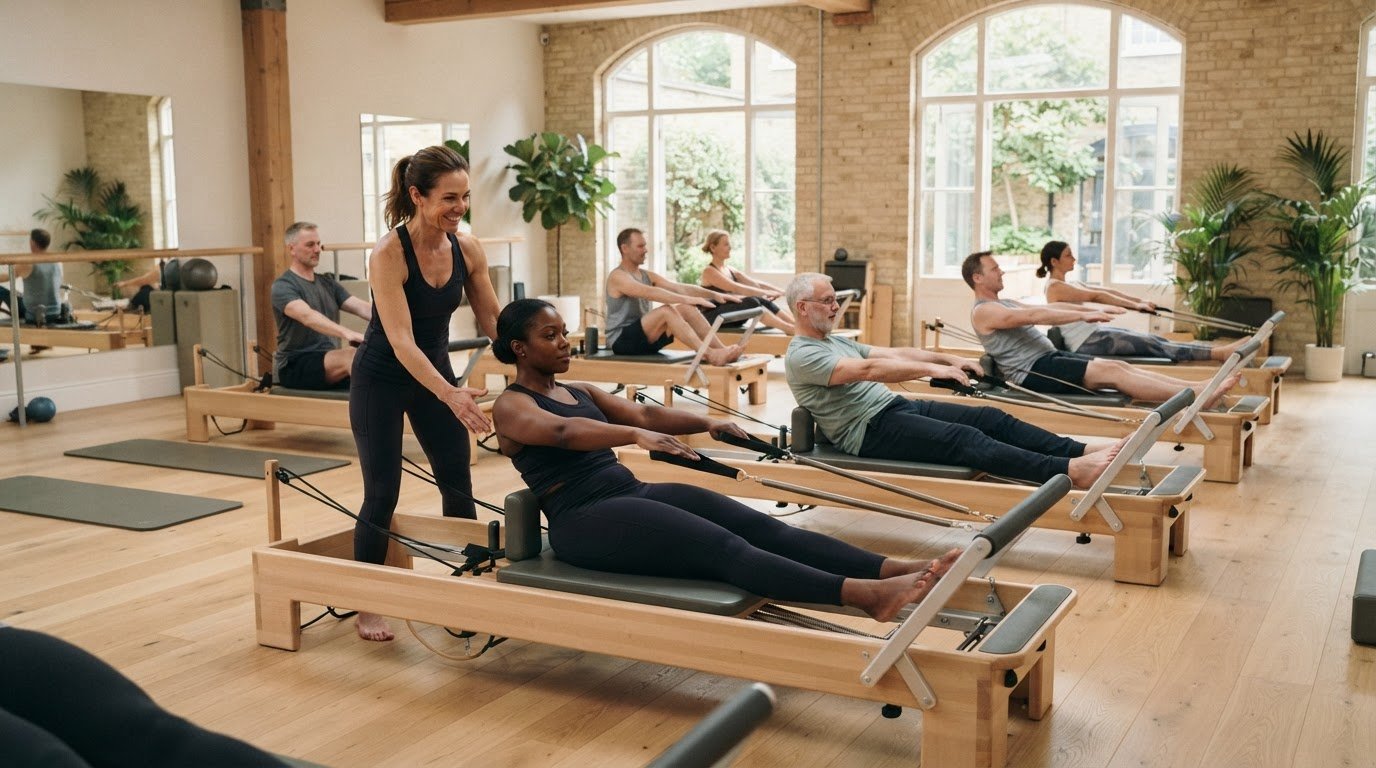
What makes a Reformer class flow well often has less to do with finding the perfect exercise list and more to do with the decisions between exercises. Strong pilates class sequencing tips start with that shift: flow comes from purposeful choices, not a fixed formula.
It’s easy to fall into familiar exercise orders or spend too long planning each class. An abrupt position change or spring adjustment can interrupt the pace, and a sequence that works for one group may not suit the next. A clear structure helps, but it needs room to adapt.
This guide will help you build classes with a deliberate beginning, progressive main section, and considered finish. You’ll learn how to group movements, plan transitions and spring changes, and adjust the sequence to meet clients’ needs while staying present as you teach.
A planning aid can also reduce prep time. ReformerFlow offers a library of over 400 exercises with video, level, and spring-setup details, so you can organize a plan around your specific Reformer. The goal isn’t to follow a list by rote. It’s to make confident choices that keep the class coherent and responsive.
Key Takeaways
- Use pilates class sequencing tips to connect exercise choices to the experience you want clients to have, rather than relying on a familiar routine.
- Build progression by adjusting coordination, range, load, and complexity, while varying movement patterns and positions.
- Assess each transition for setup demands, equipment changes, and the cues clients need to move into the next exercise.
- Before class, review your intention, progression, variety, transitions, spring changes, and possible adaptations to make the plan teachable and responsive.
- Use a planning tool to organize options, then apply your judgment to adapt the sequence to the clients in front of you.
Table of Contents
- Pilates class sequencing tips: start with the experience you want to create
- Use progression and balance to make Reformer Pilates sequences feel coherent
- Choose exercise transitions that preserve momentum without rushing
- Apply these Pilates class sequencing tips with a pre-class review
- Use ReformerFlow to prepare a sequence while keeping your teaching judgment central
Pilates class sequencing tips: start with the experience you want to create
A strong Reformer class plan is more than a list of familiar exercises. Sequencing is the deliberate order and connection of movements to serve a class intention. Each choice shapes what clients do next, how the work develops, and how much time you need for transitions and instruction.
The Pilates method provides a broad foundation, but a useful sequence must also fit the group in front of you. Consider clients’ experience, stated needs, and relevant modifications, along with the equipment setup and class length. The same exercise may be a useful progression for one group and an unnecessary complication for another. These pilates class sequencing tips can help organize your thinking, but they don’t replace instructor judgment or client-specific assessment.
Set a clear intention before choosing exercises
Start by naming the main experience you want to create. A class might emphasize mobility, strength, coordination, or balanced movement. Then consider who’s attending and what adjustments may be appropriate. This context narrows your options and gives each exercise a reason to be there. Choose movements that support the intention before reaching for something novel just to make the plan feel different.
Keep the intention practical. If the focus is coordination, for example, select work that asks clients to attend to control and the order of movement. Then consider how the preceding exercise prepares them for it. The exact choices depend on your clients and professional assessment; the planning principle is to make the connection clear.
Build a class arc without relying on a rigid template
A class arc gives you direction without prescribing one universal order. Begin with preparation that helps clients orient to the work. Progress toward more demanding exercises as appropriate for the group, then close with a considered finish that brings the session to a clear end. What counts as “more demanding” can vary, so consider coordination, range, load, and complexity rather than assuming every class should follow the same progression.
Purposeful Reformer sequencing is the intentional progression and connection of exercises toward a class goal, shaped by the clients, equipment, and time available.
Use that arc as a decision-making tool, not a script. A planned order may need to change if a setup takes longer than expected or clients need a different option. Keeping the intention in view helps you adapt without losing the thread of the class. The aim isn’t to make every session look alike. It’s to make each exercise choice and transition feel considered.
Use progression and balance to make Reformer Pilates sequences feel coherent
A coherent sequence builds challenge with purpose. Instead of jumping from a familiar movement to the most complex variation you know, consider what changes the demand: coordination, range, load, or complexity. Where appropriate, progress one major factor at a time. For example, keep the movement pattern familiar while increasing the range, then add a coordination challenge when clients are ready.
Progress challenge in manageable steps
Begin with accessible preparation, then build toward more demanding work in response to what you observe. If clients can follow the setup, maintain control, and respond to cues, you may have room to progress. If they’re losing the movement’s organization, struggling to follow instructions, or showing that the current option isn’t working for them, pause and simplify. A smaller range, less coordination, or a more supported variation can restore clarity without abandoning the class intention.
Challenge also needs contrast. Plan moments to reset, breathe, or return to a more familiar movement before the next demanding passage. These pauses aren’t wasted time. They give clients a chance to reorient and keep effort from becoming a continuous climb.
Balance movement patterns and class demands
Review the full plan for repeated positions, patterns, and dominant demands. A sequence may spend a long stretch in one position or repeatedly ask for the same kind of effort. Consider whether a change in position or focus would serve the class, while keeping transitions and the overall intention in view. Guidance on perfect class design also highlights the value of considering movement planes and transitions as part of class planning.
Balance is a check, not a quota. Every class doesn’t need identical coverage of every position or movement pattern. The aim is to notice where the plan concentrates effort and decide whether that emphasis is deliberate and appropriate for this group.
- Progress: Increase one key demand when clients show control and readiness.
- Regress: Simplify the range, coordination, or setup when movement quality or comprehension starts to slip.
- Review: Look for repeated patterns, then add variation or a reset when it supports the class goal.
These pilates class sequencing tips are guides, not fixed rules. If you want a practical way to compare exercise options and setup details as you plan, explore the ReformerFlow app and use your judgment to shape the sequence for your clients.
Choose exercise transitions that preserve momentum without rushing
A transition is part of the sequence, not empty space between exercises. It includes the change in body position, any spring or equipment adjustment, and the instructions clients need to move into the next task. A plan may look smooth on paper but feel disjointed if those practical steps take longer or require more attention than expected.
Assess what each transition asks of the group
Before finalizing the exercise order, trace each change from the clients’ perspective. Can they move from one position to another with the guidance you plan to give? Will they understand what to do next, and can they manage the spring or equipment setup? A change involving several steps may need a demonstration, a specific cue, or more time than a simple repositioning.
For example, placing two exercises with similar setups next to each other may reduce unnecessary adjustments. But don’t keep that order at all costs if clients would struggle to move between positions or understand the change. Flag transitions that need hands-on attention or clear group instructions, then decide whether they fit the pace and teaching focus of the class. For more practical ideas, see this guide to transitioning between Reformer exercises.
Keep class flow purposeful, not hurried
Preparation cues can reduce avoidable pauses. Before clients finish an exercise, give them a concise preview of the next position or setup, then allow time to act on it. If a spring change is coming, state the intended adjustment clearly and check that clients are ready before moving on. This keeps the class organized without asking people to rush through equipment handling or miss essential instructions.
A well-planned transition gives clients clear instructions and enough time to change position or setup before the next exercise begins.
That time also serves the instructor. Use it to observe how clients are managing, answer a question, or adjust the plan if the group needs a different option. A seamless transition isn’t necessarily fast. It feels connected because clients know what’s next and have room to get there.
- Check the sequence: Note every position, spring, or equipment change.
- Estimate the teaching demand: Identify where clients may need a demonstration or extra cue.
- Protect useful pauses: Leave space for setup, observation, and questions.
These pilates class sequencing tips help you plan momentum without treating speed as the goal. A considered transition supports the work and gives both you and your clients a clearer path into the next movement.
Apply these Pilates class sequencing tips with a pre-class review
A brief review can catch gaps that aren’t obvious while you’re building a sequence. Use this checklist to move from class intention to a plan you can consult without losing focus on the people in front of you.
Run a practical sequence check before class
- 1. Confirm the intention. Check that each exercise supports the session’s focus and suits the expected experience level of the group. Remove movements that are interesting but don’t serve the plan.
- 2. Review the progression. Look at how coordination, range, load, or complexity changes across the class. Make sure each increase feels considered, and identify where clients may need an easier option or a chance to reset.
- 3. Check movement variety. Scan for repeated positions or demands. Keep an emphasis if it’s intentional, but note where a change in focus could better serve the class.
- 4. Walk through transitions. Account for position changes, equipment handling, instructions, and the time clients need to get ready. Flag any transition that may require a demonstration or more support.
- 5. Verify spring configurations. Confirm the planned settings match the Reformer being used. If you need a refresher on spring considerations, consult this Reformer Pilates machine spring setup guide.
- 6. Plan likely adaptations. Identify exercises that may not suit every participant and choose an alternative or modification you can offer without derailing the class.
- 7. Make it teachable. Keep the final order, essential setup details, and key cues easy to scan. Then review the plan as a whole: does it support the intention, and can you teach it clearly?
Make the plan usable while you teach
A class plan should support your attention, not compete with it. Keep notes focused on information you may need at a glance, such as the next exercise, spring setup, or a cue that clarifies the movement. Avoid writing out every possible instruction. Too much detail can make the plan harder to use and pull your attention away from observing clients.
These pilates class sequencing tips turn preparation into a repeatable review while leaving room to adapt when the class unfolds differently than expected. The plan is a reference, not a script. Your observation and judgment remain central.
Explore ReformerFlow for your class planning## Use ReformerFlow to prepare a sequence while keeping your teaching judgment central
Planning tools can make preparation more organized, but they shouldn’t decide what your clients need. ReformerFlow is a mobile app for Reformer Pilates instructors. It helps you review exercise options and prepare a class plan, leaving the final decisions with you. The aim is to spend less time searching through ideas and keep more attention available for assessing the group and teaching.
Turn exercise ideas into a practical class plan
ReformerFlow includes a library of over 400 Reformer exercises, with video, level, and spring-setup details. Use those details to compare options during preparation: review a movement on video, consider its listed level, then assess whether it fits the class intention and progression. The library gives you material to work with, not a prescribed order. You decide which exercises belong in the sequence, what to modify, and what to leave out.
Spring information can also help you prepare for the specific Reformer you use. Instructors can personalize spring configurations to their machine, making the plan more relevant to their equipment. For a broader planning reference, see this Reformer Pilates class design guide.
Keep the plan accessible during live teaching
Preparation matters most when it supports your attention in the room. ReformerFlow’s glanceable teaching mode lets you consult your plan during live instruction, so you can check what’s next without treating the sequence as a script. Keep watching how clients move and respond. If the class needs a different option, your professional judgment takes priority over the written plan.
The app is available on iPhone, iPad, and Android. You can consult your prepared sequence on these devices while keeping the plan focused on Reformer classes. These pilates class sequencing tips work best when a planning aid reduces the administrative load but leaves room for responsive teaching.
Use ReformerFlow as a practical starting point: explore exercise options, review the setup details, and shape the order around your clients. A 14-day free trial gives you time to explore the app and see whether it fits your planning routine.
Try ReformerFlow free for 14 days## Build your next Reformer class with a clear plan
Strong pilates class sequencing tips come back to one principle: choose each exercise and transition with purpose, while staying ready to adapt. Start from the experience you want clients to have, build challenge in manageable steps, and review the plan for balance, setup demands, and alternatives before class.
A sequence should guide your teaching, not compete with it. ReformerFlow supports preparation with a curated library of over 400 Reformer exercises, including video, level, and spring-setup details. Personalize spring configurations to your Reformer, then consult your plan in glanceable teaching mode while keeping your attention on clients. The app is available on iPhone, iPad, and Android, with a 14-day free trial.
With a considered plan and room to respond, you can teach with greater clarity and let the class unfold one purposeful movement at a time.
Try ReformerFlow free for 14 days## Frequently Asked Questions
How do you sequence a Pilates class?
Start by defining the class intention, then choose exercises that support it and suit the clients attending. These pilates class sequencing tips offer a planning framework: begin with preparation, build toward appropriately challenging work, and finish with a considered close. Check that the order allows for clear transitions, manageable spring changes, and adaptations. The sequence should guide your teaching, not prevent you from responding to clients.
What makes a Reformer Pilates class flow well?
A Reformer class flows well when exercises connect logically and clients have enough time and information to move between them. Grouping exercises with similar positions or setups can reduce unnecessary changes, while clear preparation cues help clients know what comes next. Flow doesn’t mean moving quickly at every moment. Planned pauses for spring adjustments, questions, or observation can keep the class composed and attentive.
How many exercises should be in a Pilates class?
There isn’t one ideal number of exercises for every Pilates class. The right amount depends on class length, exercise complexity, repetitions, client experience, and the time needed for transitions and instruction. A shorter list of well-connected exercises may serve the class better than a longer sequence that feels rushed. Plan enough material to meet your intention, then leave room to modify or adjust the pace.
How do you make a Pilates class more challenging?
Increase challenge by adjusting a clear factor, such as range, load, coordination, or movement complexity, when clients appear ready. Where possible, change one major demand at a time so you can observe how the group responds. If clients maintain control and follow the cues, consider a progression. If movement quality or understanding becomes inconsistent, offer a simpler variation or a moment to reset.
How do you plan transitions between Reformer exercises?
Review each transition for position changes, spring adjustments, equipment handling, and the instructions clients will need. Consider whether the group can make the change with the guidance you provide and whether a demonstration or extra cue is needed. Give clients a preview before the current exercise ends when that helps them prepare. Allow time to set up, ask questions, and check readiness instead of treating speed as the measure of flow.
Should every Pilates class follow the same sequence?
No. A familiar class arc can help you plan, but the exercise order should reflect the session’s intention, the clients attending, and the available equipment and time. Keep useful structures, such as preparation, progression, and a finish, while changing exercise choices or transitions as needed. A fixed sequence may not suit every group. Use your assessment and teaching judgment to adapt the plan.
Can an app help me sequence a Reformer Pilates class?
Yes. A planning app can help you review exercises and organize a sequence, but it shouldn’t replace instructor judgment. ReformerFlow includes over 400 Reformer exercises with video, level, and spring-setup details. Instructors can personalize spring configurations to their specific Reformer and consult a plan in glanceable teaching mode. The app is available on iPhone, iPad, and Android, with a 14-day free trial.