
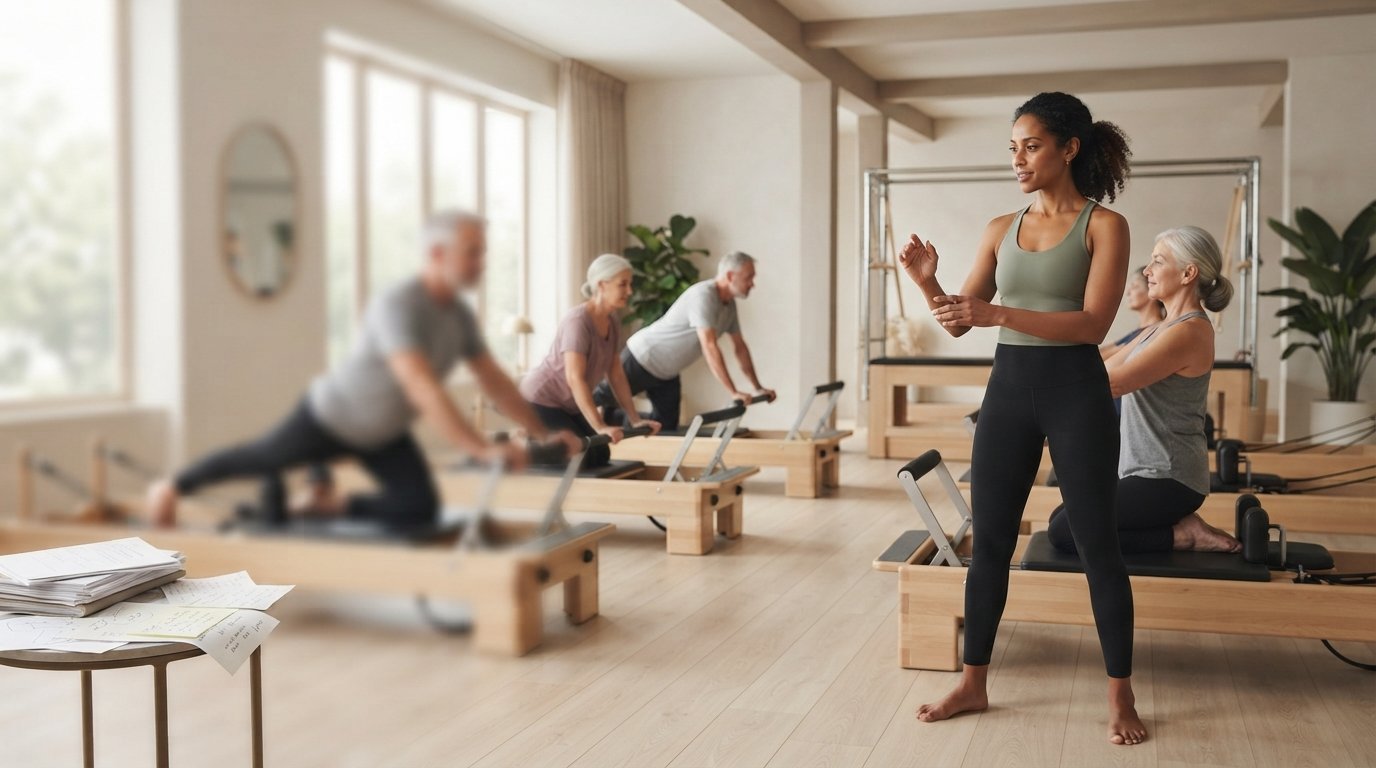
Imposter syndrome on the studio floor isn't a lack of anatomical knowledge; it is cognitive overload disguised as self-doubt. You know the quiet panic of scanning a full room of moving carriages, second-guessing spring choices in real time, or dreading a freeze during multi-level transitions. Spending hours drafting intricate paper notes only leaves you depleted before the session even starts. Overcoming pilates instructor imposter syndrome begins by recognizing that your anxiety isn't an issue of personal capability. It is the friction of an unsustainable, disjointed workflow.
In this guide, you'll learn practical, evidence-based systems to overcome self-doubt, streamline class preparation into minutes, and step into every Reformer session with grounded authority. You will discover how to deliver seamless spring cues, manage complex client modifications with poise, and replace social media comparison fatigue with authentic presence. Here is your roadmap to trading studio panic for clear, sustainable teaching confidence.
Key Takeaways
- Recognize that persistent teaching anxiety stems from cognitive overload and equipment variables, not a lack of anatomical competence.
- Practical strategies for overcoming pilates instructor imposter syndrome begin by identifying specific studio triggers, such as commercial spring variations and sudden client injury disclosures.
- Shifting from an entertainer mindset to a movement facilitator role removes performance pressure and centers client biomechanics over continuous monologues.
- Anchoring class design around clear movement objectives eliminates floor panic and replaces complex choreography with purposeful progressions.
- Streamlining class preparation into modular, glanceable systems protects your mental bandwidth so you can teach with calm, grounded presence.
Table of Contents
- Understanding Pilates Instructor Imposter Syndrome: Why Self-Doubt Strikes Good Teachers
- The 4 Studio Triggers That Fuel Imposter Feelings on the Reformer
- Reframing Your Mindset: Shifting from Performer to Movement Guide
- How to Build Unshakeable Teaching Confidence: A 5-Step System
- Transforming Your Workflow: The Sustainable Antidote to Imposter Syndrome
Understanding Pilates Instructor Imposter Syndrome: Why Self-Doubt Strikes Good Teachers
Instructor imposter syndrome is the persistent inability to internalize your professional competence, technical training, and movement expertise. Instead of attributing a smooth fifty-minute session to rigorous preparation, you credit luck. When an exercise falls flat, you treat it as proof of your inadequacy. While healthy clinical humility encourages ongoing education and careful spotting, imposter anxiety actively erodes your vocal delivery, disrupts class pacing, and drains your teaching presence.
Movement professionals are uniquely vulnerable to perceived fraudulence. You work in a high-empathy, detail-oriented discipline where you monitor alignment down to millimeter deviations. Studies examining the psychological concept of impostor syndrome show that high-achieving professionals prone to perfectionism struggle most with chronic self-doubt. Industry survey data reveals that up to 80% of Pilates teachers experience imposter phenomenon, questioning their biomechanical knowledge or feeling unwarranted anxiety over modifying around client injuries. True technical knowledge gaps are resolved through continuing education; imposter syndrome is an emotional tax fueled by the perceived pressure to perform entertaining choreography rather than guide biomechanics.
The Neurological Reality of Studio Floor Anxiety
Your studio floor anxiety is physiological, not personal weakness. Monitoring dynamic apparatus triggers acute sympathetic nervous system arousal. When you track eight to twelve moving carriages simultaneously, your brain processes an overwhelming volume of sensory inputs:
- Predicting carriage velocity and return deceleration on high spring loads.
- Assessing wrist, shoulder, and lumbo-pelvic alignment across multiple bodies.
- Anticipating verbal modifications for individual client restrictions before transitions.
Cognitive bandwidth shrinks rapidly under this sensory flood. The result is instant physical tension: shallow apical breathing, a tightened diaphragm, and a higher vocal pitch. This vocal constriction telegraphs hesitation to the room, reinforcing an internal sense of panic.
Common Internal Narratives That Sabotage New Instructors
Overcoming pilates instructor imposter syndrome requires dismantling three pervasive internal scripts that derail capable teachers:
The myth of the infallible veteran. Senior teachers do not possess flawless photographic memory. They forget planned cues and omit unilateral sets just like beginners. The difference lies in their reaction: seasoned instructors adapt without internalizing the lapse as a catastrophic failure.
Fear of the tenured client. New instructors often dread clients who have practiced on the apparatus for a decade. When a participant questions your spring setting, it is rarely an interrogation of your competence; it is simply physical habit. You guide the movement based on clear mechanical principles, not their comfort with legacy routines.
Social media comparison fatigue. Polished thirty-second video clips feature extreme acrobatic progressions under studio lighting. Real teaching centers on accessibility, foundational spinal articulation, and stability. You are a movement facilitator, not an acrobatic performer.
Recognizing these cognitive traps is the critical first step toward overcoming pilates instructor imposter syndrome. Once you shift your perspective from personal flaw to neurological load, you can rebuild your teaching practice on sustainable operational systems.
The 4 Studio Triggers That Fuel Imposter Feelings on the Reformer
Teaching dynamic apparatus involves a cognitive load that mat classes never demand. On the mat, gravity is uniform; on the Reformer, you manage dynamic resistance, moving carriages, and variable leverage. A single hesitation around spring resistance can derail your cadence, while managing class tempo alongside tactile adjustments leaves little room to think. Clinical research into overcoming the impostor phenomenon emphasizes that separating emotional inadequacy from environmental triggers is essential to reclaiming agency. In Pilates pedagogy, self-doubt rarely stems from poor knowledge; it stems from unmanaged operational friction.
Machine Variations and Spring Configuration Hesitation
Subbing at a new studio often triggers instant self-doubt. You walk into a room with unfamiliar equipment and suddenly second-guess your basic load recommendations. Balanced Body uses red, blue, and yellow springs, while Merrithew, Peak, and Gratz feature entirely different tension ratios, gearbar systems, and resistance curves. Calculating mechanical loads on the fly introduces micro-delays that rattle your delivery. Consulting a standardized Reformer Pilates machine spring setup guide eliminates this guesswork so you aren't running mental conversions while cueing.
Unscripted Class Interruptions and Regression Management
Few scenarios induce panic faster than an unannounced pathology. A client arrives two minutes before start time mentioning an acute lumbar disc herniation, a frozen shoulder, or cervical stenosis. If your planned class revolves around spinal flexion or overhead arm arcs, your entire plan evaporates. Without an immediate, structured modification hierarchy, you feel exposed. You scramble to invent safe variations on the fly, which saps your vocal authority. True teaching mastery relies on having pre-planned regressions ready for every movement block, not creative improvisation under pressure.
The Blank-Mind Phenomenon During Class Transitions
Transition paralysis is the classic imposter trigger. You wrap up supine footwork in straps and suddenly go completely blank on what comes next. Fumbling through handwritten notes on a clipboard breaks eye contact, halts the room's momentum, and invites awkward silence. The key to how to sequence a reformer pilates class lies in modular block design rather than memorizing long lists of unconnected choreography. When movements flow naturally from one anatomical position to the next, memory lapses disappear.
Overcoming pilates instructor imposter syndrome requires swapping paper scribbles for intuitive, glanceable tools. If you want to eliminate real-time transition dread entirely, testing a structured mobile planning system through a 14-day free trial can help keep your eyes focused on your clients rather than a forgotten notebook.
Reframing Your Mindset: Shifting from Performer to Movement Guide
Most teaching anxiety comes from an unspoken identity crisis. Many instructors treat the studio floor like a theater stage, believing they must perform non-stop, entertain the room, and possess encyclopedic recall under bright lights. This entertainer paradigm guarantees exhaustion. In contrast, the facilitator paradigm treats you as a calm movement guide. Clients do not pay for a charismatic monologue; they pay for physical awareness, joint decompression, and safe mechanical outcomes. Stepping off the internal stage immediately quiets the critical voice in your head.
Dismantling this pressure requires psychological detachment. When a student struggles with a cue, it is diagnostic data, not a referendum on your worth. The table below outlines how this mental shift transforms your daily teaching habits:
Teaching DimensionThe Entertainer ParadigmThe Master Facilitator ParadigmVocal DeliveryContinuous talking to fill every pause and maintain hype.Spacious, rhythmic cues alternating with intentional silence.Sequencing FocusComplex choreography designed to impress the room.Biomechanically sound progressions tailored to client capabilities.Response to ErrorInternal panic and self-blame when a student misinterprets a cue.Curiosity; adjusting the verbal cue or altering the lever arm objectively.
The Facilitator Paradigm: Why the Room Is Never About You
Spotlight anxiety disappears when you point the beam outward. Shift your attention away from your internal dialogue and ground yourself in real-time mechanical observation. Watch the deceleration of the carriage into the bumpers. Track the lateral expansion of the ribcage. Notice whether pelvises stay stable during unilateral footwork. This active visual assessment shuts down imposter rumination by consuming your working memory. Before welcoming your first student, run through three brief grounding questions:
- What primary movement plane needs balancing across the room today?
- Where can I build purposeful silence into my cueing rhythms?
- How can I help each student feel the intended muscular target without over-explaining?
Reframing the "I Don’t Know" Moment into Collaborative Expertise
Overcoming pilates instructor imposter syndrome does not require feigning omniscience. When a client presents an unfamiliar joint pathology or asks an unexpected anatomical question, projecting false certainty endangers their safety. True authority lies in disciplined professional boundaries:
"That specific knee tracking issue warrants targeted attention. Let's keep your load light today to avoid joint shearing, and I will consult clinical biomechanics resources before our next session to program safe modifications."
Framing the moment this way demonstrates professional integrity. Clients do not expect you to replace an orthopedic surgeon; they expect you to guide movement responsibly within your certified scope. Approaching surprises with methodical curiosity is the hallmark of overcoming pilates instructor imposter syndrome on the studio floor.
How to Build Unshakeable Teaching Confidence: A 5-Step System
Confidence on the studio floor is an operational outcome, not an inherent personality trait. When you rely on memory or disorganized scribbles, anxiety fills the void. A repeatable system eliminates guesswork and anchors your delivery in clear biomechanics:
- Define clear movement objectives. Build sessions around functional joint actions, such as hip extension or thoracic rotation, rather than novel acrobatics.
- Calibrate machine settings early. Pre-determine exact spring tensions for your studio's specific apparatus line before walking through the door.
- Establish branching modifications. Pair every primary movement block with one universal regression and one progression.
- Transition to glanceable formats. Replace long narrative paragraphs with visual cues that reveal your sequence in a half-second glance.
- Run a two-minute post-class debrief. Note what cues landed and what transitions dragged, capturing objective data instead of emotional critique.
Structuring Predictable Class Arcs That Prevent Choreographic Drifting
Wandering through exercises without an anatomical narrative creates confusion for you and your clients. Solid reformer pilates class design relies on a predictable progression arc. Begin with foundational footwork to warm the lower chain, progress through lumbo-pelvic core stabilization, peak with compound kneeling or standing balance, and finish with restorative spinal articulation. This structure prevents choreographic drifting and keeps your transitions intuitive.
Streamlining Preparation to Eliminate Pre-Class Cognitive Burnout
Spending ninety minutes writing notes for a single fifty-minute class heightens emotional stakes. When you invest that much unpaid time, the pressure to deliver a flawless performance skyrockets. Modern teaching demands efficient reformer pilates instructor tools that let you assemble balanced, machine-calibrated classes in under five minutes. Standardizing your class structures protects your personal energy, which directly reduces pre-class dread.
Mastering the Glanceable Floor Cueing Technique
Reading dense text from a clipboard breaks room awareness. The moment you look down to untangle your notes, you lose eye contact and miss subtle alignment compensations. Glanceable cueing uses minimal anchors: the exercise name, the machine-specific spring setup, and a single biomechanical focus cue. Scanning this data in a fraction of a second keeps your attention where it belongs: on your clients.
Applying this five-step operational method is the most reliable strategy for overcoming pilates instructor imposter syndrome and anchoring your floor presence.
Start your 14-day free trial of ReformerFlow## Transforming Your Workflow: The Sustainable Antidote to Imposter Syndrome
Pedagogical confidence is an operational result. It is not an innate trait reserved for a chosen few. When you step onto the studio floor with your sequences organized, self-doubt loses its grip. Automated, systematic class planning liberates cognitive bandwidth, freeing you to focus entirely on tactile cuing and meaningful student connection. Drawing from a verified library of over 400 Reformer exercises with reference videos and precise spring calibrations neutralizes second-guessing before you ever teach your first block.
A sustainable career requires protecting your personal movement practice alongside structured prep. Instead of spending unpaid hours drafting intricate paper notes, dedicated mobile workflows let you assemble balanced sessions in under five minutes. This efficiency returns time to your schedule, allowing you to train on the apparatus yourself. You teach best when your own body feels organized, rested, and connected to the work.
The Power of Machine-Specific Calibration
Spring calculation anxiety vanishes when your prep tool matches the physical apparatus in front of you. Moving between different studio environments often sparks micro-hesitations around tension ratios. By relying on machine-specific calibrations across major commercial manufacturers, you remove the mental math of converting loads mid-class:
- Select exact spring tensions tailored directly to the specific brand on your studio floor.
- Deliver confident resistance modifications for rehabilitation clients versus advanced practitioners instantly.
- Reinforce vocal authority through prompt, decisive equipment directions that keep classes moving.
Reclaiming Your Presence on the Studio Floor
Trading loose paper notebooks for a glanceable mobile interface restores spatial command. When you aren't deciphering handwritten lines across a room, your gaze stays fixed on moving carriages. A quick tap provides instant visual confirmation of the next movement block, spring setting, and primary cue. Spatial awareness expands immediately. You catch a flared ribcage during chest expansion or an unstable pelvis in side-lying leg work the moment it happens.
Teaching from an intuitive mobile system turns anxious second-guessing into quiet professional poise. Overcoming pilates instructor imposter syndrome ultimately means replacing chaotic preparation with dependable structure. When your sequencing tools shoulder the logistical burden, you step onto the studio floor composed, grounded, and fully available for your students.
Step Onto the Studio Floor with Quiet Authority
Confidence on the apparatus is built on deliberate systems, not innate bravado. Overcoming pilates instructor imposter syndrome happens when you replace manual guesswork with repeatable operational habits. Anchoring your classes around biomechanical goals, preparing clear regressions, and shedding the pressure to perform an entertaining monologue frees you to guide students with grounded precision.
Streamlining your preparation protects your energy before class even begins. Access over 400 curated Reformer exercises with machine-specific spring configurations matching your studio's exact equipment. With a distraction-free teaching mode engineered for glanceable floor presence, you can design balanced classes in five minutes and keep your focus where it belongs.
Start your free 14-day trial on iOS and AndroidYou have completed the training, and your anatomical knowledge is sound. Give yourself the operational tools to match your expertise, and step onto the studio floor with calm, quiet authority.
Frequently Asked Questions
How long does it typically take for a new Pilates instructor to feel confident?
Most instructors take between six to twelve months of regular teaching, or roughly one hundred to two hundred teaching hours, to find their rhythm. Real confidence develops from pattern recognition, not just time. As you encounter recurring student movement patterns and apparatus quirks, floor anxiety subsides. Overcoming pilates instructor imposter syndrome accelerates dramatically when you establish structured planning habits early rather than relying purely on trial and error.
What should I do if I completely forget my sequence mid-class on the Reformer?
Reset the room into a stable, prolonged movement like pelvic curls, feet in straps, or a forearm plank. This gives your clients purposeful work while buying you thirty seconds of mental space. Take a slow breath, check your visual cue sheet, and transition logically into the next anatomical plane. Never apologize or announce the lapse; your students will interpret the pause as an intentional endurance challenge.
Is it unprofessional to teach with class notes or a digital lesson plan nearby?
Not at all, provided the plan remains glanceable. Top movement educators use unobtrusive reference tools to maintain class pacing and safety. The friction arises when you hold a paper clipboard or read dense paragraphs during class. Using a clean mobile interface on an equipment shelf lets you check an exercise or spring setup in a split second without severing eye contact with your students.
How do I handle experienced clients who question my cues or spring settings?
Acknowledge their experience calmly and explain the biomechanical intent behind the chosen resistance. You might say, "We are using a lighter spring here to challenge pelvic stability rather than leg drive." If they still prefer their usual setting, let them adjust unless it compromises safety. Holding your ground with neutral anatomical logic defuses tension and establishes quiet authority on the studio floor.
Can over-preparing for a Reformer Pilates class actually worsen imposter syndrome?
Yes, over-preparing directly inflates studio anxiety. When you spend two hours scripting every transition for a 50-minute class, you raise the emotional stakes to unsustainable levels. You become rigidly attached to an idealized script that shatters the moment a client arrives with an unannounced shoulder injury. Overcoming pilates instructor imposter syndrome requires capping class prep at ten minutes so you remain adaptable on the floor.
What is the fastest way to plan a balanced class without feeling overwhelmed?
Organize classes into modular anatomical blocks rather than single disconnected exercises. Group your repertoire by position: supine, quadruped, seated box, and standing. Utilizing dedicated mobile apps like ReformerFlow allows you to curate sequences in five minutes using a searchable library of over 400 exercises. Automated spring calibration for your specific studio machines eliminates the cognitive burden of converting resistance on paper.
Why do I feel like an imposter even after completing a 500-hour comprehensive certification?
Comprehensive teacher trainings teach anatomy, biomechanics, and historical repertoire in controlled environments. They rarely simulate the cognitive chaos of managing twelve clients with differing physical restrictions on live commercial equipment. Feeling uncertain is simply an operational transition, not a gap in your competence. Your diploma provides technical knowledge; managing room logistics and equipment variables is a separate skill refined through practical systems.