
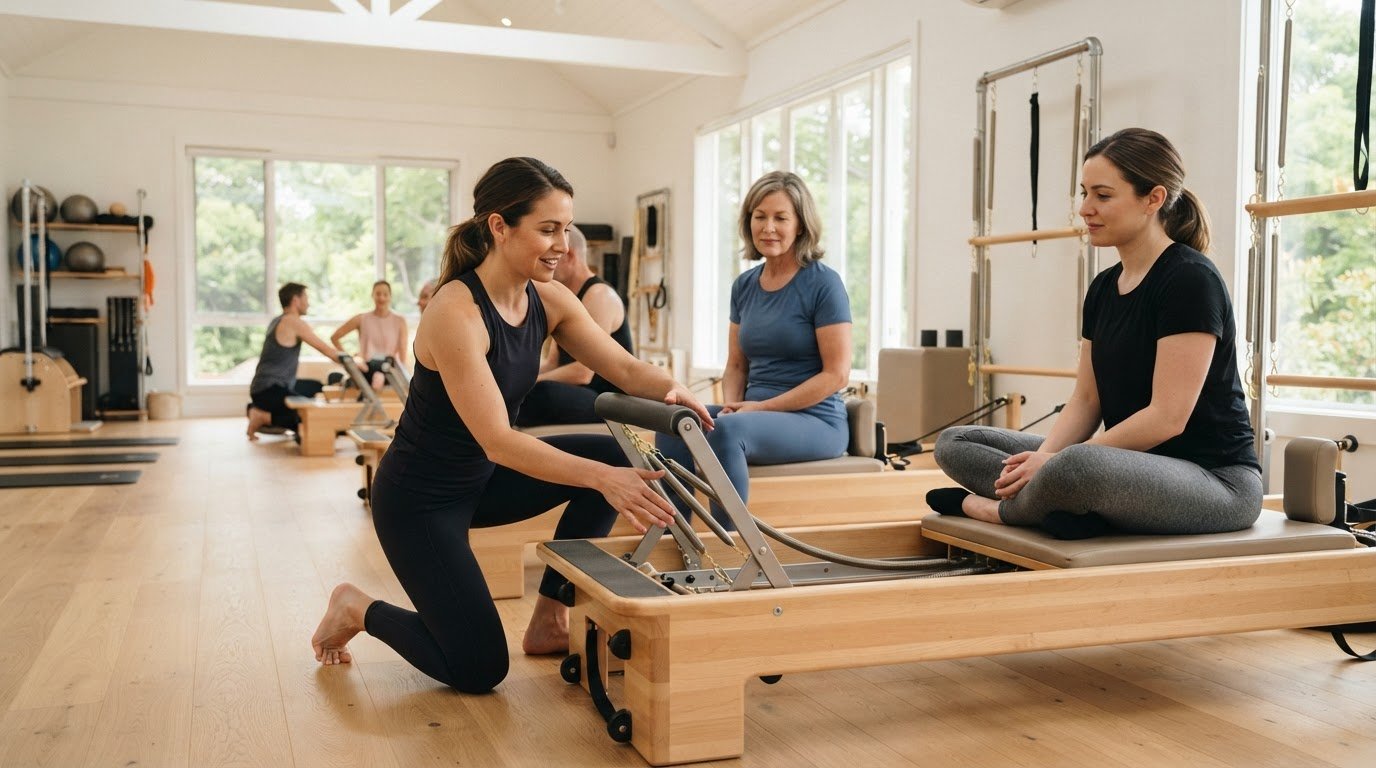
A spring change shouldn’t bring class to a halt. Learning how to cue spring changes effectively starts before anyone reaches for a spring: clients need a clear sequence, a stable carriage, and time to confirm the setup before moving on.
If clients miss an instruction or aren’t sure which spring you mean, the transition can pull attention away from the work. Spring colors aren’t universal across Reformer brands, so relative terms such as “heavy,” “medium,” and “light” can make cues clearer, especially when you pair them with the purpose of the change.
This guide shows you how to prepare spring changes, give concise instructions, and confirm each setup while maintaining safety and class momentum. You’ll also learn how to preview the next exercise during the transition instead of leaving clients waiting.
Planning machine-specific spring details in advance can reduce guesswork during class. Tools such as ReformerFlow can help you review those details while preparing a sequence, leaving more attention for the room.
Key Takeaways
- Use a consistent sequence: preview the change, position clients, cue the action, confirm the setup, then resume.
- Rehearse concise wording for common transitions so clients can act without repeated explanations.
- Choose whole-group, individualized, or pre-class cues based on the group and the transition.
- Build in time for a setup check instead of rushing clients through the change.
- Demonstrate an adjustment when seeing the action will clarify it faster than adding verbal directions.
Table of Contents
- Why clear spring-change cues matter in Reformer Pilates
- Build a spring-change cue sequence before class
- Adapt spring-change cues for mixed groups and different Reformers
- Keep spring changes smooth without rushing clients
- Make effective spring-change cueing part of your teaching system
Why clear spring-change cues matter in Reformer Pilates
Clients may still be on the carriage when a spring change comes up. They could be holding a position or finishing a repetition while trying to hear what happens next. If a cue combines several actions, clients can hesitate, ask for clarification, or make different adjustments. That interrupts concentration and shifts your attention from teaching to troubleshooting. Understanding how to cue spring changes effectively helps separate the transition instruction from the movement itself.
A spring-change cue should give clients an immediate action. It doesn’t need to include the full reasoning behind spring selection. Explain the purpose when it helps clients understand the exercise, then keep the direction concise. This distinction supports the Pilates method, where controlled movement and focused attention matter. Clear instructions help clients know when to listen, when to adjust, and when to return their focus to the movement.
What makes a spring-change cue easy to follow?
Give one action at a time and use language clients already know. State when to pause and how to position themselves before asking them to reach for equipment. For example: “After this repetition, bring the carriage to a full stop and stay seated. Then make the spring change.” Keep the shared instruction separate from any client-specific variation. Spring settings depend on the exercise, the client, the Reformer, and your professional judgement, so a brief individual clarification may be needed.
Cue clarity, safety, and client attention
Ask clients to stabilize before reaching for springs, and allow them to finish the adjustment before movement begins. A calm pause gives you and the group time to focus on the setup rather than rush into the next exercise. Check visually that clients are ready. Silence alone doesn’t confirm that everyone understood or completed the change.
When you consider how to cue spring changes effectively, make confirmation part of the instruction, not an afterthought. A quick scan can reveal uncertainty while there’s still time to clarify. Clients can then return their attention to the exercise with a shared understanding of what comes next.
How to cue spring changes effectively: build a sequence before class
A spring change is easier to teach when you’ve already decided how the transition will unfold. Before class, review each exercise pair that requires an adjustment and plan the cue around your actual Reformer setup. Spring colors and configurations vary by manufacturer, so don’t rely on a color label alone. Use terminology your studio and clients recognize, and check that the planned setting matches the machine.
A reliable sequence is: preview, position, cue, confirm, resume. It gives clients a predictable order and gives you a moment to check readiness before movement starts again.
- Preview: Signal the change before the current exercise ends.
- Position: Tell clients when to stop and where to settle before adjusting.
- Cue: State the spring action using familiar studio terms.
- Confirm: Check that the intended setup is in place.
- Resume: Give the next movement cue once the group is ready.
A useful cue states when to change, what to change, and when to wait. Keep the instruction focused on the transition instead of crowding it with unrelated alignment or breathing corrections. Clear sequencing also protects the attention clients need for controlled movement, a focus explored in research on the movement principles behind Pilates.
Preview the change before the transition
Give clients advance notice while they’re completing the current exercise, rather than waiting until they’ve stopped and are ready for direction. Name the next exercise if that helps them prepare their body position or equipment. Otherwise, keep the preview simple: “After this last repetition, we’ll pause for a spring change.” Rehearse phrasing for transitions you use often. Familiar words are easier to deliver calmly while you monitor the room.
Give an actionable cue, then confirm the setup
Once clients are positioned, make the instruction specific to your equipment and sequence. For example: “Bring the carriage to a full stop, then remove the light spring. Wait there before starting the next exercise.” Pause long enough for clients to act, scan the group, and clarify privately if someone needs a different setting. Resume only after your visual check.
Planning can also mean checking machine-specific spring details while you build the class, rather than trying to recall them mid-transition. ReformerFlow includes spring-setup details that can be personalized to your Reformer, alongside a glanceable teaching mode for checking planned exercise information. Explore the ReformerFlow app as one way to keep those details organized during preparation.
Adapt spring-change cues for mixed groups and different Reformers
Spring colors aren’t universal resistance labels. Manufacturers use different spring systems, and similar colors can represent different resistance across Reformers. The number and arrangement of springs can also vary by model. If you teach on more than one type of machine, check the setup instead of assuming a familiar color means a familiar load. For more equipment-specific context, see this guide to Reformer Pilates machine spring setup.
To cue spring changes effectively across a mixed group, keep the instruction shared but make the reference machine-appropriate. Use familiar studio terms such as “one spring,” “the outer hook,” or “your light spring” only when clients know what those terms mean on their equipment. Relative labels like “heavy” or “light” can help, but they shouldn’t replace checking the actual Reformer setup.
Cueing different spring systems without confusing clients
Choose wording that points clients to a recognizable spring or attachment position on their machine. If “remove the blue spring” could mean different things across the room, name the location or demonstrate the adjustment. Keep the safety check consistent for everyone, even if the specific spring instruction differs by machine. Clear, repeatable language is a core part of successful Pilates cueing.
Managing varied client needs in one class
Mixed groups may need different spring choices for the same exercise. Identify those exceptions while planning, so you can give the general direction first and discreetly clarify individual variations without interrupting the room. Avoid announcing clients’ spring choices as comparisons. A different setting can reflect the person, exercise, or machine, not a ranking of effort.
Choose the cueing approach that fits the transition:
- Whole-group cue: Use when clients share a setup and the instruction is clear across machines.
- Individual cue: Add a quiet, specific direction when one client’s planned setting differs.
- Pre-class setup cue: Use when a machine-specific adjustment is easier to handle before movement begins.
Preparation supports calm delivery. Reviewing spring configurations for the machines in the room helps you avoid relying on color alone, while your judgement guides any adaptations. The goal isn’t to make every Reformer identical. It’s to give each client a clear instruction they can follow on the equipment in front of them.
Keep spring changes smooth without rushing clients
A smooth transition has a steady rhythm: give advance notice, pause for the change, check the setup, then restart. Clients hear what’s coming before they need to act, and you have a clear moment to confirm the group is ready. This structure can keep class moving without making clients feel hurried.
Offer the preview while clients can still listen comfortably, such as during the final repetitions of an exercise. Keep it focused: “After this set, we’ll pause and change springs for the next movement.” Name the next exercise when it helps clients anticipate their position or equipment needs. Avoid layering the spring instruction with several unrelated corrections. Give clients space to hear and remember the key action.
Use timing and demonstration to protect class flow
Some adjustments are easier to understand when clients can see them. If the attachment point or action may be unfamiliar, give a brief demonstration before asking the group to follow. Keep the demonstration specific to the change, then allow clients time to complete their own setup. A useful transition doesn’t require constant talking. Once the adjustment is done, check the room and direct attention back to movement.
Planning transitions as part of the class sequence can help you decide where to preview, pause, or demonstrate. For more on organizing the order and flow of exercises, see this guide to sequencing a Reformer Pilates class.
Recover calmly when a cue is missed
Clients may start moving before the change is complete, miss part of the instruction, or set up differently than you intended. Don’t talk over the confusion or push into the next exercise. Delay the restart, identify what needs attention, and restate only that part of the cue.
For example: “Let’s pause here. Please finish attaching the spring, then wait for my next cue.” A neutral, specific correction keeps the focus on the action, not the person. If one client needs a different setup, clarify quietly while the rest of the group waits or prepares. Calm recovery helps the class return to its rhythm without repeating the full explanation.
Organizing exercise details in advance can make transition cues easier to deliver without relying on memory mid-class. A glanceable plan can help you check what comes next while keeping your attention on the room.
Explore the ReformerFlow app## Make effective spring-change cueing part of your teaching system
Clear spring cues are easier to deliver when you make the decisions during planning, rather than trying to recall them under pressure. Build a short review into your class preparation. Mark where each spring change occurs, check the setup for the Reformers you’ll teach on, and decide how you’ll cue planned variations. This gives you a reliable reference while leaving room to respond to the people in front of you.
Create a repeatable pre-class cueing checklist
Keep the checklist brief enough to use consistently. For each transition, confirm:
- Machine setup: Does the planned spring configuration match the Reformer and its manufacturer guidance?
- Transition point: When will you preview the adjustment during the current exercise?
- Cue wording: What concise instruction will clients understand in this studio?
- Individual variations: Does anyone need a different setup, and when will you clarify it?
- Confirmation: How will you check that the group is ready before movement resumes?
Writing down these details helps you avoid relying on memory for each transition. It can also make your wording more consistent from one class to the next, without requiring every spring cue to sound scripted.
Use planning support while keeping the instructor in control
A prepared class view can make exercise and spring details easier to review before teaching. ReformerFlow is a mobile app with a curated library of over 400 Reformer exercises, including video, level, and spring-setup details. You can personalize spring configurations to your machine, and glanceable teaching mode supports checking planned class information while instructing.
Use that information as preparation support, not as a substitute for your judgement, training, or the machine manufacturer’s guidance. An exercise reference can help you organize a plan, but you still decide whether a setting is appropriate for the client, the exercise, and the equipment in your studio. The result is a prepared teaching system that can still adapt to the room.
If you’d like to review exercise and spring details while planning, explore ReformerFlow and its 14-day free trial.
Make your next spring transition more intentional
Clear spring-change cueing comes from preparation and presence. Preview the adjustment, give clients one actionable instruction, and confirm the setup before movement resumes. For mixed groups, adapt the details to each Reformer and client instead of assuming one spring color means the same thing everywhere.
That repeatable approach is how to cue spring changes effectively without letting equipment adjustments take over the class. Keep your sequence flexible, use your judgement, and let planning support reduce the details you need to hold in mind while teaching.
ReformerFlow offers a curated library of over 400 exercises with video, level, and spring-setup details. You can personalize spring configurations to your Reformer and check planned information in glanceable teaching mode. The app is available on iPhone, iPad, and Android.
Explore ReformerFlow and start your 14-day free trialA little preparation can help each transition feel clearer for you and your clients. Take the approach that fits your room, and keep building a class rhythm that feels calm, attentive, and safe.
Frequently Asked Questions
How do you cue a spring change on a Reformer?
Give the change in a clear sequence: tell clients when to pause, how to position themselves, what adjustment to make, and when to wait. For example: “Finish this repetition, bring the carriage to a full stop, then remove the planned spring. Wait for my check before moving.” To cue spring changes effectively, use familiar terms, allow time to act, and confirm the setup before restarting.
When should an instructor cue a spring change during class?
Preview the change before clients finish the exercise, while they can still listen without rushing. Give the specific action after the carriage has stopped and clients are positioned to adjust. Allow time for everyone to complete the change, then check the setups before beginning the next movement. If the next exercise requires a different body position, mention it in the preview so clients can prepare.
Should clients change Reformer springs while lying on the carriage?
Clients shouldn’t adjust springs while the carriage is moving. Whether they can remain lying down depends on the exercise position, spring access, and their ability to stay stable while reaching. If the position makes the adjustment awkward or compromises control, cue them to stop, reposition safely, and then change the springs. Follow your training and the Reformer manufacturer’s guidance, and confirm clients are ready before movement resumes.
Are Reformer spring colours the same on every machine?
No. There’s no universal spring-color standard across Reformer brands, so the same color can indicate different resistance on different machines. Spring arrangements also vary by model. Don’t assume a color cue will transfer between Reformers. Use the equipment’s established labels or positions, and check the manufacturer’s guidance for the specific machine. Relative terms like “heavy” or “light” can help, but should be clear in your studio’s context.
How can I cue spring changes for a mixed-level Reformer class?
Give the shared instruction first, then clarify individual variations discreetly. For example, cue everyone to bring the carriage to a full stop, while giving a client who needs a different setup a quiet, specific direction. Plan known variations before class and avoid presenting spring choices as a measure of ability. The right setup depends on the client, exercise, Reformer, and your professional judgement.
What should I do if a client changes to the wrong spring?
Pause or delay the next movement if the setup is unclear or doesn’t match the plan. Restate the correction calmly and specifically, such as, “Please pause and check the spring at the near end.” Verify the intended setup before restarting. Avoid calling the client out or continuing while uncertain. If you’re unsure which configuration is appropriate, consult your training and the Reformer manufacturer’s guidance.
Can a class-planning app help with Reformer spring cues?
Yes. A class-planning app can help you review spring details while preparing, rather than relying on memory during a transition. ReformerFlow is a mobile app with a curated library of over 400 exercises, including video, level, and spring-setup details. Configurations can be personalized to your Reformer, and glanceable teaching mode supports checking planned information during class. It supports preparation, but doesn’t replace instructor judgement or manufacturer guidance.