
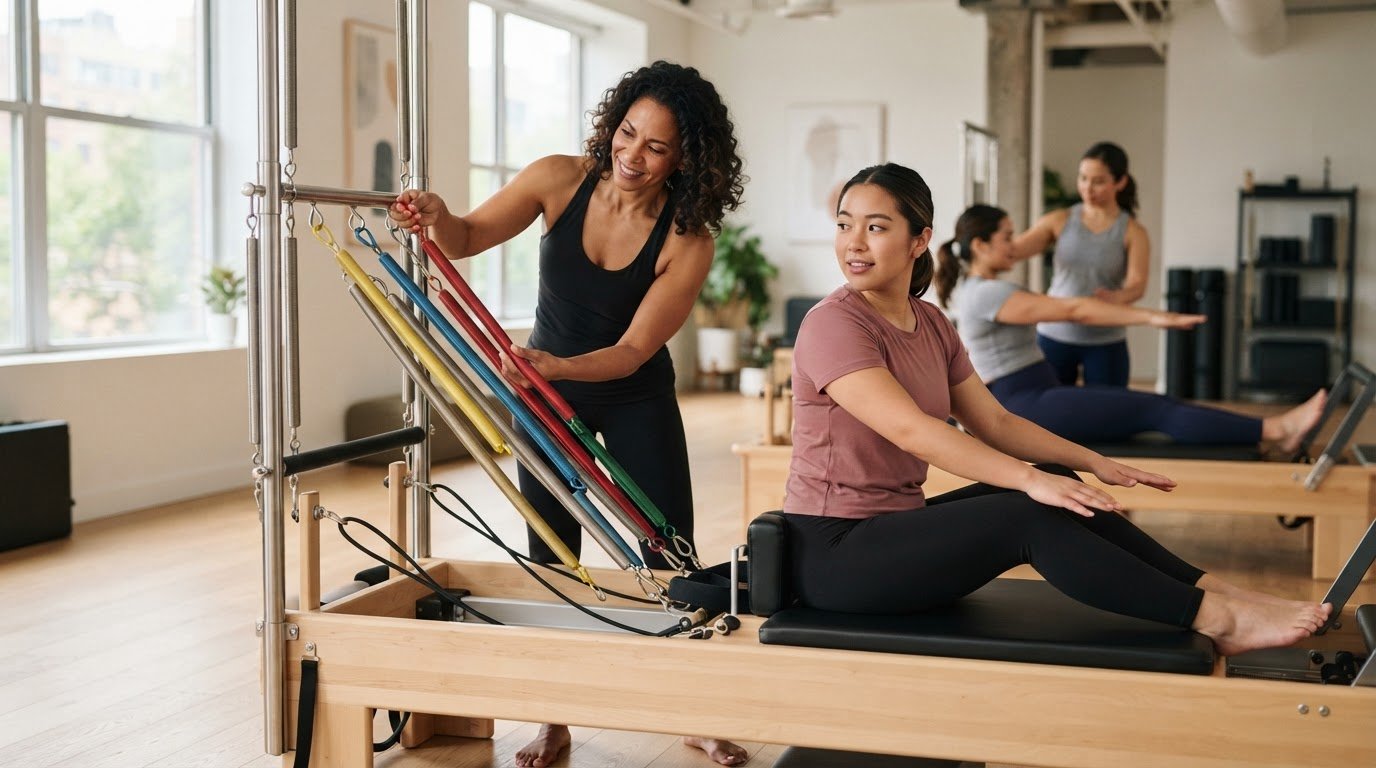
Spring color is a starting point, not a prescription. On a Balanced Body Reformer, yellow indicates very light resistance, blue light, red medium, and green heavy. A balanced body reformer spring settings app can help instructors translate that color code into a considered class setup, but the right combination still depends on the movement and the person doing it.
When body needs, experience, and exercise goals make spring choices less straightforward, color alone is not enough. This guide explains how resistance levels relate, why the same setup can feel different across exercises, and how to consider combinations for different skill levels. Height, weight, and control needs can also influence a choice, helping you plan with greater clarity instead of relying on one default.
Key Takeaways
- Use spring colors as a resistance guide, then match the setup to the exercise rather than relying on color alone.
- Compare combinations in full-spring equivalents to understand how adding or changing springs shifts the overall load.
- Use the client’s movement and control as feedback: a setup that feels compressive or unstable may need adjusting.
- Account for height, body needs, and experience when choosing tension; one setting won’t suit every person or movement.
- For faster class planning, ReformerFlow organizes exercise videos, levels, and spring setup details around the specific Reformer machine.
Table of Contents
- What Color Reformer Springs Should I Use?
- Estimating spring resistance in full-spring equivalents
- Adjusting spring load while maintaining form
- Choosing spring tension for different bodies and skill levels
- Suggested spring combinations by number of springs
- ReformerFlow by Ginty: ReformerFlow App Subscription
What Color Reformer Springs Should I Use?
On a Balanced Body Reformer, spring colors indicate resistance: yellow is very light, blue is light, red is medium, and green is heavy. Use that scale to understand relative load, then consider the exercise and the person performing it. Color is a useful reference, but it does not determine one ideal setting for every Pilates movement.
The standard Balanced Body Studio Reformer configuration includes three red springs, one blue spring, and one green spring. In the Balanced Body setup described here, blue provides about half the resistance of red, while yellow provides about half the resistance of blue. Green is the heaviest spring in this color set, and yellow is the lightest. These relationships help explain how combinations change overall resistance, but they are not interchangeable across Reformer brands.
Color codes vary by manufacturer, so a blue spring does not always represent the same resistance. Merrithew STOTT, for example, uses black for extra-heavy, red for heavy, blue for medium, and white for light. Spring colors and machine settings can affect resistance, so check the guidance for the specific Reformer. AeroPilates uses black for heavy, with optional red extra-heavy and yellow light springs. Read the color key for the specific machine before applying another brand’s conventions.
Compare spring colors across Reformer brands using each brand’s own resistance scale, not a direct color match. Balanced Body red means medium, while Merrithew STOTT red and BASI red mean heavy. The same color can therefore indicate a different place on the resistance scale. When teaching on more than one Pilates Reformer, identify the manufacturer and spring system first, then interpret the colors accordingly.
How accurate are the app’s spring recommendations compared with Balanced Body manuals? The app provides exercise-level spring setup details personalized to the instructor’s specific Reformer. Compare those machine-specific settings with the relevant machine guidance rather than assuming a color represents identical resistance across every brand or model.
Which Balanced Body reformer models does the app support? The app’s spring setup information is personalized to the instructor’s specific Reformer, so settings relate to the selected machine rather than a universal Balanced Body configuration. This distinction matters because spring details need to match the equipment being used.
How do you use the app to find reformer spring settings for an exercise? Find the exercise in the curated library, then review its spring setup details alongside its level and video. This lets instructors assess the movement and its machine-specific setting together. A balanced body reformer spring settings app is most useful when its recommendation reflects the Reformer being taught, not just a general color chart.
Estimating spring resistance in full-spring equivalents
Full-spring equivalents offer a practical way to compare combinations on the Balanced Body Reformer described here. In this system, one red spring counts as one full spring, while a green spring counts as almost one and a quarter. These are working estimates, not universal measurements for every Reformer brand. Use them to describe a setup’s relative load and make adjustments more deliberate.
For example, three red springs equal three full-spring equivalents. Add one blue spring and the combination counts as three and a half. This is more informative than simply saying “four springs,” because each spring contributes a different amount of resistance. It also makes a change easier to describe: removing the blue spring reduces the estimated load by half a spring.
- One red: one full-spring equivalent.
- One green: almost one and a quarter full springs.
- Three red and one blue: three and a half full-spring equivalents.
Attachment position changes how a spring feels, too. On the Balanced Body setup described here, a spring on the hook creates less tension than one on the button. Two configurations with the same spring count can therefore feel different. For a useful comparison, record both the spring combination and its attachment position. This matters when repeating an exercise or describing a setup to another instructor.
Resistance affects exercise difficulty differently depending on the movement’s goal. In balance or control work, a heavier spring can make an exercise more manageable by supporting the carriage. A lighter spring can demand more control because the carriage offers less support. Rather than asking only whether a setting feels harder, consider whether the load supports the intended movement or makes it harder to maintain control and form.
Balanced Body Signature Springs are made of nickel-plated carbon steel and manufactured in an ISO 9000-certified facility. Those material and manufacturing details identify the spring, but don’t by themselves establish its remaining service life. A general rule of thumb is to replace Reformer springs every two years. Balanced Body DURO Springs should not be combined with Signature Springs, so don’t treat different spring types as interchangeable when calculating a setup.
For class planning, note the spring type, combination, and attachment position together. That record makes it easier to compare one exercise setup with another without mistaking spring count for equal resistance. Reviewing exercise-specific spring setup details can also help keep the chosen configuration connected to the movement being taught.
These estimates are most useful for describing a setup, not as a universal rating. In the Balanced Body Reformer tutorial described here, a green spring counts as a spring and a quarter, while three red springs with one blue count as three and a half. Keeping these comparisons in mind can help instructors explain the estimated load of a combination.
When the goal is control or balance, the instructor advises that a heavier spring often makes an exercise more manageable, while a lighter spring makes it harder. Choose according to the movement’s goal, considering how much support and control it requires.
Adjusting spring load while maintaining form
Choose spring load by observing how the carriage and body move together. If a setting feels too heavy, the user may feel compressed; if it feels too light, the user may feel out of control. These are practical cues to reassess the load, not reasons to push through with compromised form. Instructors can observe carriage control, alignment, and whether the intended action of the exercise remains clear.
Adjust the load to suit the movement’s goal. More resistance can increase the demand on working muscles during a strength-focused exercise, but it should not distort the movement. In balance or control work, a heavier spring can sometimes make the carriage easier to manage, while a lighter spring can make the task harder by reducing support. The right setting serves the exercise’s purpose while allowing the mover to control the carriage.
Footwork offers a practical example of adjusting load. In the teaching guidance described here, the instructor’s maximum footwork load is about three and a half full-spring equivalents, sometimes four depending on the person. This is an individual working range, not a universal target. Control and form remain central: a heavier setup is not automatically better just because it provides more support.
If a setting seems mismatched, compare deliberately. Keep the exercise and body position consistent, then change the spring load and observe the effect on carriage movement and form. If the user feels compressed, reduce the load and reassess. If the user feels out of control, consider whether additional resistance would provide more support. Avoid changing several setup factors at once, so you can identify what affected the movement.
- Compressed feeling: reassess whether the spring load is too heavy.
- Uncontrolled carriage: consider whether the setting is too light.
- Balance or control goal: recognize that heavier support may make the task more manageable.
- Footwork: treat three and a half, sometimes four, as one instructor’s maximum example, not a default.
Are there safety warnings for choosing reformer spring settings? A setting that feels compressive may be too heavy, while one that leaves the user out of control may be too light. Treat these responses as cues to reassess the setup and preserve control and form throughout the exercise.
Strength and control do not always call for the same spring choice. Compare the intended challenge with the person’s movement, then adjust the load to support that purpose. For footwork, for example, choose a setting that lets the user move through the exercise with controlled carriage travel rather than automatically selecting the highest load.
Choosing spring tension for different bodies and skill levels
Spring choice depends on the person and the exercise, not skill level alone. Height, weight, and experience all influence how resistance feels on a Reformer. A setting that supports one person’s movement may create a different challenge for another. Consider these factors together: match the spring load to the movement’s purpose, then observe whether the person can control the carriage and maintain the intended form.
Height also affects the setup before spring tension is considered. With feet on the footbar, the recommended hip angle is around 90 degrees or slightly deeper. For users between 5’3”/161cm and 6’4”/195cm, the standard gear or stopper setting is recommended to reach that angle. For someone under 5’3”/161cm, move the carriage closer to the footbar. For someone over 6’4”/195cm, move it farther away. These adjustments help establish the starting position before choosing resistance.
Consider skill level in relation to the demands of the specific exercise. A newer mover may benefit from a setup that makes the carriage’s path clear and manageable. An experienced mover may need a different challenge depending on whether the exercise emphasizes strength, balance, or coordination. Experience does not automatically call for heavier resistance. Even a familiar movement may require a lighter setting when reduced support is part of its intended challenge.
Weight can affect how a person experiences carriage resistance, but it does not provide a standalone spring formula. Consider it alongside body position, movement range, and the exercise goal. For example, two people performing the same footbar movement may need different setups to work through a similar range with control. Their spring choices can differ even when the exercise stays the same.
A useful planning sequence keeps these variables distinct:
- Set the body position: use carriage placement and the footbar position to establish a suitable working shape.
- Identify the goal: decide whether the exercise emphasizes strength, balance, or controlled movement.
- Choose resistance: select a spring combination that supports that goal for the person’s current ability.
- Reassess the movement: observe carriage control and form, then refine the setting if the exercise’s purpose is lost.
For example, a taller user may first need the carriage moved away from the footbar to approach the recommended hip angle. Assess the spring load only after setting that position. Separating body setup from resistance makes the choice more precise: proportions guide the starting geometry, while skill and exercise intent inform spring selection.
The appropriate Reformer spring tension can vary with a person’s height, weight, and skill level. These are considerations, not a fixed formula for assigning a spring: no single characteristic determines the setting. Choose for the individual in front of you, keeping the exercise’s purpose central. If the person’s position or ability changes, revisit the choice instead of assuming the previous setup remains suitable. This keeps spring selection responsive without treating height, weight, or experience as a formula.
Suggested spring combinations by number of springs
Spring count alone does not describe resistance: on a Balanced Body Reformer, the combination depends on which springs are attached. Use the examples below to compare configurations, not as fixed prescriptions for every exercise. A Balanced Body Reformer can use a maximum of five springs at one time, so keep combinations within that limit.
- One spring: A single red spring provides a practical reference point, counted as one full-spring equivalent. A blue spring offers about half a red spring’s resistance, while a yellow spring offers about half a blue spring’s resistance.
- Two springs: Two red springs give a straightforward, higher-load comparison than one red. A red and a blue offer a different pairing, with the blue contributing about half a red spring’s resistance.
- Three springs: Three red springs create a consistent combination of three full-spring equivalents. Replacing one red with a blue changes the total load while keeping the spring count at three.
- Four springs: Three red springs and one blue count as three and a half full-spring equivalents. This provides a clear example of why four attached springs don’t necessarily equal four full-spring equivalents.
- Five springs: The standard Balanced Body Studio Reformer configuration includes three red, one blue, and one green spring. It uses the machine’s full five-spring capacity when all five are attached.
For the five-spring Studio configuration, the estimated load is almost four and three-quarter full springs: three red count as three, blue contributes half, and green contributes almost one and a quarter. “Almost” matters because the green spring is described as almost one and a quarter full springs, not an exact equivalent. Use this estimate to compare loads, not as a precise measurement.
Spring-count examples mean different things across brands and models. Classical Reformers such as Gratz, Techno, Legacy, Pilates Designs, and Contrology use four springs listed with the same heavy tension. A standard Ron Fletcher Reformer configuration uses four red springs. Do not transfer either setup to a Balanced Body machine based on count or color alone.
Compare combinations by recording the spring colors and the Reformer they belong to. Note whether each spring sits on the hook or button, too, because the hook creates less tension than the button. This prevents a four-spring setup from being mistaken for one consistent resistance across attachment positions or brands.
Choose the combination to suit the exercise’s purpose and the user’s control. A heavier spring can make balance work more manageable, while a lighter setting can make it harder. The examples explain what each combination represents; the exercise and the mover determine which option fits.
Explore ReformerFlow’s exercise-specific spring setups## ReformerFlow by Ginty: ReformerFlow App Subscription
ReformerFlow by Ginty’s ReformerFlow App Subscription brings exercise selection, class sequencing, and spring setup details together in one mobile app. For instructors planning classes across different Reformer machines, exercise recommendations are personalized to the selected machine, helping keep spring configurations relevant to the equipment being taught.
The curated library includes over 400 Reformer Pilates exercises, with video, level, and spring setup details. Instructors can use these details while building a class, then refer to glanceable teaching mode during instruction. Class planning takes about five minutes, making the app a practical next step when organizing exercises and equipment-specific settings is part of regular preparation.
A 14-Day Free Trial is available. Visit reformerflow.app to explore the app.
Make Your Next Class Plan More Intentional
Spring selection is more useful when it supports a consistent teaching process. As you plan future classes, note how the chosen setup serves each movement’s purpose and how the person responds. This reflection can help you make deliberate adjustments over time, rather than treating every exercise or participant alike.
A balanced body reformer spring settings app can keep exercise choices and machine-specific setup details close while you organize a class. ReformerFlow by Ginty offers that planning support through its ReformerFlow App Subscription, with a 14-Day Free Trial for instructors who want to explore the app in their workflow.
Explore ReformerFlowBuild your next class with clear intent, then let each movement guide the choices that follow.
Frequently Asked Questions
Does the app provide settings for different body sizes or experience levels?
The app provides exercise levels and machine-specific spring configurations, but does not automatically adjust settings to body size. First, map your Reformer’s spring-slot colours. After personalisation, exercise recommendations show the exact springs for that machine; before then, Ginty’s default springs are shown. Use an exercise’s level information to guide selection, then consider the participant’s proportions and movement control when adapting the class. This keeps the equipment setup specific without treating body size as an automatic setting.
Which Balanced Body reformer models does the app support?
The app provides settings personalized to the instructor’s selected Reformer machine, rather than universal spring setup information.