
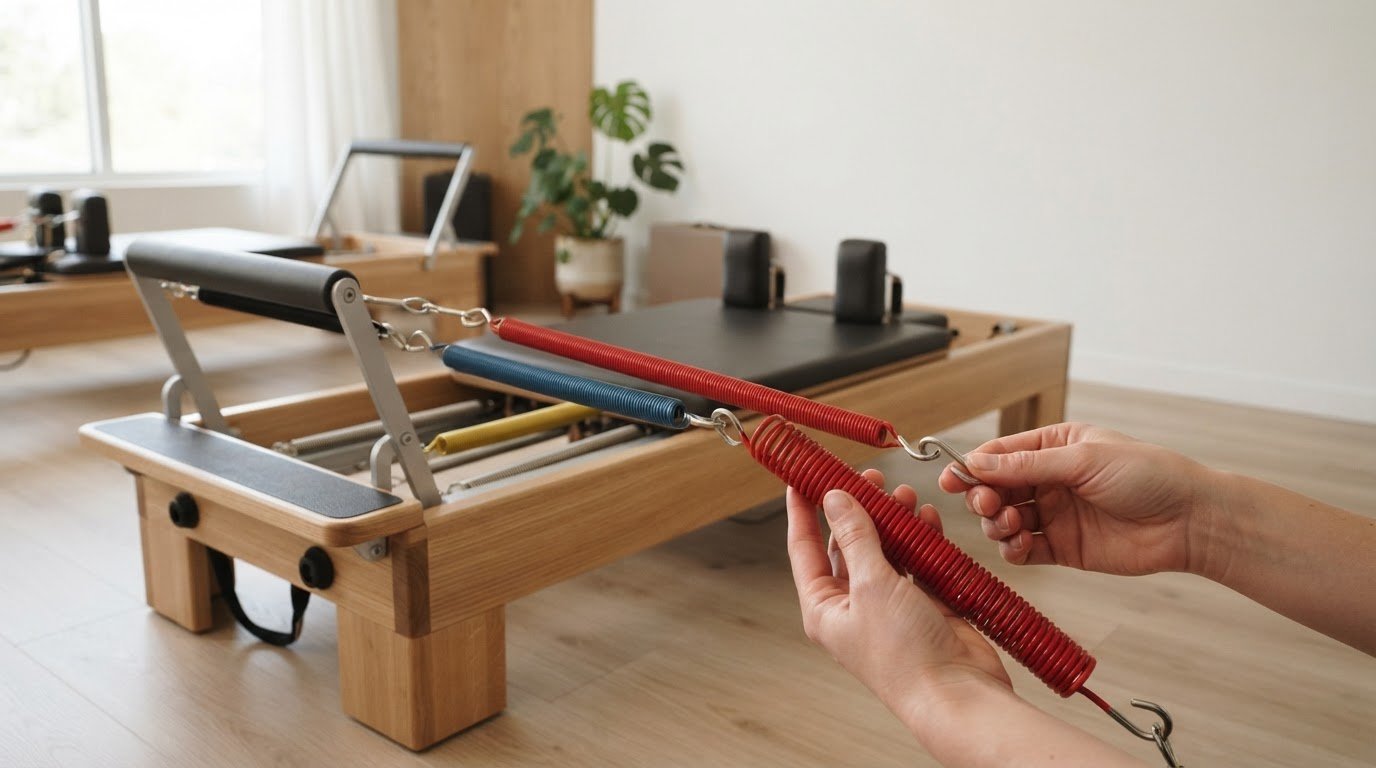
The standard Allegro 2 spring setup is three red springs, one blue spring, and one yellow spring. This Allegro 2 Reformer spring guide explains how that combination works with the carriage and frame, and what to watch for as springs age.
Spring color offers a quick reference, but the right setup also depends on the movement and the person using the Reformer. Before changing a setup or deciding a spring needs replacing, understand how spring resistance affects carriage movement. This guide covers the standard spring configuration, how resistance choices shape the carriage’s movement, and practical care and wear indicators. You’ll have a clearer basis for maintaining your equipment and choosing spring resistance with intention.
Key Takeaways
- Learn what each spring color indicates and how the standard Allegro 2 setup creates different resistance options.
- Understand how spring tension affects carriage movement, so you can make more intentional setup choices for each exercise.
- See how the carriage and frame work together, and why equipment setup matters to the Reformer experience.
- Recognize why spring condition deserves regular attention and what changes may signal that a closer inspection is needed.
- Explore how spring-setup details can support class planning when you’re sequencing exercises for a specific Reformer.
Table of Contents
- What springs come with the Balanced Body Allegro 2 Reformer?
- Pilates reformer
- ReformerFlow by Ginty: ReformerFlow App Subscription
What springs come with the Balanced Body Allegro 2 Reformer?
The standard Balanced Body Allegro 2 Reformer configuration has five springs: three red, one blue, and one yellow. Each spring connects the moving carriage to the frame, creating resistance as the carriage travels. An Allegro 2 Reformer spring guide helps instructors identify the standard set and understand how its colors distinguish resistance levels. The arrangement provides several ways to adjust the carriage’s feel without changing the machine itself.
Balanced Body’s color system identifies green as heavy resistance, red as medium, blue as light, and yellow as very light. The standard Allegro 2 set has no green spring. It instead includes three red springs, alongside one blue and one yellow. Color offers a quick visual reference during setup, but it doesn’t determine the right combination for every exercise or practitioner.
- Red: medium resistance.
- Blue: light resistance.
- Yellow: very light resistance.
- Green: heavy resistance in Balanced Body’s color system.
Attaching different springs changes the resistance the practitioner feels against carriage movement. More attached springs generally create greater resistance, while fewer generally reduce it. The Allegro 2 spring system offers up to 46 distinct resistance combinations. That range gives instructors flexibility, but the number of possible setups doesn’t mean every combination suits every movement.
Start with what the exercise asks the practitioner to do. The setup should support the intended movement and allow the person to control the carriage. The same spring arrangement can feel different to different practitioners, depending on their experience, strength, and movement control. Spring color helps identify resistance categories, while observing the movement helps an instructor judge whether the carriage response suits the exercise.
For example, if a practitioner struggles to start moving the carriage, the instructor can consider whether the resistance suits the exercise and the person’s control. If the carriage moves too freely for the task, another combination may provide a more appropriate challenge. These are considerations, not fixed prescriptions: both the movement’s purpose and the practitioner’s response matter.
The Allegro 2 Stretch Reformer has a separate standard spring configuration: three Stretch Red, one Stretch Blue, and one Stretch Yellow. The “Stretch” designation identifies that model’s setup. Keep it distinct from the standard Allegro 2 configuration when recording equipment details or matching a spring setup to a machine. Similar colors alone don’t make two spring configurations interchangeable.
The Tower configuration for the Balanced Body Allegro 2 is also distinct from the standard Reformer set. It includes two short yellow springs, two short blue springs, two long yellow springs, and two long purple springs. Those Tower springs shouldn’t be confused with the five springs used in the standard Reformer configuration. This distinction is useful when a studio has both setups in service.
Spring care involves noticing changes in appearance and behavior during routine equipment checks. Look for visible damage or a change in how a spring responds during use. A general rule of thumb recommends replacing Reformer springs every two years. Treat that interval as a maintenance reference, alongside the condition of each spring and its use.
If a spring looks damaged or behaves differently, its color alone won’t tell you whether it remains in good condition. Color identifies a resistance category, not spring condition. Keep the standard Allegro 2 springs identifiable, and separate them from Stretch Reformer and Tower configurations. This Allegro 2 Reformer spring guide can help keep those distinctions clear when reviewing setup choices and maintenance.
The Balanced Body Allegro® 2 Reformer standard configuration is 3 Red, 1 Blue, 1 Yellow. Balanced Body short yellow, blue, and red springs measure 25.25 inches (64.1 centimeters). This length is a dimensional detail alongside the color-based resistance categories, and does not change which spring colors belong to the standard set.
On Return Pilates Allegro 2 reformers, the yellow spring is equivalent to ¼ spring tension, and the blue spring is equivalent to ½ spring tension. Return Pilates Allegro 2 reformers have three red springs, each equivalent to one full spring of tension. These equivalents describe tension in fractional terms: the yellow and blue values are fractions, while each red spring is one full spring of tension. Keeping these model-specific descriptions distinct helps avoid treating the Return Pilates setup as interchangeable with the separate Stretch configuration.
Pilates reformer
The Balanced Body Allegro 2 combines a fixed frame with a moving carriage. Springs connect the carriage to the frame, resisting movement and assisting its return. The carriage travels along the frame as the practitioner pushes or pulls against that resistance. This relationship makes the frame, carriage, and spring setup part of one working system.
The Allegro 2 frame measures 239 cm long with the footbar and 79 cm wide with the footbar and legs. Its carriage measures 100 cm by 60 cm and moves on a precision system with eight wheels. These dimensions describe separate parts: the frame supports the moving carriage, while the wheels guide its travel. Approximately 30 to 60 cm of clearance on each side is recommended for exercise space.
Weight also varies with configuration. The Allegro 2 weighs approximately 67 kg without legs and approximately 70 kg with legs. That distinction matters when interpreting equipment specifications or planning its placement. The frame’s length, carriage path, and surrounding clearance affect how the Reformer fits into a room. A spring adjustment changes resistance, not the equipment’s footprint or travel path.
The Infinity Footbar offers nine horizontal positions and four vertical settings. These adjustments change where the feet or hands meet the Reformer, affecting how a practitioner organizes a movement. Footbar position and spring resistance serve different purposes: the bar changes contact and leverage, while springs change resistance against the carriage. Instructors consider both when setting up for an exercise.
Practitioner height can inform carriage and stopper choices. A classical Reformer setup aims for a hip angle around 90 degrees or slightly deeper, with the feet on the footbar. For a practitioner under 161 cm, the guide recommends moving the carriage closer to the footbar. For someone over 195 cm, it recommends moving the carriage away. Between 161 cm and 195 cm, use the standard gear or stopper setting to approach that hip angle.
On a classical Reformer, the standard gear setting is the first gear, closest to the footbar. This helps distinguish carriage positioning from spring selection. The practitioner’s position determines where the carriage starts; the attached springs determine the resistance they encounter. Changing one setting won’t automatically resolve a mismatch in the other. The goal is to make the starting position and resistance work together.
Adjustable ropes or straps introduce another setup relationship. After setting the carriage for the desired hip angle, the guide recommends positioning rope ends 3.81 cm past the front of the shoulder block. For a taller practitioner, adjust the ropes while they lie face up and hold the handles above their shoulders. Keep the rope lightly taut without engaging the spring during this adjustment.
- Carriage position: relates to practitioner height and the intended hip angle.
- Footbar setting: changes the point of contact for hands or feet.
- Spring setup: changes resistance against carriage movement.
- Rope length: sets handle reach when adjustable straps are used.
These adjustments matter because Reformer exercises combine body position with moving equipment. For example, adjusting the carriage for a taller practitioner changes their starting space, while rope length determines where the handles rest. The spring setup then affects the force needed to move the carriage. Instructors can consider each variable on its own before combining them into a coherent setup.
For instructors translating equipment choices into class sequences, spring-aware class planning from ReformerFlow by Ginty can bring exercise selection and machine-specific setup details together.
Strap attachments require careful consideration: their position should be assessed alongside the carriage’s starting position and spring choice. The Balanced Body Allegro 2 includes a precision carriage system with 8 wheels. Those wheels guide the moving carriage along the frame, so carriage travel is distinct from the practitioner’s contact with ropes or straps. A setup can therefore be considered as a combination of where the carriage begins, how the practitioner connects to the apparatus, and what resistance the springs provide. Adjusting one element does not, by itself, determine the others.
Address a mismatch with the relevant adjustment: carriage placement affects the starting position, while spring selection affects the load during movement. Then reassess the movement rather than assuming a comfortable hand or foot position guarantees appropriate carriage placement. Each part has a distinct role, even though the adjustments work together. Keeping those roles clear makes setup decisions easier to explain and repeat, and helps practitioners and instructors identify what may need attention.
ReformerFlow by Ginty: ReformerFlow App Subscription
ReformerFlow by Ginty’s ReformerFlow App Subscription helps instructors turn equipment knowledge into class plans. The app organizes more than 400 Reformer Pilates exercises with video, level, and spring-setup details. It personalizes exercise setups to the instructor’s specific Reformer, making it useful when planning for different machines or sequencing a class around spring choices.
Build a class in about five minutes, then use glanceable teaching mode to keep key exercise details accessible while instructing. The app can support planning, but it doesn’t replace equipment care or inspection when a spring shows signs of wear. Instructors can explore the app through the 14-Day Free Trial. Visit reformerflow.app to learn more.
Bring Spring Choices Into Your Next Class Plan
Spring setup is most useful when it informs the whole class, not just the first exercise. Carry that thinking into your sequence: consider how movements transition, where resistance needs to change, and how each choice supports the session’s overall intent. A clear plan helps keep equipment decisions consistent while leaving room to adapt to the people in front of you.
Keep this Allegro 2 Reformer spring guide as a reference when planning around spring choices. Then refine your sequence as you observe how practitioners move and respond. The goal isn’t to make every class identical. It’s to make each adjustment deliberate, so you can focus your attention on teaching.
Explore ReformerFlow by Ginty’s app for support with Reformer class planning, or use the 14-Day Free Trial to see whether it fits your workflow.
Explore the ReformerFlow appPlan your next class with clarity and teach with confidence.
Frequently Asked Questions
How do you attach and detach springs on an Allegro 2 Reformer?
Attach each spring between a carriage hook and a frame spring peg, making sure both ends are seated securely. To detach a spring, bring the carriage to a resting position and reduce tension first, keeping control of the carriage as you unhook it. Change one spring at a time, then check that every remaining connection is secure before using the Reformer. If a hook or spring appears damaged, stop and address it before continuing.