
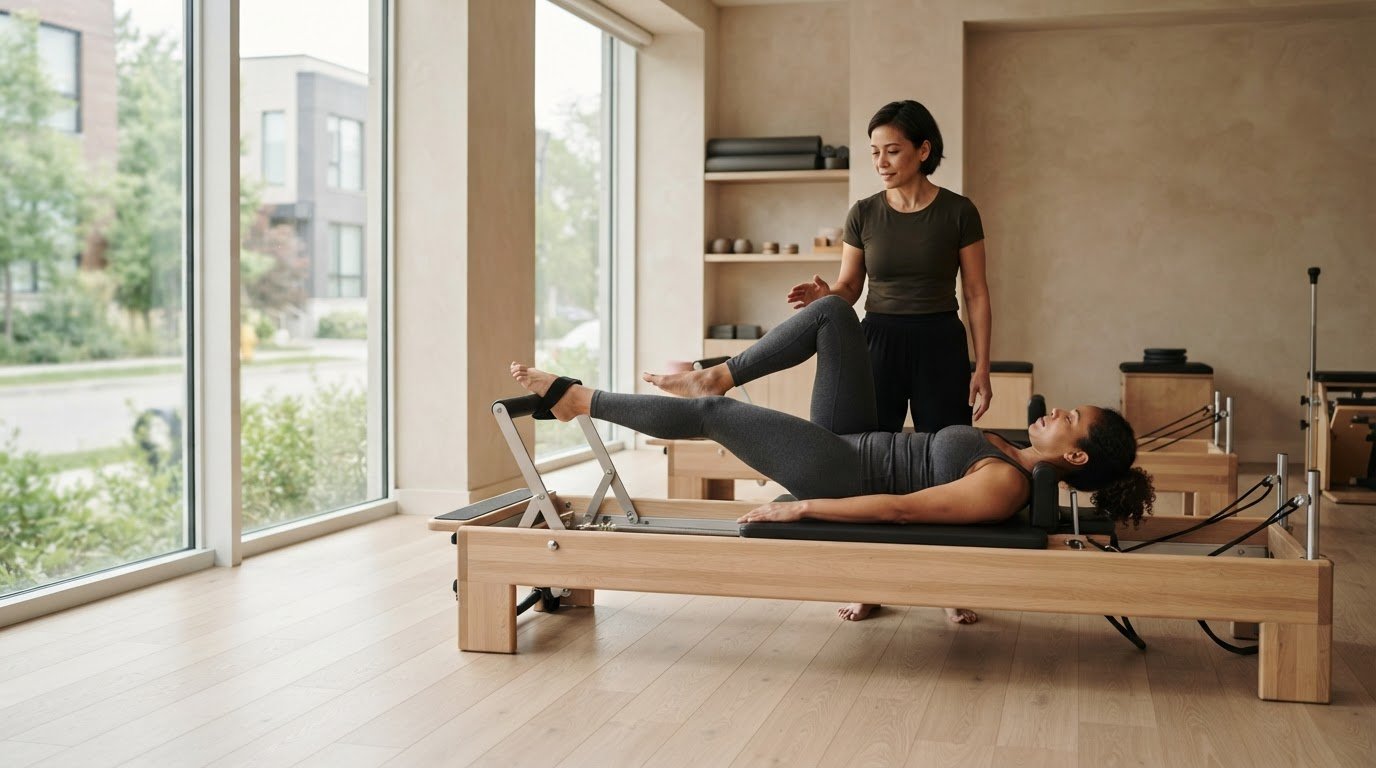
What are safe reformer exercises for scoliosis? The answer isn’t a fixed list. Exercise choices depend on how each person moves and feels, so it’s understandable to want clear guidance when asymmetry or discomfort raises concern. The same movement may feel different from one person to another.
Scoliosis-aware practice starts with individual needs, not a generic sequence. A person’s history, movement response, comfort, and guidance from their healthcare professional all matter. An instructor can observe and adapt exercise, but doesn’t diagnose scoliosis or prescribe medical treatment.
This article explains how to make movement choices with greater clarity. You’ll learn why individual assessment matters, how to adjust Reformer positions, resistance, range, and pacing, and how communication can guide each session. The practical focus is to support control and comfort, notice how the body responds, and adapt rather than pushing through uncertainty.
Key Takeaways
- Safe reformer exercises for scoliosis depend on the person’s symptoms, movement response, and clinical context, not a universal safe-or-unsafe list.
- Use a repeatable process: review relevant guidance, ask about current responses, choose an exercise, observe, and reassess.
- Evaluate supine leg work, bridging, kneeling, rotation, and loaded spinal flexion according to their demands and the individual’s comfort and control.
- Build sessions around the client’s goals and current capacity. Adjust range, tempo, and effort rather than aiming for a prescribed shape.
- Use ReformerFlow’s exercise videos, levels, and spring details to organize class planning, while grounding exercise decisions in individual judgment.
Table of Contents
- Safe Reformer Exercises for Scoliosis Start With Individual Needs
- How to Make Reformer Movement More Individual and Controlled
- Which Reformer Exercise Categories Need Careful Individual Review?
- Plan a Scoliosis-Aware Reformer Session Without a Fixed Exercise Prescription
- Use ReformerFlow to Organize Instructor Planning, Not Diagnose Scoliosis
Safe Reformer Exercises for Scoliosis Start With Individual Needs
Exercise safety depends on the individual, their current symptoms, and their clinical context. Scoliosis is a three-dimensional spinal curve, not simply a posture that looks uneven from the front or side. For a foundational overview of understanding scoliosis, including how it’s described and assessed, consider the broader context before making assumptions based on appearance.
No single Reformer exercise is universally safe for every person with scoliosis. A movement that feels manageable for one person may be uncomfortable or difficult for another. An instructor can observe and adapt movement, but general exercise education is not a substitute for diagnosis, treatment, or an individualized rehabilitation plan.
What scoliosis can mean for Reformer practice
People differ in curve pattern, mobility, strength, symptoms, training experience, and comfort with particular positions. Two people who appear to stand with a similar shift may have different clinical histories and movement needs. Appearance alone can’t establish a person’s curve type or severity, so don’t assign a pattern or choose exercises based on visual symmetry.
Think of Reformer work as adaptable movement. The carriage, springs, range of motion, and body position can change an exercise’s demands, but the equipment doesn’t straighten or correct the spine. If a client says a position feels strained, pause and ask what they notice. A smaller range or a different setup may feel more comfortable. That response can guide the session, but it doesn’t explain the cause of a curve or symptom.
Keep the decision practical: Can the person perform this movement with control and a tolerable level of effort today? A target shape or perfectly even-looking movement isn’t the measure of a useful session.
Who should guide exercise decisions?
Use relevant advice from the client’s treating clinician or physical therapist, especially if it includes specific limits or recommendations. New symptoms, recent surgery, or a changing clinical status call for individualized advice before exercise decisions are made. Don’t use a general Reformer sequence to fill gaps in clinical guidance.
An instructor’s role is to observe movement, communicate clearly, adapt exercise within their scope, and direct clinical questions to an appropriate healthcare professional. Ask what the client feels during and after a movement, and take their response seriously. If discomfort increases or a new concern arises, stop or modify the activity rather than encouraging the client to push through.
- Observe: Notice control, comfort, and how the client responds to the movement.
- Ask: Invite the client to describe sensations or changes without interpreting them as a diagnosis.
- Adapt: Adjust the exercise or pause when needed, guided by the client’s response and relevant clinical advice.
This individualized approach is the starting point for choosing safe reformer exercises for scoliosis. It replaces assumptions with attentive decision-making, while keeping clinical assessment with the appropriate healthcare professional.
How to Make Reformer Movement More Individual and Controlled
A thoughtful session follows a clear loop: review relevant guidance, check in, choose a movement, observe the response, then reassess. This keeps the plan responsive instead of treating a sequence as fixed. The aim isn’t to make movement look symmetrical. It’s to find an appropriate challenge the client can perform with control and without escalating discomfort.
- Review guidance. Carry forward relevant recommendations or restrictions from the client’s treating clinician or physical therapist. If a key detail is unclear, don’t guess. Pause and seek appropriate clinical guidance.
- Ask about today. Invite the client to share how they’re feeling, which movements have felt uncomfortable, and whether anything has changed since the last session. Their response today matters, even if the plan worked previously.
- Select a starting variation. Choose a movement that fits the client’s goals and current capacity. Begin with a manageable range and effort rather than assuming the fullest range or most demanding variation is the right one.
- Observe the movement. Notice breathing, control, confidence, and any reported change in symptoms. Stay curious and descriptive. Observation can guide an adjustment, but it isn’t a diagnosis.
- Reassess before progressing. Ask how the movement feels, then decide together whether to repeat, adjust, or stop. The client’s response can help inform the next choice.
Begin with communication and observation
Before starting, agree on a simple pause signal, such as asking the client to say “stop” or raise a hand. This makes it easier to respond promptly if discomfort changes. During the movement, check whether the client can breathe steadily and stay in control. If they report increasing discomfort, pause and review the setup rather than urging them to continue.
A tolerable range is individual, and the client’s response should guide where that range begins and ends. It may be smaller on one day than another. There’s no need to force a particular shape, depth, or endpoint to make an exercise worthwhile.
Adjust range, tempo, support, and springs
Range, tempo, body position, support, spring resistance, and repetitions can all influence how a movement feels. When practical, change one variable at a time. For example, keep the spring setup consistent while reducing the range, then check whether the adjustment changes the client’s comfort or control. Changing several factors at once makes it harder to tell what helped.
Spring references can make setup more consistent, but the same setting may feel different across machines or for different clients. Treat spring choice as one planning variable, not proof that an exercise is safe or comfortable. Don’t assume a particular spring, position, or range suits every curve pattern. Use the machine’s setup details as a reference, then observe and respond.
For instructors organizing exercise references and machine-specific spring notes, ReformerFlow’s planning app can streamline preparation. Keep exercise choices grounded in the client’s response and relevant clinical guidance. That balance supports safe reformer exercises for scoliosis without turning a planning tool or spring setting into a prescription.
Which Reformer Exercise Categories Need Careful Individual Review?
Exercise names alone don’t tell you whether a movement will suit a particular client. Consider the position, coordination and control required, range of motion, and the client’s response. The same category can feel manageable in one variation and uncomfortable in another. These examples are prompts for discussion and observation, not a prescribed routine or medical recommendation.
Positions and movements that may need adaptation
Supine, seated, kneeling, and side-lying positions each create different demands for balance, support, and movement control. None is automatically appropriate or inappropriate for everyone with scoliosis. Review the specific variation, relevant clinical guidance, and the client’s response rather than assigning a blanket label to the position.
- Supine leg work: Notice how the client manages pelvic and trunk control as the legs move, and whether the chosen range feels comfortable. If control changes or discomfort is reported, consider a smaller range or a different setup.
- Bridging: This movement involves lifting and lowering the pelvis while coordinating trunk and hip movement. Observe the client’s control and breathing, and ask how it feels. Adjust the height of the lift according to the person’s response.
- Kneeling: Balance, support, and confidence can shape how a kneeling variation feels. Pay attention to steadiness and effort. A supported or less demanding position may allow the client to move with more control.
- Rotation: Rotational exercises vary in how much movement they ask of the trunk and how they’re supported. Assess the available range and the client’s comfort rather than treating rotation as automatically unsuitable.
- Loaded spinal flexion: A flexion-based movement adds a particular trunk position and load. Consider the range, resistance, and control required, then ask about the client’s response. Clinical guidance should inform whether this demand fits the session.
How to decide whether to modify or pause
Use what the client reports, what you observe, and any relevant clinician guidance to inform an immediate decision. A movement that looks controlled may still feel uncomfortable, so appearance isn’t a substitute for checking in. Likewise, visible asymmetry alone doesn’t tell you whether an exercise is causing a problem.
- Modify: If the client reports mild discomfort or struggles to control the movement, pause and consider a smaller range, a supported position, or a less demanding variation.
- Pause: If discomfort increases or the client feels unsure, stop the movement and ask what they’re noticing before deciding whether to continue.
- Refer: Persistent, severe, or unusual symptoms call for appropriate clinical follow-up, not an instructor’s interpretation or diagnosis.
There’s no universal checklist that identifies safe reformer exercises for scoliosis by category alone. Assess each exercise’s demands and the individual’s response, then adapt or leave it out as needed.
Plan a Scoliosis-Aware Reformer Session Without a Fixed Exercise Prescription
A useful session plan gives the instructor structure without locking the client into a sequence. Start with the client’s stated goals, current capacity, and any applicable clinical guidance. Choose movements that serve those goals, with alternatives ready if a position or task doesn’t feel right. The plan is a working outline, not a scoliosis-specific exercise prescription.
Build in check-ins before movement begins, while the client is working, and after each meaningful change in exercise demand. A short question such as “How does that feel?” can invite useful feedback. Agree that the client can pause, ask for an adjustment, or change direction at any point. That keeps communication part of the session, not just an opening formality.
Create options before the client gets on the Reformer
Prepare a few alternatives for movements that vary in position, range, support, or coordination demands. For example, include a supported version and a lower-range option so there’s a clear adjustment if the starting variation feels too demanding. Keep the reason for each choice practical, such as reducing balance demands or allowing a more controlled range. Don’t promise a therapeutic outcome.
Keep the written plan concise. Note the goal of each movement, the planned starting option, and a possible adjustment. Leave space to respond rather than filling the session with exercises that must be completed. This makes it easier to prioritize the client’s experience and choose safe reformer exercises for scoliosis thoughtfully, without presenting the plan as a universal template.
Review the session and carry learning forward
At the end, ask which movements felt comfortable, which were difficult, and which the client would want to adapt next time. Record relevant teaching observations in a way that respects privacy and professional boundaries. Focus on useful details, such as the variation used and the client’s reported response, rather than drawing clinical conclusions. A comfortable session is helpful feedback, not proof that every variation will suit the client in future.
Use the review to shape the next plan, not to assume a fixed progression. A client’s capacity and experience can change, so begin each session with a fresh check-in and follow applicable clinical guidance. A planning tool can help instructors organize exercise options and setup notes; individual judgment still guides what happens in the room.
See ReformerFlow’s instructor planning features## Use ReformerFlow to Organize Instructor Planning, Not Diagnose Scoliosis
ReformerFlow is a mobile planning app for Reformer Pilates instructors. It helps organize exercise options and class details, but it doesn’t assess scoliosis or decide which movements are appropriate for an individual. Those decisions remain grounded in the instructor’s observations, the client’s response, and relevant clinical guidance.
A useful exercise reference can make preparation clearer, but it can’t replace communication with the client or clinical assessment. The instructor chooses and adapts movement within their role. The treating clinician or physical therapist provides clinical guidance. ReformerFlow supports planning, not diagnosis or treatment.
Keep exercise references separate from clinical judgment
The app’s library includes more than 400 exercises, with video, level, and spring-setup details. Instructors can use those references to review possible movements and compare their demands while preparing a class. A listing or video doesn’t certify an exercise as safe for scoliosis, and the app doesn’t recommend scoliosis treatment.
For example, an instructor might review an exercise’s setup and movement before deciding whether it fits a client’s goals and current capacity. That’s a planning step, not a clinical conclusion. Apply professional judgment, follow relevant clinician guidance, and adapt or set aside the movement if the client’s response calls for a change.
Build a clear, adaptable class plan
Exercise videos and level details can help instructors refresh their understanding of a movement before teaching it. Spring information adds a practical reference for setting up the Reformer, while machine-specific spring configuration support lets instructors personalize those references to their equipment. These details can reduce planning friction, but they don’t determine what a client should do.
Glanceable teaching mode keeps selected exercise details accessible during class, so the instructor can focus on teaching and observing rather than relying on memory alone. Use the plan as a flexible guide. A movement that seemed suitable during preparation may need a smaller range, a different position, or a pause once the client begins. Leave room to respond instead of treating the planned sequence as fixed.
For instructors planning safe reformer exercises for scoliosis, the app can help organize options, levels, and setup notes in one place. Individual assessment still guides the choice. The client’s comfort and control, along with applicable clinical advice, remain central throughout the session.
ReformerFlow is available on iPhone, iPad, and Android. Download the app to explore instructor class planning with a 14-day free trial.
Explore ReformerFlow’s 14-day free trial## Let Thoughtful Practice Guide Your Next Session
The next step isn’t finding a perfect sequence. It’s creating a teaching environment where a client can share what they notice, make choices, and help shape the session. That sense of agency can make movement feel more considered and collaborative.
Use safe reformer exercises for scoliosis as a question to explore, not a label to attach to a list of movements. Stay open to adjusting your plan as you learn what feels manageable for the individual, and keep clinical questions within the guidance of their healthcare professional.
For instructors, the right planning support can make preparation more organized while leaving the most important decisions in human hands. ReformerFlow helps structure exercise planning, so you can give more attention to the person in front of you.
Thoughtful practice grows one attentive session at a time. Trust your process, keep listening, and let the client’s needs lead.
Frequently Asked Questions
Is Reformer Pilates safe for someone with scoliosis?
It may be appropriate for some people, but safety depends on the individual rather than the diagnosis alone. Before starting, a person can ask their treating clinician whether there are movements, positions, or effort levels they should avoid or monitor. This gives the instructor relevant boundaries to work within. Reformer Pilates shouldn’t be presented as a way to correct scoliosis, and an instructor can’t diagnose the condition.
Can Reformer exercises make scoliosis worse?
A general answer can’t predict how a specific movement will affect an individual. If a client notices a new or concerning change during a movement, don’t ask them to push through it. Pause and seek appropriate clinical guidance if symptoms persist or raise concern. Avoid broad promises that Reformer Pilates will worsen or correct scoliosis; individual response and clinical context matter.
Which Reformer exercises should someone with scoliosis avoid?
There isn’t a universal avoid-list that applies to everyone with scoliosis. Rotation, spinal flexion, loaded work, and different body positions each have distinct demands, but the category alone doesn’t determine suitability. Consider whether the specific variation fits the person’s current capacity and any clinical restrictions. Don’t impose restrictions based on the diagnosis alone or treat an exercise list as a personalized rehabilitation plan.
Should someone with scoliosis get medical advice before starting Reformer Pilates?
Individual clinical advice is especially useful if symptoms are significant or changing, there has been recent surgery, or the person has restrictions from their care team. The person can share relevant guidance with the instructor so class choices respect those boundaries. Not everyone needs the same assessment, and a general routine can’t account for every history. The instructor should direct clinical questions to the treating professional.
Are asymmetrical Reformer exercises suitable for scoliosis?
They may suit some people and not others; asymmetry alone doesn’t decide. An instructor can consider whether a one-sided movement supports the client’s stated goal, then check how the client responds without assuming it will correct a curve. Don’t prescribe one-sided work as scoliosis treatment. If its purpose or appropriateness is a clinical question, defer to the client’s care team rather than guessing.
What should an instructor do if a client feels pain during a Reformer exercise?
Pause the exercise and ask the client what they’re experiencing. Don’t tell them to push through or speculate about the cause. If they feel comfortable continuing after the check-in, a change in range or position may be considered within relevant guidance. Stop if concern remains. Persistent, severe, or unusual symptoms call for clinical follow-up. An instructor can report observations, but shouldn’t diagnose pain or promise a modification will treat it.
Can an app tell an instructor which Reformer exercises are safe for scoliosis?
No. A planning app can help an instructor organize exercise references and class ideas, but it can’t determine medical safety for an individual or replace clinical guidance. ReformerFlow supports instructor planning; the instructor still considers the client’s goals, context, and response when selecting movement. An exercise reference can help with preparation, while the decision to use or adapt that exercise belongs to the instructor’s judgment and relevant clinical direction.